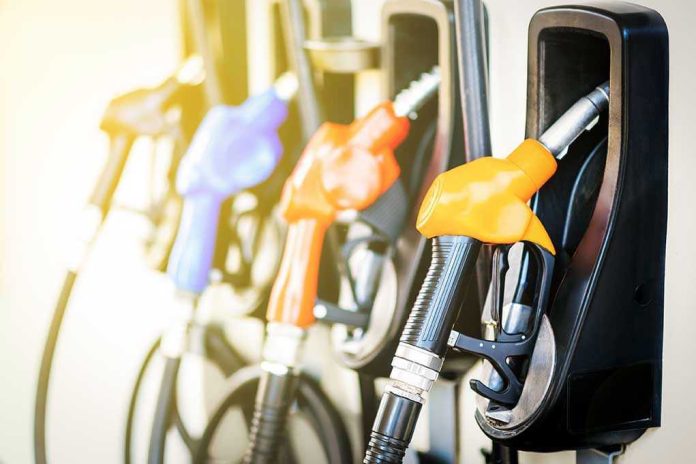
President Trump claimed credit for dramatically slashing gas prices from over six dollars per gallon during his State of the Union address, earning thunderous Republican applause despite data showing prices dropped a mere half percent over the past year.
Story Snapshot
- Trump claimed gas prices fell from over six dollars per gallon to under three dollars under his leadership during February 2026 State of the Union address
- Bureau of Labor Statistics data reveals gas prices declined only 0.5 percent year-over-year from September 2024 to 2025
- Gas prices actually peaked at $5.016 per gallon nationally in June 2022 under Biden, driven by Russia’s Ukraine invasion and post-COVID supply disruptions
- Republicans applauded enthusiastically while fact-checkers from ABC News, NPR, and other outlets immediately flagged the claims as misleading
The Numbers Tell a Different Story
Gas prices currently average $2.998 per gallon according to AAA, representing a modest decline that began long before Trump returned to office. The actual peak occurred during June 2022 when prices hit $5.016 nationally, with some states briefly exceeding six dollars. The decline Trump takes credit for started under Biden’s administration as global oil markets stabilized, U.S. production increased, and supply chain disruptions eased. The year-over-year data from September 2024 to September 2025 shows gas prices dropped just 0.5 percent, hardly the dramatic plunge suggested by Trump’s rhetoric.
Timing and Political Theater
Trump previewed his economic victory lap during a February 6, 2026 gaggle with reporters, touting “massive price reductions” before the formal address. The State of the Union claim arrived amid government shutdown recovery and ahead of pending Bureau of Labor Statistics updates. Republicans seized the moment to amplify a narrative of economic rescue, contrasting sharply with what they characterized as Biden-era disasters. The applause wasn’t spontaneous enthusiasm for accurate data reporting but calculated political theater designed to reinforce partisan messaging heading into midterm election season.
What the Data Actually Shows
The Bureau of Labor Statistics and AAA provide the clearest picture of energy price trends. Yes, prices dropped from 2022 peaks, but attributing this decline solely to Trump’s policies ignores global market forces, increased domestic production that began ramping up in 2023, and normalized supply chains. Meanwhile, Trump’s address conveniently omitted other economic realities that complicate his rescue narrative. Coffee prices jumped 18.9 percent partly due to his own tariff policies. Beef prices climbed 14.7 percent. The egg price decline he mentioned resulted from avian flu recovery, not presidential policy.
Cherry-Picking Creates False Victories
Comparing current prices to the absolute peak moment during a global crisis creates an illusion of dramatic achievement. This rhetorical sleight-of-hand works because most Americans remember paying painful prices at the pump during 2022. They don’t scrutinize whether those prices already normalized before Trump took office or whether presidential policies significantly influenced global commodity markets. The strategy relies on selective memory and emotional reactions rather than rigorous analysis of economic data spanning multiple administrations and accounting for external shocks like wars and pandemics.
The Broader Economic Picture
Energy prices represent just one component of household budgets struggling with persistent inflation. While Trump celebrated gas price victories, American families confront rising costs across numerous categories. The incomplete economic recovery highlighted by coffee and beef price increases reveals how tariff policies and agricultural disruptions continue pressuring consumers. Low-income households bear the heaviest burden from price volatility across essential goods. Aviation costs rose 3.2 percent while eggs dropped 43 percent from their avian flu peak of $6.23 per dozen, creating a mixed economic reality that defies simple political narratives from either party.
Fact-checkers from ABC News, NPR, and the Pittsburgh Post-Gazette immediately challenged Trump’s claims using Bureau of Labor Statistics data and AAA metrics. They emphasized the distinction between declines from crisis peaks versus recent year-over-year trends that show minimal improvement. The Post-Gazette published preemptive fact-checks before the address, anticipating Trump would claim credit for trends predating his administration. These outlets faced predictable accusations of bias from conservative media personalities who echoed Trump’s claims without scrutinizing underlying data. The partisan divide extends beyond policy disagreements into fundamental disputes about objective economic reality.
The State of the Union gas price claim sets a concerning precedent for crediting presidents with global market trends beyond their control while ignoring their policies that actually hurt consumers. Trump deserves recognition where his administration implements effective energy policies, but exaggerating accomplishments and cherry-picking favorable comparisons undermines credibility. Republicans applauding demonstrably misleading claims prioritize political solidarity over factual accuracy, a choice that may bolster short-term morale but ultimately erodes public trust in institutions. Americans deserve leaders who celebrate genuine achievements without resorting to statistical manipulation and selective memory about complex economic forces affecting their daily lives.
Sources:
Fact-checking Trump’s presidential address claim he brought gas prices down – ABC News
Read NPR’s annotated fact-check of President Trump’s State of the Union – KOSU
Fact check: Trump economy SOTU 2026 preview – Pittsburgh Post-Gazette