
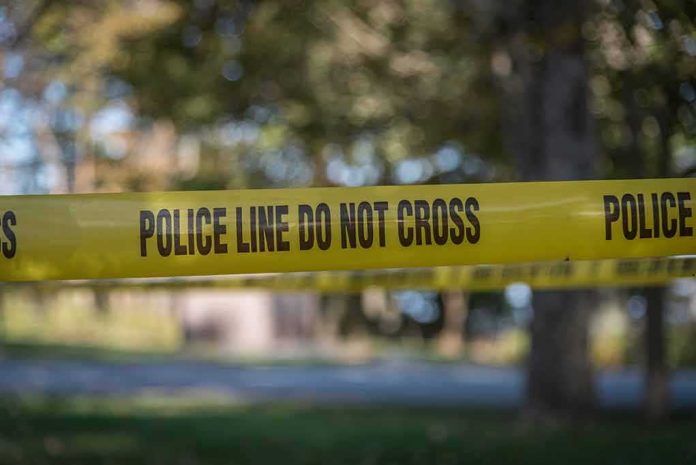
When a stranger collapses on your lawn at 3:30 a.m. and a struggle follows, the legal question isn’t abstract ideology about “stand your ground”; it is the concrete, minute-by-minute assessment of threat, reasonableness, and proportion that governs self‑defense in California—and that’s exactly the frame through which Fresno police described a homeowner’s single shot that wounded an off‑duty federal agent.
At a Glance
- Police say a 72-year-old Fresno man shot a 32-year-old off-duty ICE agent after a physical confrontation on the family’s property.
- The sequence began when the agent was found asleep on the lawn; officers reported assaults on the homeowner and his adult daughter during the encounter.
- The homeowner was not arrested; the agent was booked on felony assault-related counts while hospitalized.
- California self-defense law turns on imminent threat, reasonable belief, and proportional force—the lens for evaluating incidents like this.
What Fresno police say happened, and why it matters
According to Fresno police, the daughter of a Central Fresno household found a man asleep on the front lawn in the pre‑dawn hours and alerted her father. When the 72‑year‑old stepped outside to wake the man and tell him to leave, the man—identified by police as David Gonzalez, a 32‑year‑old off‑duty ICE agent from Texas—allegedly assaulted him, driving the older man to the ground and leaving visible injuries. When the daughter intervened, police say Gonzalez attacked her as well, pushing her to the ground and into a parked vehicle. Fearing for his daughter’s and his own safety, the father drew a lawfully owned handgun and fired a single round, striking Gonzalez.
Police reported that the daughter’s boyfriend, an off‑duty police officer, arrived within minutes and restrained Gonzalez in handcuffs before patrol units responded to multiple 911 calls. Officers secured the scene, collected physical evidence, and coordinated medical transport. Gonzalez underwent surgery and was listed in serious condition; he was then placed in police custody and booked on felony assault‑related charges, including battery likely to cause great bodily injury and felony vandalism tied to damage during the altercation. The homeowner was not arrested or charged at the scene.
From lawn to gunshot: the mechanism of a fast-moving encounter
Events of this kind hinge on seconds, not speeches. An unknown person reportedly asleep on the lawn becomes an immediate, physical presence once roused—especially if, as police reported here, he appeared intoxicated and agitated. The alleged battery on the homeowner changes the legal posture from trespass to violent confrontation; the daughter’s involvement, and the claim that she was pushed into a neighbor’s vehicle, adds both a second potential victim and evidence of escalating force. Police summarized the father’s decision point succinctly: he feared for the physical safety of himself and his daughter, and he fired one shot. The single round, the presence of a family member under assault, and the homeowner’s lawful possession of the firearm are the factual pillars supporting why police did not arrest him on the spot.
While neighbors did not witness every moment, one identified vehicle damage consistent with a body impact, and police attributed it to the struggle involving the daughter; it’s a small but telling piece of physical corroboration in a chaotic scene. Fresno detectives also recovered a handgun from the porch area as part of their evidence processing, consistent with a residential defensive use and with the described sequence unfolding at the threshold rather than at distance.
How California evaluates self-defense in the home
California’s self-defense framework is specific. A shooting is justified when the person reasonably believes they or another face imminent danger of being killed or suffering great bodily injury, and the force used is necessary and proportionate to avert that danger. Jurors are instructed to evaluate not the shooter’s hindsight, but what a reasonable person would have believed and done in the same circumstances, given the rapid evolution of threats common to violent encounters. These instructions, reflected in standard CALCRIM guidance and applied across cases ranging from altercations at the threshold to interior home invasions, supply the yardstick by which prosecutors and police preliminarily judge incidents like this one.
Context matters. A trespass alone is not a license to shoot; an assault on an elderly homeowner and a simultaneous attack on his daughter is a very different posture under the law. The single shot here aligns with the principle of proportionality—using no more force than reasonably necessary—while the decision not to arrest the homeowner signals that, based on initial evidence, investigators found his description of imminent threat plausible enough to defer charges, pending standard review.
What is known about the agent, charges, and custody
Police identified the man who was shot as David Gonzalez, an ICE agent off duty and visiting from Texas. After surgery, he was held on suspicion of felony battery likely to cause great bodily injury, felony vandalism related to property damage during the struggle, and additional battery counts. Local outlets reported that the homeowner would not be charged; that posture reflects an initial investigative assessment rather than a final legal adjudication, but it is consequential in practice because it shapes evidence collection and case routing to prosecutors.
In the aftermath, local reporting described communication between Fresno Police and ICE regarding Gonzalez’s status. The Fresno police chief publicly refuted suggestions that federal officials sought to remove Gonzalez from local custody, stating that ICE supervisors were aware he would remain in Fresno’s hold while the case proceeded; ICE referred inquiries back to the police department. That clarity matters: it affirms that, even when a federal agent is involved, local criminal jurisdiction governs the alleged off‑duty conduct and its consequences.
Protesters gathered in northeast Fresno Saturday after a shooting involving an off-duty ICE agent, as demonstrators questioned ICE operations. https://t.co/YIAN3B0dRY
— ABC30 Fresno (@ABC30) October 11, 2026
Why the frame—not the headlines—decides these cases
Self-defense law resists political shorthand because the doctrine is granular. Three questions dominate: Did Gonzalez’s actions create an imminent threat of death or great bodily injury? Would a reasonable person in the father’s position believe that threat existed in that moment? And was a single shot a proportionate response necessary to stop it? Those are the same questions police, prosecutors, and ultimately juries apply across domestic disputes, porch confrontations, and forced entries; they are equally applicable when the person shot is a stranger, a neighbor, or—as here—an off‑duty federal officer.
The Fresno account fits a pattern seen in many defensive gun uses at the home’s edge: a sudden close‑quarters assault, the involvement of a second family member, a single discharge to terminate the attack, and an immediate 911 response that anchors the timeline. None of that predetermines a legal outcome—only the full evidentiary record can—but it explains why the initial law‑enforcement posture distinguished between the shooter and the person he shot. If the described facts hold, the case sits squarely within California’s established self‑defense framework.
Sources:
feedpress.me, abcnews.com, independent.co.uk, kmph.com, azfamily.com, latimes.com, ibtimes.co.uk, yahoo.com