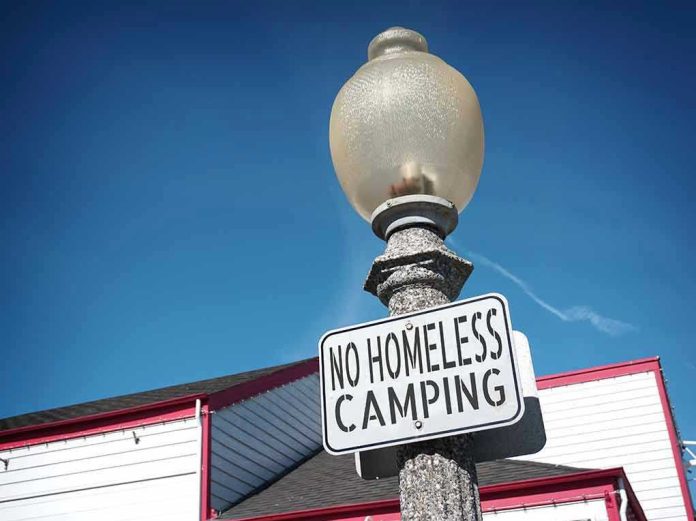
In a sweeping move that has left both supporters and critics buzzing, President Trump has signed an executive order to clear America’s streets of homeless encampments, prioritizing federal grants for states that crack down on urban disorder.
At a Glance
- Federal grants now tied to enforcement of anti-camping and loitering laws.
- States must comply with sex offender tracking to receive funding.
- Directive aims to remove visible disorder and enhance public safety.
- Controversy arises over civil liberties and treatment of homeless individuals.
Federal Grants Tied to Law Enforcement
President Trump’s executive order, effective July 2025, links federal funding to the enforcement of anti-camping, loitering, and squatting laws, as well as compliance with sex offender tracking requirements. This move aims to prioritize public safety and reduce visible urban disorder. The federal government, through the Department of Justice and Attorney General’s office, will oversee the implementation of these policies. States and municipalities complying with these directives will receive prioritized funding, providing a financial incentive to clamp down on urban encampments and related issues.
Critics argue that this approach may exacerbate challenges for homeless individuals, forcing them to relocate without addressing the root causes of homelessness. The order has sparked debate over civil liberties, with advocacy groups challenging the morality and legality of these enforcement actions. However, supporters assert that visible disorder undermines public safety and business viability, necessitating stricter enforcement.
Impact on Local Communities
Increased law enforcement activity targeting encampments has been reported across major cities. This has led to the displacement of homeless populations, who often lack access to alternative housing or services. Business owners and residents generally support these measures, citing concerns about safety, property values, and the viability of businesses. Urban centers with visible encampments and open drug use are the primary focus of these policies, as they aim to restore order to public spaces.
Local governments face the challenge of balancing compliance with federal requirements against local political and legal constraints. The directive has led to some jurisdictions reviewing and strengthening local ordinances to maintain eligibility for federal grants. This has sparked an array of responses, from legal challenges over the constitutionality of enforcement actions to calls for alternative solutions.
Legal and Social Ramifications
Legal experts warn of potential constitutional challenges as increased litigation looms over the enforcement of these measures. The risk of “catch-all” disorderly conduct statutes being used to target vulnerable populations raises concerns among civil liberties organizations. Meanwhile, the broader implications of this directive include heightened tensions between law enforcement and vulnerable populations and possible erosion of trust in public institutions.
On the economic front, the initiative could lead to increased costs associated with law enforcement and legal proceedings. However, there may be potential benefits to businesses and tourism in areas where public spaces are perceived to be safer and cleaner. As the debate continues, stakeholders remain divided over the effectiveness of enforcement-based approaches versus long-term solutions such as housing and treatment.
Expert Opinions and Future Prospects
Law enforcement experts argue that visible disorder justifies stricter enforcement to ensure public safety and business viability. In contrast, homelessness advocates and legal scholars caution against criminalizing homelessness, noting that such measures may violate constitutional rights. Research indicates that aggressive enforcement can displace individuals but fails to address the underlying issues of homelessness and addiction.
Diverse viewpoints highlight the ongoing debate between policymakers and advocacy groups. Some support the crackdown as necessary for public order, while others advocate for a focus on housing and treatment rather than punitive approaches. As the situation evolves, the federal directive and DOJ guidance remain primary sources for current policy, providing context and critique of enforcement strategies.
Sources:
California Penal Code and legal analysis of squatting and loitering laws.
July 2025 White House directive on grant prioritization and enforcement.
ASU Center for Problem-Oriented Policing report on homeless encampments and urban disorder.
Guidance for property owners on enforcing anti-loitering rules.