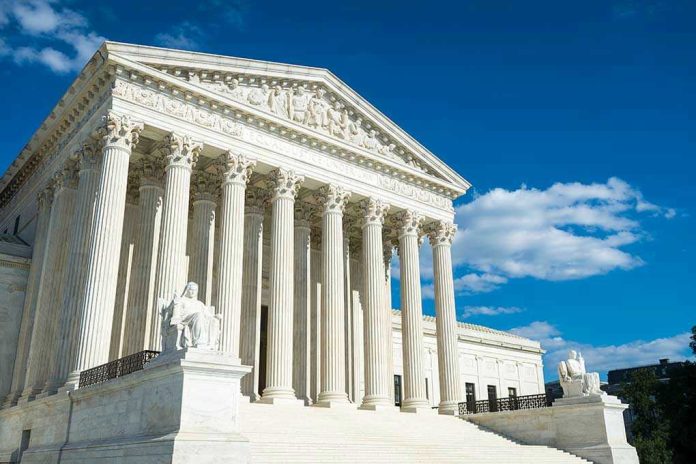
Will the U.S. Supreme Court give Ghislaine Maxwell a pass, or will justice for Epstein’s victims finally prevail?
At a Glance
- Ghislaine Maxwell appeals to the Supreme Court to overturn her sex trafficking convictions.
- Maxwell’s legal team argues a 2007 non-prosecution agreement should shield her from prosecution.
- The Department of Justice contends the agreement was geographically limited to Florida.
- The case raises questions about the rights of third-party beneficiaries to non-prosecution agreements.
Maxwell’s Supreme Court Appeal
Ghislaine Maxwell, once a close associate of the infamous Jeffrey Epstein, has taken her fight to the highest court in the land. After her 2021 conviction for sex trafficking minors, Maxwell’s legal team is now appealing to the U.S. Supreme Court, asserting that her prosecution should have been barred by a 2007 non-prosecution agreement (NPA) Epstein made with federal prosecutors. This agreement, they argue, extended immunity to Epstein’s alleged co-conspirators, including Maxwell, making her conviction unjust.\
🚨 𝗚𝗵𝗶𝘀𝗹𝗮𝗶𝗻𝗲 𝗠𝗮𝘅𝘄𝗲𝗹𝗹 𝗔𝘀𝗸𝘀 𝗦𝘂𝗽𝗿𝗲𝗺𝗲 𝗖𝗼𝘂𝗿𝘁 𝘁𝗼 𝗧𝗼𝘀𝘀 𝗛𝗲𝗿 𝗦𝗲𝘅-𝗧𝗿𝗮𝗳𝗳𝗶𝗰𝗸𝗶𝗻𝗴 𝗖𝗼𝗻𝘃𝗶𝗰𝘁𝗶𝗼𝗻𝘀
Read more 👇https://t.co/iAnHZV2bgV
— The Epoch Times (@EpochTimes) July 30, 2025
Yet, the Department of Justice (DOJ) firmly opposes this interpretation. They argue the NPA was explicitly limited to the Southern District of Florida, where it was negotiated. The DOJ’s stance is clear: Maxwell’s prosecution in the Southern District of New York was entirely valid, as the NPA did not cover her actions or bind federal prosecutors outside of Florida. This disagreement has now landed in the lap of the Supreme Court, which must decide if Maxwell’s conviction stands.
The 2007 Non-Prosecution Agreement Controversy
The 2007 NPA has been a source of controversy since its inception. It allowed Epstein to plead guilty to lesser state charges, avoiding federal prosecution, with an alleged promise of immunity for unnamed “potential co-conspirators.” Critics argue the NPA was overly broad and secretive, undermining justice for the victims. The DOJ has maintained that extending such immunity to unnamed third parties in other jurisdictions is implausible and contrary to established legal principles.
Maxwell’s defense insists that the NPA’s terms are unqualified, claiming a nationwide shield from prosecution. This argument, however, has been consistently rejected by lower courts, which have ruled that non-prosecution agreements typically bind only the jurisdiction where they are executed unless explicitly stated otherwise. The Supreme Court’s decision on Maxwell’s appeal could set a precedent on the scope of such agreements and the rights of third-party beneficiaries.
Implications for Justice and Accountability
The stakes are high. A ruling in Maxwell’s favor might change how non-prosecution agreements are interpreted, potentially limiting prosecutorial discretion and encouraging broader, less transparent plea deals. Conversely, upholding her conviction could affirm the DOJ’s position and reinforce the geographic and personal limits of NPAs. For victims seeking justice, the implications are profound. A decision favoring Maxwell could be seen as a failure of the justice system, while a decision against her would uphold the accountability of those involved in Epstein’s crimes.
Beyond the courtroom, this case has political ramifications. The House Oversight Committee has subpoenaed Maxwell for a deposition, seeking her testimony on the Epstein case. Maxwell, however, demands immunity or a pardon as a condition for testifying. This ongoing saga underscores the public’s demand for transparency and accountability in the handling of high-profile cases involving powerful individuals.
The Road Ahead
As Maxwell’s appeal awaits consideration, the legal and political landscapes remain tense. The Supreme Court’s decision could have lasting impacts on the interpretation of non-prosecution agreements and the accountability of alleged co-conspirators. Meanwhile, the congressional interest in Maxwell’s testimony highlights a broader demand for answers and justice. Whether the Supreme Court will uphold the conviction or grant Maxwell a reprieve remains to be seen, but the outcome will undoubtedly resonate beyond the courtroom, affecting victims, legal precedents, and public trust in the justice system.