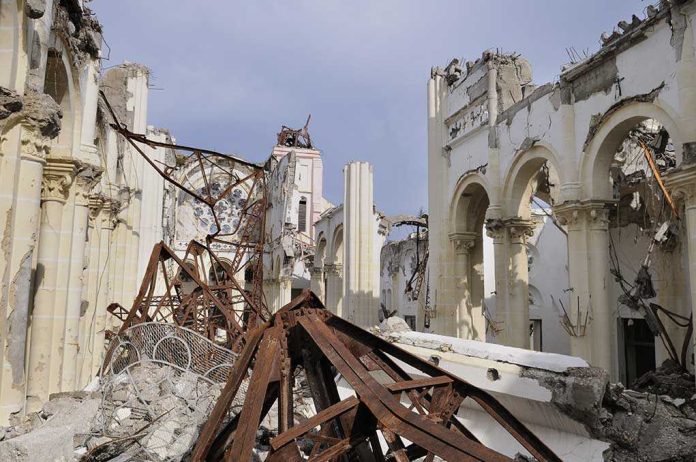
A city once teeming with life now lies flattened and unrecognizable, its existence rewritten by two years of relentless war—a transformation so extreme, even the sky seems to mourn as drone cameras capture the devastation from above.
Story Snapshot
- Drone footage reveals Gaza City’s staggering transformation: whole neighborhoods now reduced to dust and broken concrete.
- Two years of war have left Gaza’s urban heart all but erased from the map, challenging any sense of normalcy or recovery.
- The aerial perspective exposes not only physical destruction but also the erasure of daily life for hundreds of thousands.
- This stark visual evidence raises difficult questions about the future, accountability, and the true cost of prolonged conflict.
Drone Footage Captures the Scale of Destruction
Drone aerials released this week show the full measure of Gaza City’s devastation after two years of unrelenting conflict between Israel and Hamas. From above, the city’s landscape is a gray expanse of dust, shattered buildings, and twisted rebar—an endless graveyard of what once were schools, markets, and family homes. This is not the aftermath of a single strike. It is the result of persistent, grinding warfare that has erased the familiar and replaced it with ruin. Neighborhoods that once bustled with commerce and conversation now exist only as memories—flattened, indistinguishable, and silent.
Entire districts have vanished, their outlines barely discernible beneath the debris. The drone’s silent flight over the city offers a perspective impossible from the ground, exposing the grim reality in a single, unbroken panorama. For viewers, the footage is both mesmerizing and horrifying—a visual record of destruction on a scale rarely seen in the modern era. It is a perspective that cannot be ignored, forcing the world to confront the consequences of prolonged conflict in real time.
Two Years of War: A City Erased
Gaza City has endured conflicts before, but the past two years have been uniquely catastrophic. Each escalation, each round of fighting, has chipped away at the city’s infrastructure and spirit. Hospitals, already strained, now operate out of temporary shelters or not at all. Water and electricity are intermittent, if they exist. Families who once lived together in multistory homes now sleep in tents or the remains of their basements, clinging to the fragments of their former lives.
The relentless pace of destruction has outstripped any effort at rebuilding. International aid convoys, when allowed through, struggle to meet the overwhelming needs. Schools have become shelters, their classrooms filled with families instead of children. The city’s markets, once vibrant with commerce, are now empty spaces marked by collapsed roofs and abandoned stalls. For Gaza’s residents, the daily struggle is no longer just about survival—it is about enduring the psychological toll of seeing their city disappear, piece by piece.
The Human Cost Behind the Rubble
Every ruined block tells a story. What drone footage cannot show is the loss of personal histories, the disruption of generational ties, and the trauma carried by survivors. A child born two years ago has known nothing but war. Elders who remember Gaza’s past now witness its near-total erasure. The physical destruction is matched only by the emotional and psychological scars left behind. For many, the hope of returning to normalcy seems as distant as the city skyline that no longer exists.
After months of suffering, people in #Gaza are grateful the war has ended, and hope it never returns.
Humanitarians are reaching areas they couldn’t before. But needs remain massive. Sustained support will be critical.
Hear from Gazans themselves.⬇️ pic.twitter.com/cRs95ZlRP1
— UN Humanitarian (@UNOCHA) October 14, 2025
The footage has forced international observers and policymakers to grapple with uncomfortable questions: What does justice look like when a city is erased? Who is responsible for rebuilding not just structures, but lives and communities? Without answers, the images risk becoming just another entry in the endless scroll of conflict coverage—shocking, yes, but quickly forgotten unless action follows awareness.
What Comes After the Dust Settles?
Rebuilding Gaza City will take more than mortar and money. It will require an honest reckoning with the causes of the conflict, sustained international commitment, and, above all, the resilience of the city’s people. The drone’s aerial witness is a warning and a challenge: This is what unchecked war delivers. For Gaza, the path forward is uncertain, but the need for accountability, support, and lasting peace has never been more urgent. The world may look away, but the city’s fate hangs in the balance, waiting for the next chapter to be written—one that, hopefully, will not be defined by rubble.
Sources:
Before and after images show devastating destruction in Gaza