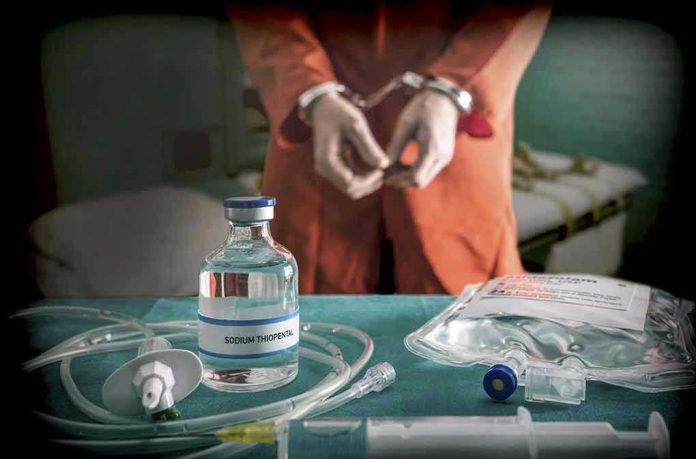
One Florida man’s decision to surrender to fate, forgoing all appeals before his scheduled execution, exposes a reality of finality and consequence that most Americans never truly imagine.
Story Snapshot
- Norman Grim, 65, convicted of rape and murder, is set for execution in Florida.
- He has dropped all legal appeals, accepting his death sentence without contest.
- The execution will take place at Florida State Prison by lethal injection.
- The case raises questions about justice, closure, and the American death penalty system.
Norman Grim’s Relentless Path to Execution
Norman Grim, a 65-year-old Florida resident, confessed to the brutal rape and murder of his neighbor, a crime that led to his conviction and subsequent death sentence. Grim’s story stands out not only for its violence but for his unusual acceptance of capital punishment. Unlike the majority of death row inmates who exhaust every avenue of appeal, Grim has dropped all efforts to overturn his sentence, signaling a rare submission to the legal system’s ultimate verdict.
By choosing not to pursue further appeals, Grim has forced both the public and legal observers to confront the absolute nature of the death penalty. His scheduled execution at 6:00 pm local time at Florida State Prison on Tuesday will mark the conclusion of a case that has haunted his community for years. The state’s machinery of justice moves forward, but questions linger about the emotional impact on the victim’s family and the broader implications for society.
The Community’s Response and the Search for Closure
The community where Grim’s crime occurred has never truly recovered from the shock of his actions. Residents recall the sense of vulnerability that followed the neighbor’s murder, a violation that shattered their assumptions about safety and trust. Some see Grim’s execution as a necessary act of closure, a way to restore a measure of justice for the victim and her loved ones. Others, however, grapple with the moral and ethical dimensions of state-sanctioned killing, questioning whether true healing is possible through retribution.
Grim’s decision to forego appeals has intensified these debates. For many, his acceptance of punishment brings a kind of resolution, eliminating the drawn-out uncertainty that often accompanies death penalty cases. For others, it underscores the irreversible nature of capital punishment—a finality that leaves no room for error or redemption.
The Death Penalty in Contemporary America
Florida’s use of lethal injection remains a focal point in the national conversation about capital punishment. Grim’s case highlights the procedural rigor of the system, but also its emotional toll. The ritual of execution, scheduled down to the minute, is a stark reminder of the state’s authority to take life as a consequence of the most serious crimes. This authority is rooted in American conservative values of law and order, yet it also invites scrutiny from those who question the efficacy and morality of the death penalty.
Norman Grim’s story, by its very finality, opens a loop that cannot be closed by policy alone. What drives a man to accept his fate so completely? Does his decision reflect genuine remorse, resignation, or something more complex? As the hour of execution approaches, these questions linger, challenging readers to reconsider what justice means when it is stripped of ambiguity—and whether the end of Grim’s life truly marks the end of the story.
Sources:
Florida man to be executed for murder of neighbor