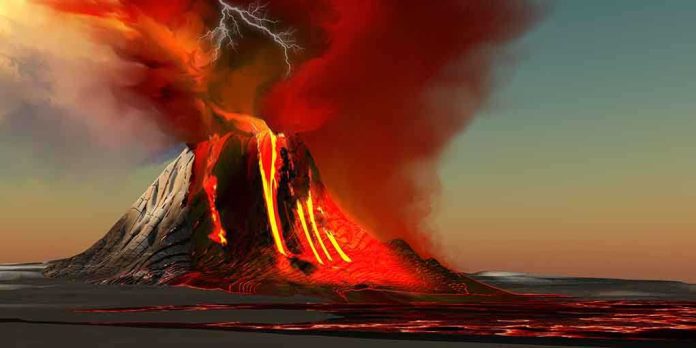
Japan’s most temperamental volcano just reminded everyone why it’s called the “Vesuvius of the East” with a spectacular eruption that sent ash towering into the sky after months of deceptive calm.
Story Snapshot
- Sakurajima volcano’s Minamidake crater erupted Sunday after four months of silence
- Ash and smoke column reached thousands of meters into the atmosphere
- First major eruption from this specific crater since October 2023
- Local communities remain on high alert as volcanic activity resumes
Nature’s Unpredictable Timekeeper Strikes Again
Sakurajima volcano demonstrated once again why volcanic prediction remains one of geology’s greatest challenges. The Minamidake crater, which had maintained relative quiet since October 2023, suddenly roared back to life on Sunday morning. The eruption launched a towering column of ash and volcanic debris thousands of meters skyward, creating a dramatic spectacle that serves as both natural wonder and serious warning.
This volcanic giant sits in Kagoshima Bay in southwestern Japan, where it has been terrorizing and fascinating locals for centuries. The four-month period of dormancy might seem significant to human timescales, but for Sakurajima, this represents merely a brief nap. The volcano typically erupts hundreds of times per year, making it one of Japan’s most active and closely monitored volcanic systems.
Why This Eruption Matters More Than You Think
Sakurajima’s location makes every eruption a potential crisis for nearly 600,000 residents of Kagoshima City, located just across the bay. The ash fallout from Sunday’s eruption likely dusted homes, cars, and infrastructure throughout the region. Residents know the drill by now: cover exposed surfaces, avoid outdoor activities, and keep windows sealed tight until the ash settles.
The volcano’s proximity to populated areas creates a unique living laboratory for volcanologists studying explosive eruptions. Japan’s sophisticated monitoring network tracks every tremor, gas emission, and ground deformation around Sakurajima. This data helps scientists understand volcanic behavior patterns, though predicting exact eruption timing remains frustratingly elusive even with advanced technology.
Living in the Shadow of Fire Mountain
Local communities have adapted to life with an active volcano in remarkable ways that showcase human resilience and ingenuity. Schools conduct regular evacuation drills specifically for volcanic activity. Bus stops feature reinforced shelters designed to protect waiting passengers from falling volcanic debris. Many residents keep special masks and eye protection readily available for ash events.
The economic impact extends beyond immediate safety concerns. Agriculture in the region suffers when ash blankets crops, though the volcanic soil provides exceptional fertility during quiet periods. Tourism presents a double-edged sword – volcanic activity attracts visitors fascinated by natural forces, but eruptions can disrupt transportation and accommodation bookings. Local businesses have learned to pivot quickly when Sakurajima decides to put on a show.
What Makes Sakurajima So Explosive
The volcano’s violent tendencies stem from its magma composition and geological setting. Sakurajima produces andesitic magma, which contains high silica content that traps gases until pressure builds beyond containment limits. When these gas-rich magmas finally breach the surface, they explode with tremendous force, hurling ash, rocks, and volcanic bombs across the landscape.
Sunday’s eruption follows typical Sakurajima patterns – sudden, violent, and impossible to predict with precision despite constant monitoring. The Minamidake crater has produced some of the volcano’s most spectacular shows over the decades. Its four-month quiet period actually makes this eruption more noteworthy, as longer dormant periods sometimes correlate with more energetic awakenings when volcanic systems finally release built-up pressure.
Sources:
Video shows Sakurajima volcano erupting in Japan over the weekend