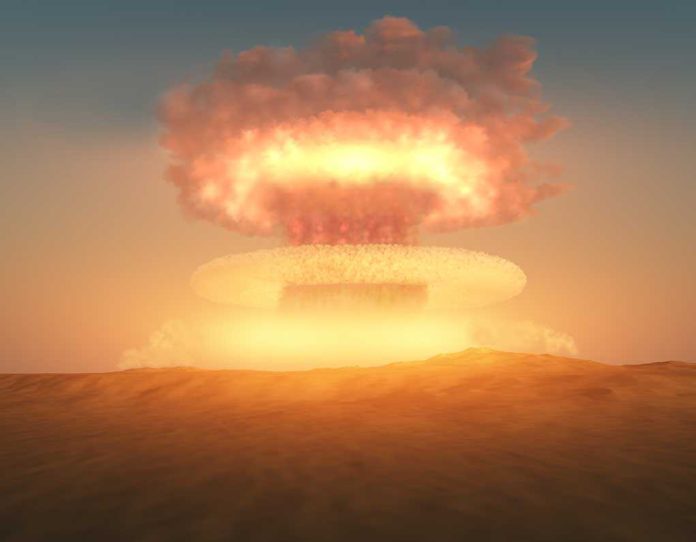
The first nuclear detonation wouldn’t target Times Square or the Golden Gate Bridge—it would obliterate a remote Air Force base in the middle of nowhere, and that distinction matters more than you think.
Quick Take
- Initial nuclear strikes would target military installations in remote locations, not major cities, following established military doctrine
- A Princeton simulation of a limited U.S.-Russia nuclear exchange projected 34.1 million deaths and 57.4 million injuries in the first few hours
- Major cities including New York, Chicago, Los Angeles, and Washington D.C. would face destruction only if conflict escalates to counter-value targeting
- Fallout would extend far beyond blast zones, making no location in America truly safe from nuclear war consequences
- Survival depends on immediate shelter for at least 72 hours, with extended protection needed for weeks
Why Military Bases Come First
Nuclear war strategy divides into two categories: counterforce and counter-value targeting. Counterforce strikes aim at military infrastructure—the weapons themselves rather than the people. This distinction explains why Kirtland Air Force Base near Albuquerque or Kings Bay Naval Base in Georgia would face destruction before Manhattan. Military planners deliberately positioned these installations away from population centers for precisely this reason: to minimize civilian casualties during an initial exchange. The logic seems almost civilized until you realize what comes next.
The Escalation That Changes Everything
An initial counterforce strike wouldn’t end the conflict. It would begin it. Once strategic weapons start flying, the calculus shifts dramatically. Counter-value targeting—attacking population centers directly—becomes the next phase. New York, Chicago, Houston, Los Angeles, San Francisco, Seattle, Atlanta, Miami, Philadelphia, and Washington D.C. transform from thriving metropolises into primary targets. Each city represents economic power, political significance, or military command capability. The targeting isn’t random; it follows brutal logic that treats millions of people as strategic assets to be eliminated.
Princeton’s Science and Global Security Programme conducted a simulation of a limited nuclear war triggered by a single low-yield weapon. The results stagger comprehension: 34.1 million deaths and 57.4 million injuries within hours. That’s not a worst-case scenario. That’s a limited exchange. A full-scale nuclear war would multiply these numbers exponentially, with casualty projections exceeding 5 billion people in the first two years alone when nuclear winter effects collapse agricultural systems globally.
Geography Doesn’t Guarantee Safety
You might assume living in rural Montana or western Texas provides protection. The fallout maps tell a different story. Almost all of California faces severe risk. Coastal New England becomes uninhabitable. The entire state of Florida disappears from the map. The Eastern United States experiences fallout ranging from minor to severe depending on proximity to targets and prevailing wind patterns. Even regions far from blast zones suffer radiation exposure, contaminated water supplies, and prolonged environmental consequences that persist for years.
John Erath, Senior Policy Director at the Center for Arms Control and Non-Proliferation, stated bluntly: “nowhere is truly ‘safe’ from fallout and other consequences like contamination of food and water supplies and prolonged radiation exposure.” This isn’t speculation. This is the consensus of experts who study nuclear weapons effects professionally. The geographic extent of nuclear war consequences means that avoiding a target city doesn’t mean avoiding the war itself.
The First 72 Hours Determine Survival
If nuclear detonations occur tomorrow, the next 72 hours become the margin between life and death for millions. Thermal radiation travels at light speed, causing second and third-degree burns miles from ground zero. An electromagnetic pulse disables every car, smartphone, computer, and unshielded electronic device across vast regions, crippling communications and transportation. Radiation sickness claims those exposed to fallout without adequate shelter. Survival requires immediate access to a shelter with thick walls separating you from the outside environment—basements, underground parking structures, or purpose-built fallout shelters.
Most Americans would need to remain sheltered for at least one week to wait out the worst fallout and radiation. The first three days represent the most critical period. After that, radiation levels decline, but the danger persists. Extended shelter-in-place requirements mean food, water, and sanitation become life-or-death matters within hours. No emergency response system could possibly meet the needs of hundreds of millions of people simultaneously.
The Uncomfortable Truth About Planning
Princeton researchers studying these scenarios reached a sobering conclusion: there is no sane plan once a nuclear weapon launches. No evacuation strategy works when fallout travels hundreds of miles. No medical system treats tens of millions of casualties simultaneously. No government maintains sufficient resources to feed and shelter the surviving population. The only rational response is prevention—supporting arms control treaties, maintaining diplomatic channels, and rejecting scenarios where nuclear war becomes acceptable policy.
The geopolitical landscape has shifted dangerously in recent years. The United States and Russia abandoned long-standing nuclear arms control treaties, developed new categories of nuclear weapons, and expanded the circumstances under which nuclear weapons might be deployed. These developments increased the perceived risk of nuclear conflict compared to the post-Cold War period. Yet the fundamental reality remains unchanged: nuclear war between major powers would be catastrophic regardless of which cities get targeted first, which regions experience fallout, or which survival strategies people employ. The only winning move is not to play.
Sources:
Mira Safety – Nuclear Attack Map
Arms Control Center – Map Shows Safest U.S. States to Live During Nuclear War
International Campaign to Abolish Nuclear Weapons – New Study on U.S. Russia Nuclear War
University of Chicago – Nuclear Risk