
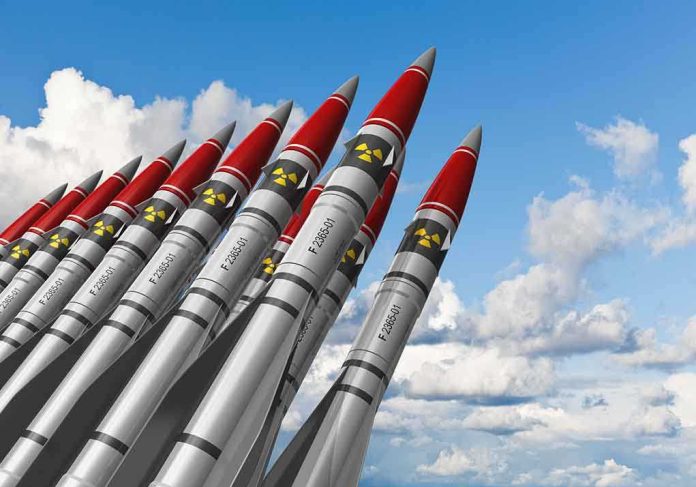
The formidable power of U.S. Navy aircraft carriers faces a strategic threat encapsulated in three ominous letters: A2/AD.
Story Overview
- A2/AD, or anti‑access/area denial, is a strategic threat, not just a technological one.
- China’s integrated missiles and sensor networks pose a significant risk to U.S. carriers.
- The U.S. Navy faces challenges with a shrinking submarine force and carrier vulnerabilities.
- Strategic operations in the Western Pacific are becoming riskier for carrier strike groups.
Understanding A2/AD Threats
The primary threat to U.S. Navy aircraft carriers is not a single weapon but a sophisticated A2/AD architecture. This strategy, particularly developed by China, combines long-range anti-ship ballistic missiles (ASBMs), cruise missiles, submarines, and aircraft. The system also integrates over-the-horizon targeting through advanced satellite and sensor networks. These elements work in concert to create a formidable barrier that could compromise the traditional advantage of U.S. carrier strike groups in power projection.
The timeline of this threat traces back to the 1990s and 2000s when the U.S. enjoyed uncontested carrier operations post-Cold War. However, as China began developing DF-21D and DF-26 missiles and their associated targeting systems in the mid-2000s, the landscape began to shift. By the 2020s, the U.S. Navy faces a diminishing submarine force, projected to drop from 55 to 43 attack submarines by 2030, while China continues to strengthen its A2/AD capabilities in the Western Pacific.
Strategic Implications for the U.S. Navy
The systemic environment created by A2/AD strategies poses a strategic threat to U.S. carriers. The maturing Chinese A2/AD envelope in the Western Pacific places U.S. carriers at significant risk. As a result, carriers can no longer assume they are safe within large parts of the region. This shift necessitates a reevaluation of U.S. Navy force structures, particularly the declining attack submarine inventory that has been crucial in countering such threats.
To maintain operational effectiveness, the U.S. Navy must adapt to these challenges by enhancing their capabilities. This includes developing longer-range carrier air wings, more resilient networks, and distributed surface and undersea forces. These adaptations will be crucial in maintaining the strategic credibility of U.S. carriers amidst evolving threats.
Impact on U.S. Military Operations
In potential conflicts, particularly in the Western Pacific, U.S. aircraft carriers may need to operate from greater distances to mitigate the risk posed by A2/AD systems. This strategic distance would reduce their sortie generation and responsiveness, impacting their operational effectiveness. Carrier strike groups would rely more on distributed escorts, submarines, and land-based assets to suppress enemy sensors and missile launchers. Enhanced electronic warfare and cyber operations will also play a critical role in degrading the targeting capabilities of adversaries.
Long-term implications of A2/AD strategies could erode the deterrent value of U.S. carriers if adversaries believe they can keep them at bay or inflict significant losses. This situation may prompt a shift in force structures, emphasizing larger missile magazines, longer-range weapons, and a more distributed, survivable force. The Navy might need to reassess the composition of carrier air wings to prioritize greater range and stand-off strike capabilities.
Broader Implications and Future Directions
The economic, social, and political impacts of these developments are significant. The cost asymmetry between missiles and ships raises sustainability concerns, influencing congressional funding decisions. The vulnerability of carriers could affect U.S. strategic signaling and alliance politics, particularly in the Indo-Pacific region. The defense industrial base faces pressure to deliver new capabilities while managing existing shipbuilding strains.
In response, there is an intensified demand for missile-defense innovation, advanced ISR and battle-management networks, and operational experimentation to validate new concepts for engaging in A2/AD environments. The U.S. must continue to adapt its strategies and capabilities to effectively counter these evolving threats and maintain its position of strength on the global stage.