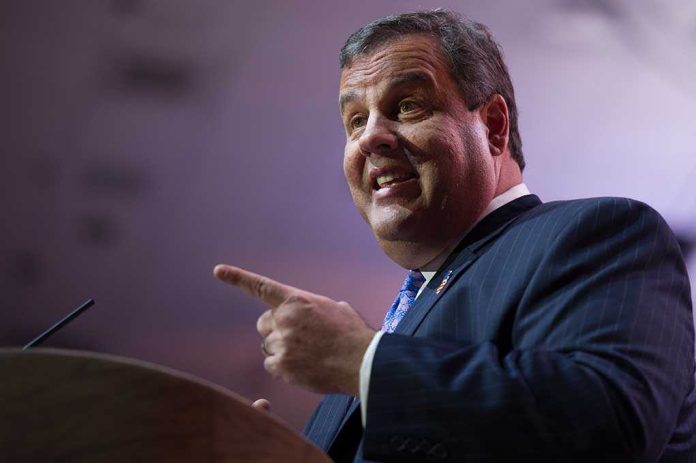
As Chris Christie sounds the alarm about Donald Trump’s “awful week,” grassroots conservatives are asking whether the real problem is Trump—or an establishment class desperate to drag the GOP back to the pre‑Trump, go‑along-to‑get‑along era.
Story Snapshot
- Chris Christie claims Trump had an “awful” week and warns of a looming “big problem” for the GOP if voters do not feel their lives improving.
- Christie’s critique revives the divide between the Trump base and establishment Republicans who long for the old party guard.
- Trump’s record on jobs, deregulation, border security, and anti‑woke reforms contrasts sharply with Christie’s warnings of political doom.
- For many conservatives, the real “big problem” is a GOP elite more focused on media praise than on defending liberty, borders, and family values.
Christie’s Warning Shot at Trump and the GOP
Former New Jersey Gov. Chris Christie recently argued that President Trump just endured an “awful” week and cautioned that Republicans will soon face a “big problem” if Trump does not make Americans’ lives better. Framing himself as a truth-teller, Christie portrays Trump as politically vulnerable and suggests voters will eventually abandon him if tangible improvements do not materialize. His comments echo years of establishment anxiety about Trump’s influence over a party base that rejects business-as-usual Republicanism.
Christie’s remarks are not simply about one news cycle; they are part of a broader narrative that paints Trump as electoral baggage. Critics in the consultant and donor class argue that Trump generates drama without delivering for everyday Americans. They imply that the GOP must either soften Trump’s agenda or move on from him entirely. For millions of conservatives who endured inflation, open-border chaos, and cultural radicalism under Democrats, that message feels disconnected from reality on the ground.
Contrasting Christie’s Doubts with Trump’s Track Record
When Christie questions whether Trump is making Americans’ lives better, many recall what life looked like before the pandemic and before the Biden years of inflation and border crises. During Trump’s first term, the United States gained roughly 7 million new jobs, middle-class family income rose by nearly $6,000, and unemployment hit its lowest rate in half a century. Deregulatory efforts were estimated to save consumers and businesses hundreds of billions of dollars annually, freeing small companies from Washington’s heavy hand.
Those earlier results matter because they reveal how policy translates into paychecks, opportunity, and stability for families. Trump’s team cut red tape at a historic pace, eliminating multiple outdated rules for every new one adopted, and reduced regulatory compliance costs by tens of billions of dollars. That approach aligned with long-standing conservative priorities: smaller government, less bureaucracy, and more room for entrepreneurs to thrive. For voters watching their grocery bills and retirement accounts, such reforms are not abstract talking points; they shape daily economic reality.
Border Security, Anti‑Woke Reforms, and the 2025 Agenda
Christie’s suggestion that Trump is failing to improve lives also clashes with the current administration’s push on border security and cultural issues. The new Trump White House has advanced executive orders focused on closing the border, cracking down on international cartels, and ensuring taxpayer-funded benefits go to citizens rather than illegal immigrants. Additional efforts target radical gender ideology in schools, remove men from women’s sports, and roll back federal diversity and equity mandates that conservatives view as ideological engineering rather than equal treatment under the law.
On foreign and domestic policy, the administration has moved quickly in 2025 to restore a peace-through-strength posture and a pro-family, pro-liberty framework at home. Trump has pressed allies to boost defense spending, confronted hostile regimes, and prioritized artificial intelligence and energy investment inside the United States instead of outsourcing American prosperity. These initiatives aim to reverse years of globalist thinking that left American workers sidelined while elites and multinational institutions prospered. For many on the right, that is exactly what “making lives better” is supposed to look like.
Establishment Fatigue vs. Grassroots Frustration
Christie’s criticism resonates most strongly with Republicans who are tired of Trump’s style, but it lands very differently with voters who feel betrayed by both parties. Many conservatives remember that before Trump, GOP leaders routinely campaigned on border enforcement, spending restraint, and protecting traditional values, only to compromise under media pressure once in Washington. Trump’s willingness to confront the bureaucracy, challenge corporate media narratives, and name problems directly is precisely why his base stuck with him through relentless attacks.
For that base, the “big problem” is not Trump’s insistence on strong borders and cultural sanity, but a political class that treats those priorities as embarrassing. They see rising crime, fentanyl deaths, classroom indoctrination, and a weaponized bureaucracy as existential threats to the republic. Against that backdrop, Christie’s focus on Trump’s bad week feels small. The central question for conservative voters is whether leaders will secure the border, tame inflationary overspending, defend the Constitution, and protect families—not whether they win praise from cable panels and legacy newspapers.