The most dangerous thing at that birthday party in Bukhara was not the fireball you saw on camera, but the invisible lie sitting inside those “harmless” balloons.
Story Snapshot
- A birthday surprise in Bukhara turned into a hydrogen-fueled fireball at face level
- The balloons were filled with flammable hydrogen, not inert helium
- Nozza Usmanova and her guests somehow escaped serious injury
- The near miss exposes a wider pattern of quiet corner-cutting in the party industry
Hydrogen Balloons And A Birthday Surprise That Became A Fireball
Birthday surprises are supposed to spike your heart rate with joy, not with a blast wave. In Bukhara, Uzbekistan, friends gathered outside a shop to surprise Nozza Usmanova with a cake, “cold-fire” sparklers, and a lush bouquet of balloons hanging right where every photo would be framed. The moment she leaned forward, blew out the visible flame, and relaxed, the real risk stepped in: the superheated tips of the sparklers brushed those balloons, and the hydrogen inside did exactly what nature designed it to do.
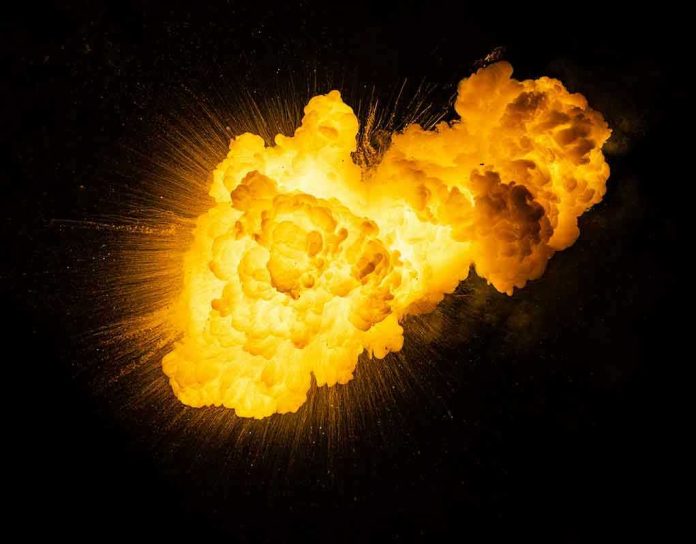
The balloons vanished in a fraction of a second. A bright orange fireball bloomed at face height, a shockwave pushed guests backward, smoke filled the doorway, and the footage looks like the opening instant of a disaster reel. Then, almost as fast, it was over. People stumbled, grabbed children, patted hair and skin, blinking in disbelief. The astonishing part is what did not happen: no serious burns, no hospital stretchers, no charred storefront. Just a lingering sense that everyone had walked away from a test they never meant to take.
Why The Gas Inside The Balloon Matters More Than The Flame On The Cake
The scene looks like a freak accident, but it follows a script written long before anyone in Bukhara ordered balloons. Hydrogen is the lightest gas in the universe and a champion at making things float, but it is also famously flammable. Mixed with ordinary air and exposed to a hot spark, it does what those balloons did: ignites in a flash, releases energy fast, and turns decoration into a fireball. That is why some countries banned public hydrogen balloons more than a century ago when they first saw what a little gas could do.
Helium, by contrast, is boring in all the right ways. It costs more, does not burn, and quietly lifts birthday balloons without drama. That price difference, however, tempts vendors in loosely enforced markets to substitute hydrogen and still call the product “helium balloons.” Consumers pay for innocence with risk they never agreed to. From an American conservative, common-sense standpoint, this is the core problem: people trying to celebrate with their families are not making an informed choice. Someone else is quietly trading their safety for a slightly better margin on a tank of gas.
A Pattern Of Parties, Shortcuts, And Unseen Risk Spreading Worldwide
The Bukhara clip went viral because the physics are cinematic, but it is not an isolated oddity. Reports out of India describe a birthday girl engulfed in flames when hydrogen balloons ignited as she lit her cake, leaving her with severe burns on her arms. Coverage from Vietnam recounts a woman’s face burned when a celebratory balloon exploded during a party. Each story is framed as “shocking,” yet the chain of events stays the same: hydrogen, open flame, close quarters, and guests who never knew they were standing next to fuel.
This repetition points to something bigger than one careless party. In many places, cylinders of balloon gas are unlabelled, mislabeled, or never explained. Families assume the stuff going into party balloons is the same harmless helium their kids have seen for years in cartoons and grocery stores. Responsibility gets muddied. Vendors can say, “Everyone uses this,” regulators keep their distance, and the cost of that ambiguity lands on the skin of the birthday girl when something goes wrong. Personal responsibility only works when people know what they are actually responsible for.
What This Near Miss Reveals About Safety, Freedom, And Accountability
Nozza Usmanova later said, “It happened so fast. I am unsure how I was able to escape that,” and added that she was relieved nobody was hurt and nothing was damaged. That reaction is human and honest. One second she is the center of a loving surprise; the next, she is the center of a fireball created by a decision she never made. Her friends did not set out to stage a stunt. They bought balloons and sparklers the way millions of families do, trusting that ordinary consumer products are not loaded with hidden explosive potential at face level.
This is where the lesson becomes uncomfortable but useful. Americans value limited government and personal freedom, but those values assume transparent markets and truthful labeling. Freedom means the right to decide, “I do not want flammable gas in my kid’s party decorations,” not to discover after the fact that someone quietly made that gamble on your behalf. Common sense does not demand a new bureaucracy for every balloon; it demands that we stop tolerating a culture where cutting corners and hiding risks is shrugged off as “just business” until someone’s birthday becomes a cautionary video.
Sources:
Birthday surprise turns terrifying as cake sparklers ignite hydrogen balloons in fireball
This birthday surprise went terrifyingly wrong the moment the candles were lit
Birthday cake sparklers cause balloons to explode in woman’s face
Birthday horror: Woman suffers facial burns after hydrogen balloons explode
Birthday balloons explode in woman’s face in wild video
Family birthday party turns to mayhem