
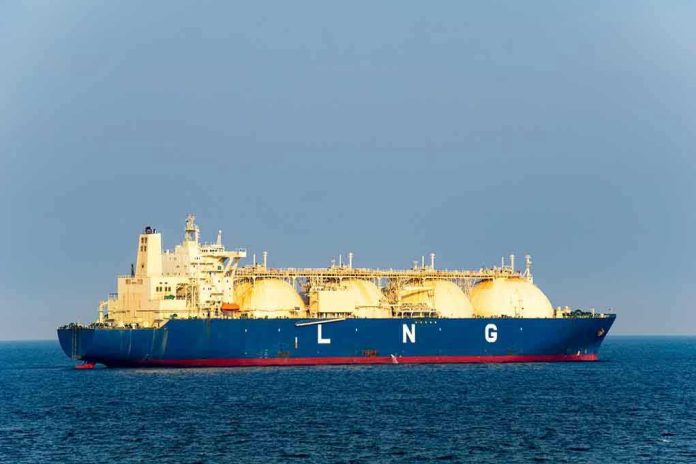
A Venezuela-linked oil tanker fled a Trump administration quarantine in the Caribbean, only to find US military forces waiting thousands of miles away in the Indian Ocean with a simple message: you cannot outrun American power.
Story Snapshot
- US forces tracked and boarded the Aquila II tanker after it defied a presidential quarantine, pursuing it from the Caribbean to the Indian Ocean
- The overnight operation occurred amid escalating enforcement of Venezuela oil sanctions following the capture of Nicolas Maduro
- The Department of War declared the vessel would run out of fuel before outrunning US military capabilities
- Venezuela’s oil output has collapsed as tankers sit idle and exports to China and Russia halt under the embargo
The Chase Across Two Oceans
The Aquila II made a calculated gamble that distance would provide safety from American enforcement. The tanker slipped away from Caribbean waters where Trump administration officials had imposed a strict quarantine on sanctioned vessels tied to Venezuela’s oil trade. Thousands of miles later, in the vastness of the Indian Ocean, US forces executed a right-of-visit maritime interdiction and boarding without incident. The Department of War announced the operation Monday morning with a phrase that encapsulated the futility of the vessel’s flight: “It ran, and we followed.”
Enforcement Backed by Unmatched Reach
Defense Secretary Pete Hegseth confirmed the boarding operation, which demonstrated capabilities few nations possess. The Department of War emphasized that protecting the homeland from illicit actors transcends geographic boundaries. The agency stated plainly that defying American power ends the same way regardless of which ocean a vessel chooses for escape. The pursuit from the Caribbean through the INDOPACOM area of operations showcased tracking assets across land, air, and sea domains working in coordination to locate a single fleeing tanker among global shipping lanes.
Venezuela’s Oil Sector in Freefall
The Aquila II boarding represents one enforcement action in a broader economic strangulation of Venezuela’s petroleum industry. Following the capture of Nicolas Maduro, who faces narco-terrorism charges alongside his wife Cilia Flores, the Trump administration imposed a comprehensive oil embargo. Chevron halted US-bound cargoes. Chinese-flagged tankers stopped loading at Venezuelan ports. Petromonagas and Sinovensa reduced output due to diluent shortages created by the blockade. Tankers now sit idle at Jose port as Venezuela, holder of the world’s largest oil reserves, watches its primary revenue source evaporate under American pressure.
President Trump announced Saturday that the United States would become “very strongly involved” in Venezuela’s oil sector post-Maduro. The statement signals intention beyond mere sanctions enforcement toward active participation in reshaping how those massive reserves reach global markets. Previous Trump administration actions against Venezuelan interests included strikes on drug-smuggling boats that killed over 115 people, establishing a pattern of kinetic responses to threats emanating from the regime. The transition government taking shape in Caracas will likely negotiate oil arrangements favorable to American companies seeking access to reserves previously controlled by hostile actors.
Global Implications for Maritime Defiance
Tanker operators worldwide received an unmistakable message through the Aquila II interdiction. Evading American sanctions by changing course or seeking distant waters no longer provides refuge when Washington decides enforcement matters. Russia and China both lost cargoes they expected from Venezuelan exports, finding their economic arrangements with Maduro subordinated to US military capabilities. Senator Tim Kaine called the broader Venezuela actions unauthorized military attacks, but the administration frames operations as defending American interests against narco-terrorism and securing critical energy resources for eventual friendly governance.
The shipping industry now calculates new risks for sanctioned cargo movements. Diluent shortages prove particularly crippling for Venezuela’s heavy crude operations, creating cascading supply chain failures that extend beyond simple export restrictions. LSEG and TankerTrackers data reveal operational chaos at Venezuelan terminals as the embargo forces fundamental recalculations about which contracts can physically be fulfilled. American oil companies operating under previous licensing exceptions now face halted activities, awaiting clarity on how the post-Maduro landscape reshapes business conditions in a country whose petroleum reserves exceed those of Saudi Arabia.
Sources:
US forces hunt down and board tanker ship defying Trump admin quarantine
Defense Secretary confirms military boarding of Aquila II tanker
Kaine: Trump conducted unauthorized military attack on Venezuela
Trump talks US involvement in Venezuela’s oil sector
Venezuela moves to cut oil output amid embargo pressure