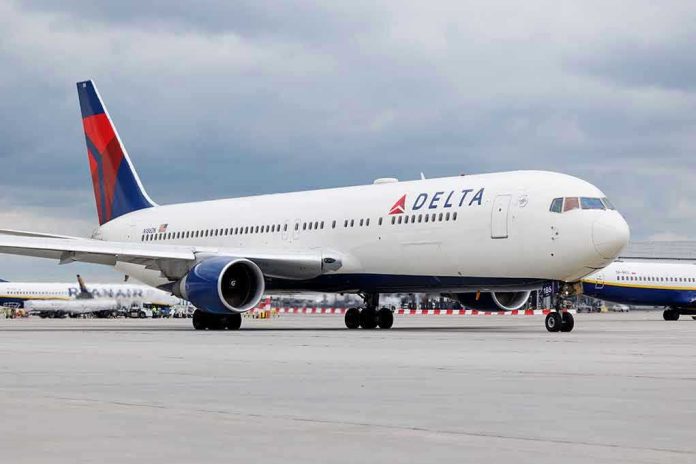
A 15-minute hop out of Houston turned into a full-scale restraint and emergency return when one passenger’s meltdown threatened the one line nobody gets to cross: the cockpit.
Quick Take
- Delta Flight 2557 left Houston Hobby around 5:25 a.m. for Atlanta and turned back minutes later after a violent disturbance.
- Witness accounts described punches and a targeted assault; several people helped crew restrain the passenger.
- Air traffic control audio and pilot reports suggested a cockpit access attempt, but Delta later said the person did not attempt to access the flight deck.
- Houston police detained the passenger after landing and transported the individual for a mental health crisis evaluation.
What Happened on Delta 2557: A Routine Departure That Didn’t Stay Routine
Delta Flight 2557 departed William P. Hobby Airport in Houston early Wednesday morning, February 18, 2026, bound for Hartsfield-Jackson Atlanta International. The aircraft, a Boeing 717, carried 85 passengers and five crew members. About ten minutes after takeoff, the situation degraded fast enough that the crew declared an emergency and brought the plane back, landing roughly 15 minutes after departure.
Onboard accounts described a passenger who shifted from disruptive behavior to violence, striking other travelers and singling out one man for a more aggressive assault that included grabbing him by his clothing and hair. Restraining a combative adult inside a narrow cabin is not a “handle it when we land” scenario; it risks injuries, panic, and a chain reaction of bad decisions. Crew and passengers reportedly needed multiple people to get control.
Cockpit Access Claims: The Contradiction That Matters Most
Air traffic control communications and initial reports indicated someone tried to get into the cockpit, the kind of phrase that makes every frequent flyer sit up straight. Delta later contradicted that framing, stating the customer did not make contact with or attempt to access the flight deck. That gap is not a trivial PR squabble. “Approached the cockpit area” and “attempted to breach the door” live in different legal and safety universes, and the FAA investigation will matter.
Post-9/11 cockpit security works because it turns the flight deck into a hardened boundary with procedures, barriers, and disciplined crew routines. Aviation safety experts treat any pressure toward that door as a cardinal violation, even when it stops short of contact. Common sense says the crew cannot wait to litigate semantics at 35,000 feet. When the cockpit becomes part of the radio call, the prudent move is immediate control and, if needed, immediate diversion.
Why Early-Morning Flights Can Turn Volatile Faster Than You Expect
The departure time—around 5:25 a.m.—adds context people overlook. Cabins fill with half-awake passengers, reduced situational awareness, and a crew trying to run tight checklists on schedule. A disturbance in that window can bloom before a nearby passenger fully understands what’s happening. That does not excuse anyone’s behavior, but it explains why decisive action becomes the only safe action. A mid-cabin brawl is dangerous; a mid-cabin brawl near the front is worse.
Unruly passenger incidents surged during the COVID-era mask mandate fights, then declined from peak levels but stayed higher than pre-pandemic norms. That trend suggests something deeper than masks: frayed social trust, entitlement, substance abuse, and untreated mental illness showing up in public places with zero padding for failure. Commercial aviation has no shoulder to pull onto. The cabin is a closed system where one person’s spiral becomes everyone’s problem.
Mental Health, Public Safety, and Accountability in a Confined Metal Tube
Houston police detained the passenger after the plane returned to Hobby, then transported the individual for a mental health crisis. That choice can be both humane and practical, but it also raises a hard question many Americans quietly ask: where is the line between treatment and consequences when innocent people get hurt? Conservatism values ordered liberty. Compassion belongs in the response, but so does accountability—especially when violence and threats to aviation safety enter the picture.
Delta said the flight re-departed and arrived in Atlanta roughly 90 minutes late. For travelers, that number sounds minor until you translate it into missed connections, lost work time, and the lingering feeling that the system protects the disruptor more than the decent people trapped next to the incident. Airlines can apologize—and should—but passengers want prevention. The FAA investigation becomes the hinge: clarity on what happened, and pressure on what changes.
What This Incident Signals for Flyers and Airlines in 2026
Flight 2557 shows how quickly “unruly” becomes operationally critical: a handful of minutes, a few rows of seats, and suddenly a plane reverses course with law enforcement waiting at the gate. The strongest lesson is not fear; it is realism. Cabin crews act as safety professionals first, hospitality second. The public should support firm enforcement, quicker intervention, and policies that keep violent passengers off planes before they become airborne problems.
The unresolved cockpit question will keep this story alive. If the passenger truly did not attempt to access the flight deck, the system still faced a violent assault in flight—serious enough on its own. If the person pressed toward the cockpit, even without touching the door, that should trigger hard scrutiny of screening, onboard monitoring, and deterrence. Either way, the conservative, common-sense position is simple: protect the innocent, back the crew, and stop normalizing chaos.
Sources:
Unruly passenger detained after incident on Delta flight, police say
Delta flight diverted back to Hobby Airport after passenger attempted to breach cockpit, police say