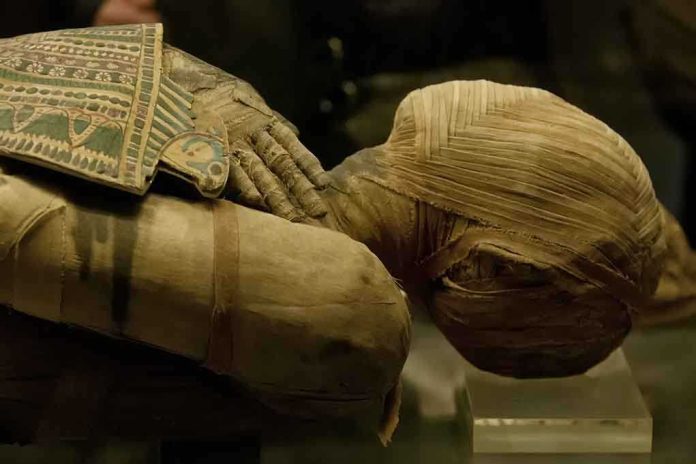
Scientists have unlocked chemical secrets hidden in the distinctive scent of ancient Egyptian mummies, revealing a 2,000-year evolution of sophisticated embalming practices that challenges modern conservation methods and demonstrates the remarkable ingenuity of ancient civilizations.
Story Snapshot
- Researchers analyzed 81 volatile organic compounds from 19 mummies spanning 3200 BC to 395 AD using non-destructive techniques
- Studies reveal mummification evolved from simple fats and oils to complex imported resins, bitumen, myrrh, and frankincense
- New methods detect original embalming materials while distinguishing them from later contamination, pesticides, and microbial degradation
- Each mummy possesses a unique chemical signature with woody, spicy, and sweet odor profiles varying by body region and time period
Revolutionary Non-Destructive Analysis Methods
University of Bristol researchers developed a groundbreaking technique analyzing volatile organic compounds from peppercorn-sized samples of mummy balms and bandages. Dr. Wanyue Zhao and her team identified 81 distinct VOCs using solid phase micro-extraction with gas chromatography and mass spectrometry. This method preserves artifacts unlike traditional solvent-based approaches that damage irreplaceable historical materials. The research spans 35 samples from 19 mummies across more than 3,500 years, providing unprecedented insight into ancient Egyptian funerary practices without compromising the integrity of these cultural treasures.
Evolution of Ancient Egyptian Embalming Sophistication
Chemical analysis reveals early Egyptian embalmers used basic fats and oils, but practices grew increasingly sophisticated over centuries. Later periods incorporated imported coniferous resins from pine and cedar, bitumen, myrrh, frankincense, and various waxes. These complex recipes reflect expanding trade networks, accumulated wealth, and deepening ritual significance. The evolution demonstrates remarkable chemical knowledge among ancient practitioners who developed body-specific formulations. Different regions of individual mummies show varying compositions, suggesting targeted applications for heads versus torsos. This level of specialization contradicts simplistic views of ancient technology.
Complementary Sensory Research Findings
A complementary study from UCL Bartlett School and University of Ljubljana examined nine mummies from Cairo’s Egyptian Museum using human “supersniffers,” electronic noses, and advanced gas chromatography-olfactometry-mass spectrometry. Professor Matija Strlič reported researchers were “flabbergasted” that each mummy possessed distinct aromatic profiles categorized as woody, spicy, sweet, herbal, or rancid. Dr. Cecilia Bembibre emphasized the importance of sensory data for understanding past cultures. These findings, published in the Journal of the American Chemical Society, successfully distinguished original embalming materials from post-excavation treatments, conservation chemicals, and environmental contamination.
Practical Applications for Museum Conservation
The research provides practical benefits beyond historical curiosity. Museums can now rapidly screen collections for conservation needs without invasive sampling. Rancid odors may indicate mold growth requiring immediate intervention, while detecting pesticides helps protect curators handling artifacts. Professor Ian Bull described the technique as an “effective first step for collections” management. Professor Richard Evershed noted it “expands study” capabilities to provide “clearer pictures of recipes” used across different periods and regions. The low-cost, non-invasive approach reduces damage risks while enabling comprehensive surveys of extensive museum holdings previously impossible to analyze systematically.
This scientific achievement demonstrates how respecting and preserving historical artifacts reveals wisdom from civilizations that thrived millennia before modern technology. Ancient Egyptians developed sophisticated chemical processes through observation, experimentation, and accumulated knowledge passed through generations. Their mastery of materials science, international trade, and ritual precision reflects values of excellence, ingenuity, and cultural continuity. Modern researchers benefit from non-destructive methods that honor these irreplaceable cultural treasures while expanding our understanding of human achievement. The work showcases how genuine scientific inquiry enriches appreciation for ancestral accomplishments rather than dismissing them as primitive.
Sources:
Discover the Aromas of Ancient Egyptian Mummies, From Orange Peels to Pine to Incense
Woody, Spicy or Sweet: What Did Ancient Egyptian Mummies Smell Like?
What Do Egyptian Mummies Smell Like?