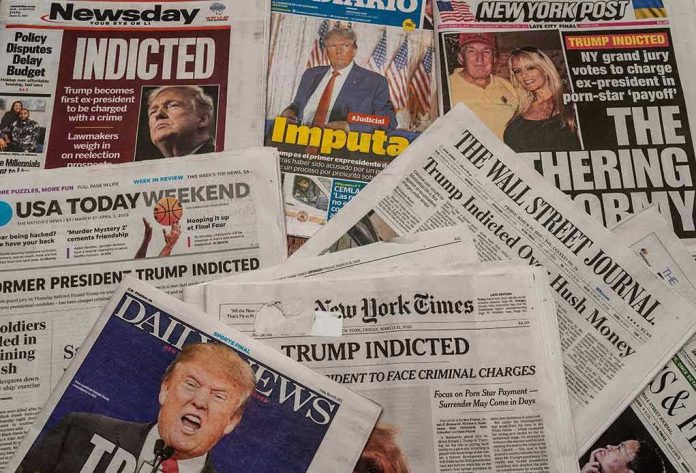
President Trump declared war not just on Iran’s nuclear program, but on the very media outlets Americans once relied on to cover military conflicts with impartiality and historical perspective.
Story Snapshot
- Trump accused legacy media of deliberately undermining U.S. military operations in Iran through biased coverage that ignored historical precedents
- FCC Chairman Brendan Carr warned broadcasters they risk losing licenses over reporting deemed “hoaxes and fake news” during wartime
- The president’s attacks expanded beyond traditional media to include conservative allies like Tucker Carlson and Megyn Kelly who questioned the war
- Operation Epic Fury launched against Iran’s nuclear facilities after Iranian proxies attacked the U.S. Embassy in Baghdad
- White House corrected media reports about Iran negotiations, calling a supposed “10-point plan” unserious and discarded
When Wartime Coverage Becomes the Battlefield
President Trump unleashed a torrent of criticism against The New York Times, The Wall Street Journal, ABC News, and CNN during the third week of Operation Epic Fury. His grievance centered on what he characterized as deliberately pessimistic reporting that emphasized American unpreparedness for Iran closing the Strait of Hormuz while downplaying the precision and effectiveness of U.S. military strikes. Trump took to Truth Social on April 17, 2026, declaring these outlets “want us to lose the War” through reporting he branded as corrupt, fake, and anti-American.
The accusations escalated beyond typical presidential complaints about unfavorable press coverage. Trump suggested media behavior bordered on treason, claiming journalists lacked the empirical understanding of military history that would allow them to contextualize current operations alongside successful campaigns in Serbia and Afghanistan. His press secretary Karoline Leavitt backed this narrative, correcting what she called false reports about ongoing negotiations with Iran. The White House insisted media outlets fabricated details about a diplomatic “10-point plan” that officials had already deemed unserious and rejected.
The Regulatory Hammer Falls
FCC Chairman Brendan Carr, a Trump appointee, transformed the president’s rhetorical attacks into tangible threats. Carr warned broadcast outlets they faced potential license reviews for spreading what he classified as hoaxes during wartime coverage. This marked a departure from traditional government-media tensions during military conflicts. Previous administrations complained about coverage, wrote critical op-eds, and occasionally restricted press access to combat zones. None deployed federal regulatory agencies as enforcement mechanisms against editorial decisions about war reporting.
The intersection of wartime coverage and broadcast licensing created a chilling dynamic for journalism. Media organizations faced a calculation: report critically on military preparedness gaps like the Strait of Hormuz vulnerability, or risk government retaliation through the regulatory apparatus. Conservative commentator Pete Hegseth amplified this pressure, demanding CNN undergo a complete overhaul and insisting outlets publish more favorable headlines about Operation Epic Fury. Half the American public already distrusted legacy media according to polling data, creating fertile ground for accusations that negative coverage stemmed from anti-Trump animus rather than journalistic duty.
Conservative Civil War Over Iran Strategy
Trump’s media offensive fractured the conservative coalition that propelled him to a second term. Tucker Carlson, Megyn Kelly, Candace Owens, and Alex Jones all questioned the wisdom of military escalation against Iran, echoing Trump’s own previous rhetoric about avoiding endless Middle Eastern entanglements. The president responded by calling these former allies “NUT JOBS” seeking “cheap publicity” and suggested they secretly sympathized with Iran’s nuclear ambitions. He labeled them “low IQ” commentators who failed to grasp the strategic necessity of eliminating Iran’s nuclear crown jewel.
This internal division exposed contradictions between Trump’s 2024 campaign messaging and his 2026 governing decisions. Secretary of State Marco Rubio described the conflict as Israel-led with American support, while Trump characterized it as a U.S.-initiated operation to protect American interests after the Baghdad embassy attack. Conservative critics argued the administration had abandoned its America First principles by deploying 5,000 Marines and sailors to eliminate threats that diplomatic pressure and sanctions might contain. The president’s willingness to attack right-wing media figures who built careers defending him demonstrated how completely the Iran operation dominated his strategic thinking.
Historical Precedents and Military Reality
Trump and his defenders pointed to successful American bombing campaigns in Serbia, Afghanistan, and against ISIS to contextualize Operation Epic Fury. They argued media coverage ignored the military’s demonstrated ability to execute precision strikes that destroyed strategic targets while minimizing civilian casualties. The Washington Examiner and American Enterprise Institute published analyses claiming journalists exhibited deep anti-military bias rooted in Vietnam-era cynicism about American power projection. These commentators suggested reporters wanted Trump to fail more than they wanted America to succeed.
Trump Torches Legacy Media Outlets for Lying About Iran War https://t.co/gKXzw5mxCh
— Fearless45 (@Fearless45Trump) April 21, 2026
The administration claimed 18 days of strikes effectively degraded Iran’s nuclear infrastructure and proxy network capabilities despite media narratives emphasizing setbacks and unpreparedness. Officials dismissed reports about inadequate planning for Strait of Hormuz closure as fake news divorced from classified intelligence and contingency planning. White House briefings highlighted six fallen American soldiers as heroes whose sacrifice media coverage dishonored through relentless negativity. Yet independent verification of casualty figures, strike effectiveness, and economic consequences remained limited to administration sources and allied outlets willing to accept official narratives at face value.
The Stakes for Presidential Legacy and Press Freedom
Trump’s confrontation with media over Iran war coverage carries implications beyond typical partisan battles about journalistic fairness. A decisive military victory that eliminates Iran’s nuclear program and regional proxy networks could cement his legacy as a strongman willing to use American power effectively where predecessors exercised restraint. Conversely, a protracted conflict validating media warnings about unpreparedness and escalation risks would empower critics who warned against entanglement. The president clearly calculated that delegitimizing skeptical coverage now insulates him from accountability if operations bog down.
The broader threat to press freedom deserves scrutiny regardless of one’s assessment of media bias. Government agencies wielding licensing authority as weapons against unfavorable war coverage establishes dangerous precedents that transcend any single administration or conflict. Journalists may reasonably exhibit anti-military bias shaped by decades of failed Middle Eastern interventions. They may unfairly apply stricter standards to Republican presidents than Democratic ones. But the solution to biased journalism is competing narratives and audience choice, not regulatory threats from political appointees. Americans who distrust legacy media should demand better reporting, not government censorship masquerading as license enforcement.
Sources:
Business Standard – Trump Lashes Out at Conservative US Media Figures Over Iran War Criticism
Washington Examiner – Why Half Country Tunes Out Legacy Media Iran War Coverage
American Enterprise Institute – Legacy Media Root Against US in Iran War to Spite Trump
Washington Times – Donald Trump Lashes Conservative Media Figures Iran War