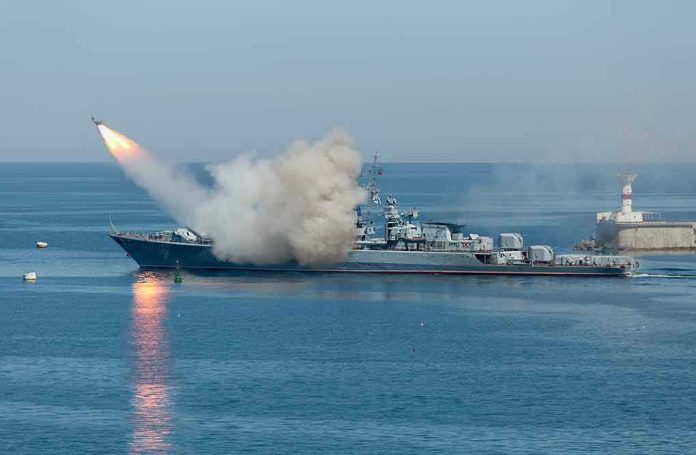
When a guided-missile destroyer fires live rounds into a cargo ship’s engine room in one of the world’s most critical oil chokepoints, you’re witnessing the moment economic pressure transforms into explosive confrontation.
Story Snapshot
- USS Spruance disabled Iranian vessel MV Touska with 5-inch gunfire after six hours of ignored warnings on April 19, 2026
- First U.S. boarding and seizure since blockade began, marking escalation from interdiction to kinetic enforcement
- U.S. turned away over 30 vessels attempting to reach Iranian ports, strangling maritime access to the regime
- Defense Secretary Hegseth vowed blockade continues “for as long as it takes” despite ceasefire and diplomatic overtures
- Iran characterized seizure as “armed piracy” and promised retaliation, threatening fragile 72-hour peace window
Six Hours of Warnings Before Thunder
The Iranian-flagged cargo vessel MV Touska steamed toward Bandar Abbas at 17 knots on April 19, 2026, ignoring every warning broadcast by the USS Spruance. For six hours, the Arleigh Burke-class destroyer escalated communications, demanding the vessel halt and comply with the U.S. naval blockade of Iranian ports. The crew refused. At the end of that six-hour period, the destroyer’s 5-inch Mark 45 gun roared to life, firing multiple rounds directly into the ship’s engine room. Propulsion disabled, the vessel drifted helplessly as U.S. Marines from the 31st Marine Expeditionary Unit swarmed aboard and seized control.
U.S. Central Command described the action as deliberate, professional, and proportional. The graduated response demonstrated both restraint and resolve, offering the Iranian crew every opportunity to comply before resorting to force. This wasn’t impulsive gunboat diplomacy. This was calculated enforcement designed to send an unmistakable message: the blockade is real, violations carry consequences, and American warnings are not suggestions. The seizure marked the first boarding since Operation Epic Fury commenced in late February 2026, transforming the blockade from theoretical threat into tangible reality.
Retaliation for Iranian Attacks on Commercial Shipping
The USS Spruance’s actions didn’t occur in a vacuum. Two days before the seizure, on April 17, Iran’s Revolutionary Guards Corps fired on three commercial container ships transiting the Strait of Hormuz. Those attacks on international shipping triggered the U.S. response, establishing a direct cause-and-effect relationship between Iranian aggression and American enforcement. President Trump had already authorized U.S. forces to “shoot and kill” any Iranian vessels attempting to mine the waterway, signaling zero tolerance for interference with maritime traffic through the strait that carries one-fifth of global oil supplies.
Iran’s subsequent characterization of the MV Touska seizure as “armed piracy” reveals the regime’s strategic dilemma. Unable to contest U.S. naval superiority directly, Iranian officials condemned the action and vowed retaliation while simultaneously demanding the blockade’s end as a prerequisite for peace negotiations. This rhetorical posturing masks a fundamental power imbalance: the U.S. controls the strait, and Iran lacks the conventional capability to break that control. The regime’s asymmetric options, mines, anti-ship missiles, and attacks on commercial vessels, carry escalation risks that could shatter the fragile ceasefire currently in place.
Blockade Economics and Strategic Pressure
Defense Secretary Pete Hegseth and Joint Chiefs Chairman Gen. Dan Caine announced on April 23 that the blockade will continue “for as long as it takes.” That commitment transforms the naval operation from temporary tactical measure into sustained strategic pressure campaign. The U.S. has already turned away over 30 vessels attempting to reach Iranian ports, choking maritime access and forcing shipping traffic well below pre-war levels. This economic strangulation aims to compel Iranian concessions without requiring full-scale military operations, leveraging American naval dominance to achieve diplomatic objectives.
The Strait of Hormuz represents one of the world’s most critical maritime chokepoints, a narrow passage through which roughly 20 percent of global oil supply normally flows. Disruption to this shipping creates immediate inflationary pressure on energy markets and forces commercial carriers to reroute, increasing costs and transit times. President Trump claims the U.S. maintains “total control” over the strait, a boast supported by the Navy’s demonstrated ability to intercept and disable vessels at will. Iran’s counter-claim that it collected its first toll revenue from the strait rings hollow when U.S. destroyers physically prevent ships from reaching Iranian ports.
The Fragile Ceasefire and Diplomatic Deadlock
President Trump announced on April 23 that peace talks could begin within 36 to 72 hours, expressing optimism about diplomatic progress. Yet Iran insists the blockade must end before negotiations commence, a precondition the U.S. categorically rejects. This deadlock illustrates competing pressure strategies: Iran seeks relief before concessions, while America maintains coercion during negotiations to strengthen its bargaining position. The ceasefire remains technically in place, but maritime incidents, Iranian attacks on commercial shipping, vessel seizures by both sides, and the MV Touska boarding suggest practical deterioration of the agreement’s restraint mechanisms.
Iran’s Revolutionary Guards seized two vessels, MSC Francesca and Epaminodes, on April 23 for alleged “maritime violations,” straining the ceasefire further. These tit-for-tat actions create escalation risks where miscalculation or unintended incidents could trigger broader conflict despite neither side desiring full-scale warfare. The U.S. Navy Chief stepped down amid these tensions, though the reasons for that departure remain unclear. What is clear: the blockade strategy reflects confidence in American naval superiority and willingness to sustain economic pressure indefinitely, regardless of Iranian complaints about “piracy” or international concerns about freedom of navigation.
Sources:
Iran-US war LIVE: Trump ceasefire deadline – Strait of Hormuz
Hegseth and Caine news conference on Iran war, ceasefire, Lebanon, Israel, Hormuz
Fox News Video: US Navy Seizes Iranian Ship
US Navy Seizes an Iranian-Flagged Ship Near Strait of Hormuz