Federal agents swept through Los Angeles’ MacArthur Park to dismantle a sprawling open-air drug market controlled by the 18th Street Gang, arresting 18 suspects tied to fentanyl and methamphetamine distribution that has plagued the community for decades.
Story Snapshot
- Operation Free MacArthur Park resulted in 18 arrests with 25 total defendants charged in federal court for running a gang-controlled drug distribution network.
- DEA and LAPD targeted mid-level suppliers linked to the 18th Street Gang who concealed drugs in homeless encampments and local businesses.
- Two alleged main suppliers from South LA face potential life sentences for providing fentanyl and methamphetamine to street-level dealers in the Alvarado Corridor.
- Seven fugitives remain at large as prosecutors pursue charges against defendants who exploited the park’s homeless population to mask their operations.
Decades-Long Drug Market Finally Targeted
MacArthur Park has served as an open-air drug marketplace since the 1980s crack epidemic, with the 18th Street Gang maintaining control through storefronts and homeless encampments near downtown Los Angeles. Federal agents and LAPD officers executed Operation Free MacArthur Park during the first week of May 2026, arresting suspects who allegedly supplied fentanyl and methamphetamine throughout the Alvarado Corridor. The operation specifically targeted Mallaly Moreno-Lopez and Jackson Tarfur, both 31-year-old South LA residents accused of serving as primary drug suppliers for the gang’s distribution network. Authorities served warrants at six businesses along the corridor where dealers allegedly stashed narcotics.
Gang Infrastructure Exposed in Federal Charges
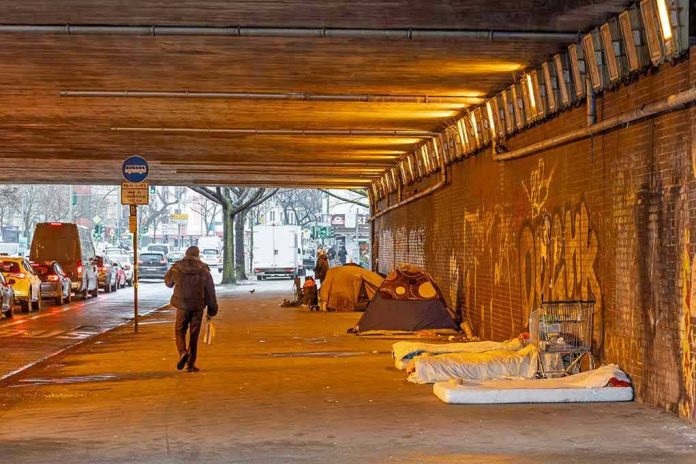
The 25 defendants charged in federal court include upstream suppliers Yolanda Iriarte-Avila, a 40-year-old Calabasas resident, and Jesus Morales-Landel from South LA, who allegedly fed the distribution chain. First Assistant U.S. Attorney Bill Essayli announced the charges and declared federal determination to fight traffickers poisoning citizens. The 18th Street Gang exploited MacArthur Park’s estimated 10,000-area homeless population to conceal their operation, blending drug stashes among tents and struggling residents. This tactic allowed the gang to operate openly while evading law enforcement scrutiny. DEA Los Angeles head Anthony Chrysanthis emphasized returning safety and hope to a community devastated by over 1,800 overdose deaths in LA County during 2025 alone.
Operation Follows Established Disruption Strategies
The MacArthur Park sweep builds on March 2026 federal arrests of 12 additional 18th Street members charged with murder, extortion, and drug trafficking at the same location. Acting U.S. Attorney General Todd Blanche publicly endorsed the operation on social media, declaring that DEA and LAPD have taken back MacArthur Park for law-abiding residents. The approach mirrors successful high-visibility policing tactics used in New York City during the 1990s, which disrupted street-level markets through sustained pressure and landlord cooperation. However, law enforcement studies warn that arrests alone prove ineffective without follow-through strategies like business evictions and continued visibility to prevent dealer replacement and market displacement to neighboring areas like Echo Park.
Community Safety Versus Long-Term Solutions
Residents near MacArthur Park stand to benefit immediately from reduced drug activity and potential decreases in local overdoses, though displaced dealers may simply relocate operations. The arrested defendants face decades to life in federal prison if convicted, significantly disrupting the 18th Street Gang’s revenue stream estimated in the millions annually from park-based trafficking. Critics note that enforcement-focused operations fail to address root causes like addiction treatment access and economic despair fueling demand. The operation represents a visible win for the Trump administration’s Department of Justice push against open-air drug markets and transnational gang networks, aligning with Attorney General Pam Bondi’s March 2026 call for crackdowns on such criminal enterprises.
🚨NEWS:
DOJ Launches Blitz on LA's Open-Air Drug Market, Seizes 40 Pounds of Fentanyl
Eighteen defendants, including two people law enforcement believes are the main sources of fentanyl and methamphetamine in Los Angeles’s gang-and drug-infested MacArthur Park, have been arrested…— ADDLEPATED DSF (@DSFisAddlepated) May 7, 2026
The ongoing fentanyl crisis claimed over 100,000 American lives nationally in recent years, making targeted disruption of distribution networks a priority for federal law enforcement. With seven fugitives still at large and prosecutions underway, authorities face the challenge of sustaining pressure to prevent the 18th Street Gang from simply replacing arrested members and resuming operations. The true test will be whether this operation evolves beyond arrests into comprehensive market disruption through business accountability and community restoration, or whether MacArthur Park returns to its four-decade role as a drug distribution hub once media attention fades.
Sources:
Feds sweep into MacArthur Park targeting ‘open-air drug market’
DOJ COPS Report on Open-Air Drug Markets
Department of Justice Instagram – Transnational Gang Enforcement