The important story here is not that one smuggling corridor exists; it is that the Jordan-Israel frontier has evolved into a disciplined weapons pipeline whose scale, methods, and recipients now matter more than the old assumption that it was a peripheral desert problem. The evidence supports a picture of organized criminal logistics, repeated interdiction, and a security establishment that has had to adapt quickly—while the more dramatic claim that Kurdish militias sit at the center of this pipeline remains unproven in the material provided.
Intro Header
- The best-documented threat is the Jordanian border smuggling ecosystem itself: repeated crossings, drones, handoffs, and arrests, not a single isolated incident.
- Israeli and regional reporting points to a high proportion of handguns, many linked to Delta Defence Group production, moving through the Levant’s illicit markets.
- The specific claim that Kurdish militias are the operational engine of the Israel-bound flow lacks direct forensic or documentary support in the research package.
- The sharper debate is not whether smuggling exists, but whether it is primarily a criminal-border phenomenon or evidence of a broader state or militia network.
A Border That Stopped Being Quiet
For years, Israel’s eastern border was treated as a secondary front compared with Gaza, Lebanon, or Syria. That assumption no longer fits the facts. Israeli, Jordanian, and U.S.-aligned reporting all describe a steady rise in weapons smuggling from Jordan into Israel and the West Bank, with authorities seizing more than 800 weapons across 35 thwarted attempts in roughly two years, including 570 in 2022 alone. The picture that emerges is not a random trickle but a repeatable system: reconnaissance, couriers, concealment, and increasingly drones. In one widely reported case, Israeli authorities intercepted a Jordan-bound smuggling attempt carrying 40 handguns, underscoring how quickly the tactics have become more sophisticated.
That escalation matters because border smuggling is not merely a customs problem. It is a force multiplier for violence. Smuggled handguns and assault rifles do not stay abstract; they move into criminal networks, local militias, and terror cells. Israeli reporting has linked some illicit weapons to deadly attacks inside Israel, while security officials have responded by building a joint operational headquarters involving the IDF, police, and Shin Bet to disrupt large rings before they can move bulk shipments. In practical terms, the state has stopped treating the Jordan line as a passive barrier and begun treating it as an active counter-smuggling theater.
What the Seized Weapons Tell Us About the Market
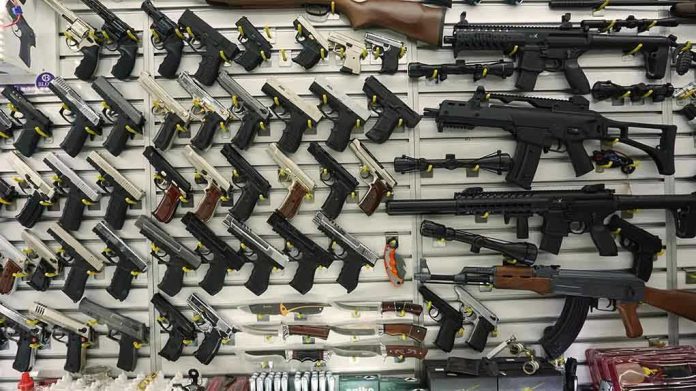
The most revealing fact in the research is not just the number of weapons seized, but their composition. According to IDF-linked reporting summarized in the West Point study, about 90 percent of the weapons intercepted at or near the Jordan-Israel border are handguns. That matters because handguns are the most portable currency of the black market: easy to hide, easy to move in small lots, and easy to distribute to individuals rather than organized military formations. The same reporting says many of these pistols are produced by Delta Defence Group, which has reportedly saturated markets in Syria and Iraq.
This is the kind of supply-chain detail that cuts through romantic theories about clandestine grand strategy. If a weapon type is repeatedly appearing in border seizures, the first-order explanation is usually market plumbing: where the guns are made, where they are cheapest, who already trades them, and which corridors are hardest to police. The research package also points to a broader Levantine circuit, with weapons flowing through Syria and Iraq before passing into Jordanian dealer networks and then toward Israeli or Palestinian recipients. That is a regional criminal economy, and it is dangerous enough without embellishment.
It is also why the claim of “Kurdistan flooding Israel” needs careful handling. The available material does mention Delta Defence Group pistols reaching Iraq and being trafficked through Kurdistan, but it does not establish that Kurdish militias are reverse-engineering Israeli designs, nor that they are directing the specific Jordan-to-Israel routes described in the border-smuggling reporting. That is a meaningful distinction. A weapon can pass through a place without that place being the cause, the organizer, or even the principal beneficiary. The research supports trafficking through the wider Kurdish-Iraqi commercial space; it does not prove Kurdish militia authorship of the Israeli smuggling stream.
The Imad al-Adwan Case Shows How the Network Actually Operates
Few cases illustrate the mechanics more clearly than the arrest of Jordanian MP Imad al-Adwan. Israeli and third-party reporting states that he was detained on April 22, 2023, after 12 rifles and 194 pistols were found in his vehicle, and that investigators concluded he had carried out 12 smuggling operations since February 2022 using a diplomatic passport. Jordan later confirmed his release. Whatever one concludes about the politics surrounding his case, the operational lesson is plain: smuggling in this corridor can exploit status, paperwork, and access as much as terrain. It is not the work of lone gunmen improvising in the desert; it is logistics with political cover.
That case also weakens any simplistic account of the border as a purely tribal or purely state-driven phenomenon. The research repeatedly references Bedouin runners, Jordanian dealers, and criminal profit motives. Those actors matter, but they do not exhaust the story. Smuggling systems survive when several conditions line up: corruptible intermediaries, porous terrain, strong demand, and a price gap large enough to reward risk. In that sense, the Jordan corridor resembles other illicit arms markets around the Levant more than it resembles a single ideological pipeline. The network is opportunistic first and political only when political use becomes profitable.
Where the Kurdish Claim Fits — and Where It Does Not
The research package surfaces a separate, more explosive allegation: that Israel and the United States once considered arming Kurdish militias, and that some reporting later described Mossad transferring seized Hamas and Hezbollah weapons to Kurdish groups for use against Iran. That claim is not the same as the Kurdistan-smuggling thesis, and the evidence quality is uneven. The strongest item in the counter-evidence is straightforward denial: three Iranian Kurdish opposition parties told Iran International they did not receive weapons from Israel or the United States.
Those denials should not be dismissed casually, but they also do not settle the matter. They are party statements, not forensic refutations. More important, they address a different question from the one most readers care about here. The fact that Kurdish opposition parties deny receiving weapons does not prove that Kurdish territory is the source of the Jordanian smuggling flow into Israel, and it certainly does not prove the reverse-engineering narrative. Conversely, the Israeli and West Bank border-smuggling reporting does not prove a Kurdish militia connection. The overlap is thematic, not evidentiary. The current record supports two separate conversations: one about border smuggling into Israel, another about reported covert support to Kurdish actors. They should not be fused into a single causal story without hard proof.
This is the central discipline the topic demands. There is real evidence of weapons moving into Israel from Jordan through criminal and semi-criminal channels. There is also real evidence of wider Levantine arms trafficking and of recurring claims about Kurdish actors in regional proxy politics. But the package does not supply the forensic chain needed to say that Kurdish militias are the source of the Israel-bound guns, nor that a failed Mossad-CIA plan explains the border flow. That is precisely where sensational narratives outrun the record.
Why the Security Response Has Become So Aggressive
Israeli authorities have not tightened the Jordan border because of abstract intelligence anxiety; they have done so because the operational data forced their hand. The West Point study notes that the overwhelming majority of the smuggled weapons are handguns and that recurring crossing points appear along the Jordan-Israel frontier, especially north of the Dead Sea and south of the Sea of Galilee. The IDF has also reported significant interceptions earlier than 2023, and later commentary described the surge as having accelerated after October 7 while still predating it.
That chronology is important. October 7 did not create the smuggling problem; it intensified an existing one and sharpened the stakes around it. Once a border corridor becomes reliable enough to move weapons, it attracts both criminal profit-seekers and politically motivated actors. The state response then becomes a race against adaptation: better sensors, more drones, more patrol integration, more intelligence fusion. The establishment of a joint headquarters is the bureaucratic expression of that race. It signals that the frontier is now understood as a live system, not a line on a map.
The deeper implication is that border weapons trafficking rarely remains local. Guns that begin in one illicit market are often re-sold, re-routed, and recontextualized several times before they are ever used. That is why provenance matters so much. Without a documented chain—manufacturer, distributor, intermediary, courier, seizure point—political actors can project almost any narrative onto the same box of pistols. The research here supports a sober conclusion: the Jordan corridor is real, dangerous, and increasingly professionalized; the Kurdish-militia theory, by contrast, remains unsubstantiated in the evidence supplied.
Sources:
realcleardefense.com, timesofisrael.com, washingtoninstitute.org, aljazeera.com, ctc.westpoint.edu, x.com, youtube.com, facebook.com