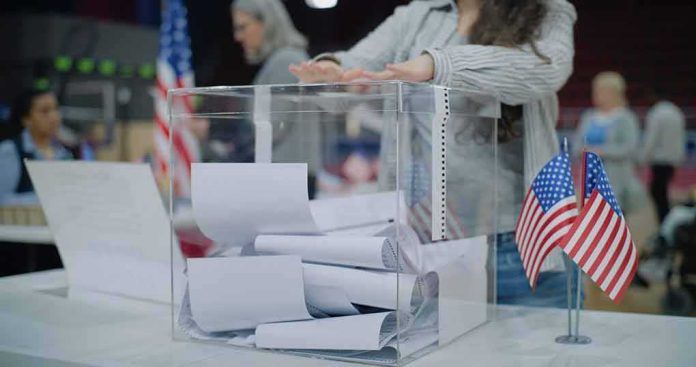
The core tension is simple and durable: election law treats polling places as intimidation-sensitive zones, while federal agencies insist they must still act on bona fide public-safety threats and targeted warrants—even if that action intersects with a voting site.
The Short Version
- DHS has said ICE does not conduct routine patrols at polling places and has no plans to station agents there.
- Secretary Markwayne Mullin framed any ICE presence as conditional: credible threats or preexisting targeted warrant service, not voter oversight.
- Civil-rights groups argue that sending armed federal agents to polls is illegal and inherently intimidating under federal and state law.
- The legal line is narrow and fact-dependent: targeted enforcement can be lawful; visible “presence” that chills voting risks violation.
What DHS actually said—and what it didn’t
Department of Homeland Security messaging has been consistent on a first principle: ICE will not be “stationed” at polling places and is not planning operations that target voting sites. The department has characterized ICE enforcement as intelligence-driven and target-specific, reserving only a narrow carve-out for situations in which an active public-safety threat endangers a polling location or when officers serve a preexisting warrant on a known target who happens to be there. In multiple interviews and summaries, Secretary Markwayne Mullin reiterated the point succinctly: “ICE isn’t there to patrol the polling places. We’re there to enforce specific threats.”
For election officials worried about a chilling effect, DHS also provided a categorical assurance earlier in the cycle—“There will be no ICE presence at polling locations”—a declarative line that easily translates to public guidance but leaves practical exceptions to be explained elsewhere. Later clarifications reintroduced the threat-and-warrant caveat, which is operationally sensible yet rhetorically messier: it assures the public there are no deployments to “the polls” while acknowledging that urgent law-enforcement work does not pause simply because a location is hosting voting.
The legal architecture around polling-place enforcement
American election law treats the physical space of voting as uniquely vulnerable to coercion. Two bedrock federal anchors define the boundary. First, 18 U.S.C. § 592—colloquially “troops at the polls”—has long barred stationing troops or “armed men” where an election is held, reflecting a Reconstruction-era consensus against martial or quasi-military presence at voting places. Second, Section 11(b) of the Voting Rights Act prohibits intimidation, threats, or coercion of voters; critically, courts can find a violation without proof of intent if the conduct reasonably produces an intimidating effect. Advocacy groups distill the doctrine bluntly: deploying armed federal agents to polling sites is unlawful and risks voter intimidation per se.
The enforcement community, in turn, points to uncontroversial premises: federal officers may execute a valid arrest warrant, interdict an imminent violent threat, or respond to exigent circumstances anywhere in the country, including near a polling place. DHS’s exception tracks that logic. The friction arises not from the underlying authority but from the election-specific overlay—laws and norms that limit how such authority is exercised when ballots are being cast. That is why many states’ election codes and professional guidance for prosecutors and election officials emphasize that law enforcement should not be “stationed” at the polls and should generally be called in by election authorities only to restore order or address discrete illegality. The design is to keep visible, armed presence out of the voting experience absent necessity.
Where the sides genuinely disagree
There is little dispute that routine patrols or deterrence-by-visibility are out of bounds. DHS disclaims them; rights groups oppose them. The disagreement lives in the details of the exception. Secretary Mullin’s formulation—credible threat response or targeted warrant on a tracked individual—fits traditional law-enforcement doctrine but raises three implementation questions that shape legality and public confidence: proximity, visibility, and predicate.
Proximity asks: does the action occur inside the polling place or within a perimeter that voters experience as part of the voting space? Visibility asks: are agents openly armed and identifiable in a manner that chills participation, even if they are not engaging voters? Predicate asks: is there a documented, preexisting basis—threat assessment, warrant, or ongoing casework—that explains why this enforcement action could not reasonably be conducted elsewhere or at another time? The advocacy position warns that, without transparent constraints on those factors, any asserted “targeted enforcement” can morph into impermissible presence that looks and feels like intimidation. DHS’s position, by contrast, assumes disciplined case selection and tight operational control to avoid those outcomes.
How we got here: a recurring election-security paradox
American elections have a long memory of law enforcement used—or perceived—as a lever of voter suppression, particularly against communities of color. That history explains why courts and administrators draw a bright line against “stationing” officers and why modern guidance urges minimal, on-call intervention. At the same time, election officials manage real risks: threats to poll workers, doxxing, sporadic violence, and rare but nonzero instances of criminal activity that overlap with voting sites. The system’s answer has been a narrow exception, not a blanket ban on responsive policing. That balance is fragile. It depends on planning documents, disciplined coordination with local election administrators, and after-action transparency—materials that are often law-enforcement sensitive and therefore hard to communicate publicly in real time.
In this environment, DHS’s categorical reassurance—no routine ICE presence—lands well as public messaging but immediately invites the follow-on: what happens when a target walks into a polling place? The department’s answer is operationally standard: if there is a credible threat or a pressing warrant service need, agents may act. What is missing from the public record are the implementing guardrails that election lawyers look for—written rules of engagement near polls, thresholds for deferring arrests, visibility protocols, and who must be notified and when. That documentation, even if summarized, is what converts a verbal exception into a lawful, confidence-preserving practice.
Practical guardrails that make the exception work
The law does not forbid federal agents from existing near a polling place; it forbids turning the voting experience into a police event. Experts who have worked both elections and public safety tend to converge on the same controls:
– Deferral default: execute warrants away from polling sites unless there is a concrete, articulable exigency or flight risk that cannot be managed otherwise. Document the rationale contemporaneously. – Invisible posture: if action near a poll is unavoidable, minimize overt displays—no long guns, minimal marked vehicles, discrete ingress/egress—and avoid lingering presence. – Election coordination: notify the chief election official or designated security lead when feasible, and never request voter rolls, ID checks, or any action that touches ballot administration. – Clear perimeters: define “at” versus “near” a polling place in feet and function, anchored to voter experience; prioritize staging areas outside the line of sight of queues and entrances. – After-action sunlight: maintain incident logs and release high-level summaries post-election to verify that the exception was rare, necessary, and tightly scoped.
None of these measures erodes valid law-enforcement authority; they discipline it for a uniquely sensitive civic moment. They also align with the statutory framework that punishes intimidation based on effect: if voters never experience the operation, the intimidation risk drops dramatically.
BREAKING 🚨: DHS Secretary Markwayne Mullin now says that ICE will be arresting people at polling places on election day.
Specifically:"ICE isn't there to patrol the polling places, we're there to enforce specific threats. The only reason why we would be at polling places if… pic.twitter.com/gKeb9kDIW5
— StandupSpeakOut (@StndupSpekup) September 2, 2026
Bottom line: targeted enforcement is lawful, routine presence is not
On the evidentiary record, the primary claim holds: DHS and Secretary Mullin disavow routine ICE patrols at polling places and allow only narrow, threat- or warrant-driven actions. Advocacy groups press a maximalist reading of the prohibitions, warning that any armed federal presence at the polls is illegal or chilling. The strongest reading of the law supports a middle path that has long governed election security: categorical bans on stationing agents at voting sites, coupled with a constrained, well-documented capacity to neutralize a genuine threat or execute a preexisting arrest—ideally somewhere else, and, if not, in a way voters do not see. The policy challenge ahead is not whether that exception exists; it does. It is whether DHS will publish enough operational guidance to prove it is used rarely, wisely, and far from the voter’s line of sight.
Sources:
youtube.com, politico.com, nbcnews.com, democracydocket.com, lawyer-monthly.com, brennancenter.org