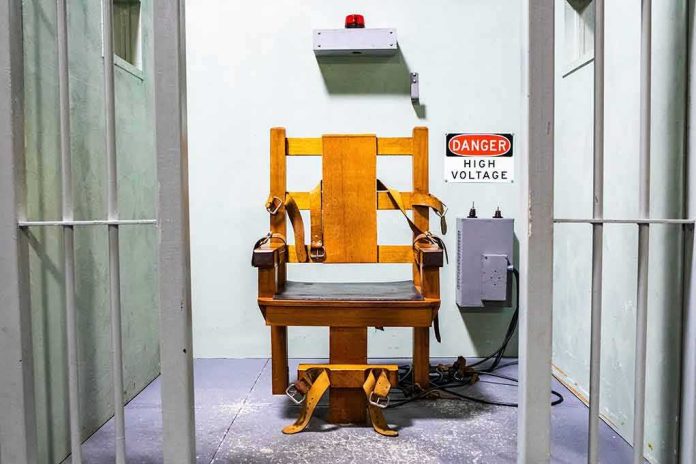
When an execution fails after two full doses of a barbiturate that ordinarily ends life within minutes, the problem is not a quirk; it is a systems failure built into how American lethal injection actually works—dependent on difficult IV access, tight-lipped protocols, and nonclinical execution teams navigating medical tasks without medicine’s safeguards.
The Short Version
- Multiple on-site witnesses reported Christa Pike was still breathing—audibly snoring—after two pentobarbital doses, and her attorneys filed an emergency motion while the execution was underway stating she had a heartbeat.
- State officials transported Pike to a hospital; her lawyers said she was in critical condition, and the governor halted executions for the remainder of the year and ordered a third-party review.
- The likeliest mechanism is IV failure—drug delivery outside the vein—long recognized as the signature vulnerability of lethal injection systems.
- The “botched execution” claim is well-supported by contemporaneous evidence; a definitive diagnosis of brain injury has not been established publicly.
What happened in the chamber—and why those details matter
According to journalists and official-counsel filings during the procedure, Pike remained alive after two lethal-injection doses, with witnesses describing continued breathing and audible snoring. Her legal team’s emergency motion, filed while the execution was ongoing, asserted she had a heartbeat and was snoring—observations consistent with a person who received sedatives without achieving the intended pharmacologic effect in the bloodstream. A federal judge noted that medical personnel began to administer care; Pike was then transported to a hospital, and her attorneys described her condition as critical. Tennessee’s governor subsequently paused remaining executions for the year and ordered an independent review, signaling recognition that the event was not a minor deviation but a breakdown warranting formal scrutiny.
Those facts support a clear conclusion: the execution attempt did not function as designed. In lethal injection, mechanism matters. Pentobarbital, used at high dose, is intended to induce profound unconsciousness, suppress respiration, and lead rapidly to death. When a person continues to breathe audibly long after administration, the most parsimonious explanation is delivery failure—drug not reaching the central circulation at effective concentration—rather than an implausible pharmacologic resistance. Contemporary expert commentary, grounded in decades of postmortem reviews of failed executions, points squarely to IV access problems as the leading cause of this failure mode.
The mechanism: why IV access is the Achilles’ heel
Lethal injection borrows the form of a medical infusion without its clinical redundancies. In a hospital, difficult venous access triggers ultrasound-guided placement, rapid escalation to central venous access, full monitoring, and trained anesthesia personnel who can recognize and correct extravasation (fluid leaking into tissue) in real time. In an execution chamber, medical ethics rules limit physician participation, staff work behind walls, and protocols are rigid—often prohibiting additional procedures once a sequence begins. If a catheter tip sits outside the vein or infiltrates after initial placement, the delivered barbiturate pools in muscle or subcutaneous fat; sedation may be partial, delayed, or absent, and the expected cardiopulmonary collapse does not occur. This is not theoretical: modern botched executions overwhelmingly trace back to failed IV placement or maintenance across multiple states and years.
Witness timelines describing repeated curtain closures, audible complaints about arm pain—“My arm feels like it’s about to burst”—and later snoring map onto classic infiltration signs: local burning, swelling, and pain during infusion followed by inadequate systemic effect. Experts retained in Pike’s matter offered that hypothesis immediately; it fits both pharmacology and the observable course better than any alternative explanation available in the public record.
The state’s position—and what it does and does not rebut
The Tennessee Department of Correction stated it followed every step of its approved protocol and emphasized that its lethal-injection chemical has been consistently effective. The department also said the protocol does not allow additional procedures beyond what was performed; Pike was then transported for off-site medical care. Those assertions explain the department’s adherence to process and its procedural ceiling, but they do not refute the observed clinical reality that the drugs did not achieve their intended effect that night. Process compliance is not outcome proof; if a protocol rigidly prevents corrective action when IV failure is suspected, adherence can coexist with failure.
By contrast, the governor’s pause and order for a third-party review do bear directly on the seriousness of the event. Governors do not halt a state’s executions for the year because of minor paperwork disputes; they do so when outcome-level failures occur, and causes must be mapped. That step is a practical acknowledgment that the system, as executed, did not work.
What the evidence demonstrates—and what remains unproven
The botched-execution claim is well supported. Multiple independent witnesses, an emergency-court filing, and the subsequent medical transport converge on the same picture: two doses were administered; Pike continued to breathe; the procedure failed to produce death as intended; emergency care followed; executions were paused statewide. That evidence set is qualitatively stronger than generic skepticism and stands without recourse to speculation.
By contrast, the more consequential medical allegation—that Pike suffered hypoxic brain injury—remains unproven in the public domain. Brain injury is a clinical diagnosis requiring neurologic examination, imaging, and laboratory data; none of those records have been publicly released. Snoring and prolonged breathing indicate airway patency and incomplete anesthetic effect; they do not quantify oxygenation or establish cerebral injury. Until toxicology, IV-site documentation, and hospital records are disclosed, brain injury is possible but not established. The center of gravity of the case is the failed execution, not a confirmed neurological outcome.
How we got here: the structural roots of recurring failure
Modern U.S. lethal injection was built on a medicalized aesthetic rather than medical practice. Drug shortages forced states to abandon the original three-drug sequence and adopt barbiturate-forward protocols reliant on compounded or tightly controlled supplies. Simultaneously, ethical barriers keep anesthesiologists at arm’s length, while secrecy laws and restrictive protocols limit transparency and adaptation. The predictable result is a method whose success turns on the hardest part of IV therapy—reliable vascular access—performed under nonclinical conditions with little capacity to troubleshoot. Nationally, analyses over decades have tallied dozens of botched executions, most tied to this IV-access problem and to protocol rigidity that prevents corrective steps when complications emerge.
Tennessee’s recent history reinforces the pattern. Earlier failed attempts in the state centered on vascular access difficulties, prompting calls from medical and legal communities to reform or suspend the protocol. Those warnings forecast precisely what Pike’s chamber exhibited: prolonged attempts at cannulation, complaints consistent with infiltration, then a pharmacologic nonresult.
Christa Pike survived two doses of pentobarbital during Tennessee’s September 30 execution attempt. Governor Bill Lee halted executions through the end of 2026 and ordered an independent review.
The attempt at Riverbend Maximum Security Institution in Nashville ended with an… pic.twitter.com/Fxa3EI0ixd
— HeyDay News (@heyday_news) October 2, 2026
What a credible review must answer
Accountability requires evidence, not platitudes. A meaningful third-party review will preserve and examine: execution-team logs; IV-placement records and site photographs; drug compounding and storage documentation; chain-of-custody for the pentobarbital lot; and the timing of all curtain closures, infusions, and medical interventions. Independent toxicology can establish whether pentobarbital reached therapeutic blood levels; forensic nursing review can determine whether the catheter infiltrated; hospital records can clarify clinical course and neurologic status. Without those disclosures, conclusions will remain litigated rather than resolved—an outcome no one should accept in matters of life and death.
The implications—legal, ethical, and operational
Operationally, the lesson is stark: any protocol that cannot rapidly detect and correct IV failure will fail again. Ethically, a state that stages a medical facsimile without medicine’s safeguards invites precisely the suffering the Eighth Amendment forbids. Legally, a documented survival after full dosing gives fresh traction to method-of-execution challenges by demonstrating a substantial risk of severe pain in practice, not abstraction. None of that depends on sympathy for the condemned; it depends on competence and constitutional duty. Until the review answers core questions—and reforms address the IV-access Achilles’ heel—confidence in lethal injection as a reliable, humane method is not warranted.
Sources:
theguardian.com, pbs.org, yahoo.com, cbsnews.com, wsmv.com, abcnews.com, cnn.com