
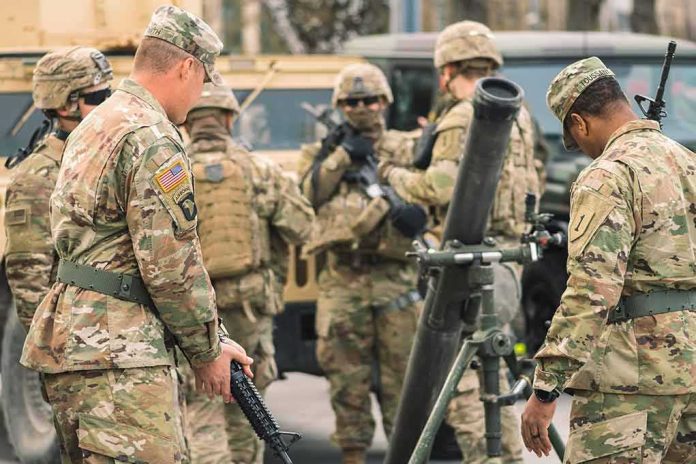
The 2027 “Davidson window” is not a countdown to war; it is a deadline for deterrence. U.S. Army Pacific has treated it that way—translating a capability warning into concrete posture, logistics, and readiness tasks designed to keep a fight over Taiwan from happening at all.
At a Glance
- U.S. Army Pacific’s commander affirmed that 2027 remains the planning benchmark for Taiwan-related readiness.
- The window is a readiness horizon, not a prediction that conflict will occur on a fixed date.
- USARPAC is executing “Army Ready Forward,” prepositioning equipment, materiel, and rotational forces across the first and second island chains.
- The command has set April 2, 2027, as the internal mark-on-the-wall for posture and preparedness tasks.
What the Army actually said and why it matters
Gen. Ronald Clark, who leads U.S. Army Pacific (USARPAC), was unambiguous when asked whether the so‑called Davidson window still guides the command’s planning. “The answer for us at USARPAC is yes.” That position does not forecast a war on a calendar; it anchors a theater-wide readiness push to a specific horizon. Clark has repeatedly clarified the distinction: 2027 is a line by which forces must be ready, not a date on which conflict is expected to ignite. The difference seems semantic until you translate it into tasks—stockpiles, transportation, access, and command-and-control that must exist in the right places at the right time. Those are the levers that make deterrence credible.
The benchmark’s pedigree matters because it explains why the Army treats 2027 as more than rhetoric. Adm. Philip Davidson told the Senate in 2021 that the People’s Republic of China could have the capability to seize Taiwan by force by 2027. That testimony—about potential capability, not assured intent—became a planning spur across the joint force and allied capitals. Clark’s endorsement of the timeline preserves that continuity, not as prophecy but as a forcing function for posture and procurement decisions that take years to mature.
From headline to hard tasks: “Army Ready Forward” and setting the theater
USARPAC’s program for translating a date into deterrent power is “Army Ready Forward.” In practical terms, that means prepositioning equipment and materiel, rotating units and enablers, and building the logistics sinew needed to surge combat power quickly along the first and second island chains—spanning key terrain from Japan’s southwest archipelago to the Philippines and beyond the International Date Line. These moves are not glamorous; they are the slow, necessary work of setting the theater—landing rights negotiated, fuel bladders emplaced, air defense launchers dispersed, munitions stored in accessible but survivable sites, and joint communications hardened against cyber and electronic attack. Clark has described April 2, 2027, as the “mark on the wall” by which those pieces must be in place.
Why April 2? Readiness is perishable and logistics slow-rolls by default; a crisp date disciplines staff work, budgets, and allied coordination. It also creates a measurable standard for internal assessment: Are the stocks forward? Are sealift and airlift lanes rehearsed? Can multidomain task forces move, shoot, and communicate in contested electromagnetic conditions? The point is not simply to deploy more things farther west; it is to make the first days of any crisis inhospitable for coercion by presenting ready, integrated kill chains and resilient sustainment.
The origin and the translation problem: capability versus intent
The Davidson window began as a capability estimate, and capability is not intent. The public record supports that separation: even as U.S. planners hold to 2027 as a readiness horizon, reporting has reflected official assessments that a Chinese invasion before 2028 is increasingly unlikely—consistent with the idea that Xi Jinping has directed his military to be ready by 2027, not to attack by 2027. That is the planning dilemma in miniature; the military must hit a deadline so national leaders have options, even as the adversary’s decision calculus remains opaque and dynamic. The Army’s framing keeps those lanes clear: prepare for the most dangerous case; deter so it never materializes.
This matters for how the public hears the message. Headlines compress nuance; “be ready by 2027” can read as “war next year.” Clark’s formulation avoids that trap. It also constrains the reputational risk that comes with date-driven signaling: if no conflict occurs by 2027, the standard was still valid because it pulled posture and readiness forward—outcomes that improve deterrence in any year.
What readiness means in practice across the island chains
In the Western Pacific, speed and dispersion are survival. Setting the theater means pushing the Army’s enabling core—air and missile defense, long-range fires, engineers, logistics, networked command posts—closer to likely problem-sets while rehearsing the connective tissue with allies. Prepositioned materiel sets reduce strategic lift demand and compress timelines. Rotational presence distributes risk and normalizes access. The aim is a lattice of sites that can receive follow-on forces rapidly, sustain them under missile and cyber pressure, and integrate with joint and allied sensors and shooters across vast distances.
That lattice is already visible in allied exercises that stress maritime denial, air defense, logistics under fire, and cross-border command integration. While exercises are not war plans, they are where interoperability is earned and bottlenecks surface. In a Taiwan contingency, minutes matter; the theater either functions as a networked whole or it buckles under initial pressure. “Ready forward” posture buys time and options for national leaders by complicating any adversary’s opening moves.
Why the Army’s role is central in a maritime fight
A Taiwan scenario is often framed as a naval and air contest across 80 miles of strait, but the Army’s theater role is pivotal. Land-based anti-ship and air-defense fires thicken maritime denial. Engineers and logisticians keep austere airfields and ports operating. Communications and electronic-warfare teams harden the electromagnetic spectrum. Medical, maintenance, and munitions pipelines determine whether joint forces can sustain combat power beyond the first salvos. The Army’s multidomain task forces, designed to knit cyber, space, electronic warfare, and long-range precision fires, are tailored for exactly this environment—where geography favors dispersed land nodes that feed joint kill webs rather than single-point behemoths.
Equally, the Army is the alliance’s connective tissue. Interoperability with Japan, the Philippines, Australia, and Taiwan is not a bumper sticker; it is shared targeting data formats, compatible logistics codes, and rehearsed authorities for cross-border support. Clark’s emphasis on setting the theater aligns with the allies’ own forward-leaning posture decisions, increasing the credibility of combined deterrence even as each capital calibrates its political risk.
What to watch between now and 2027
Three indicators will reveal whether the 2027 benchmark is doing its job. First, material posture: where equipment and munitions actually sit along the first and second island chains, and whether dispersion and hardening keep pace with adversary missile accuracy. Second, movement timelines: how fast rotational forces close on forward sites in exercises, and how often those movements are contested in the cyber and electromagnetic domains. Third, allied integration: not just symbolic participation, but shared concepts of operation, interoperable networks, and complementary investments that close gaps rather than duplicate strengths.
One brief caveat belongs here only because the Army itself makes it: 2027 is a readiness horizon, not a forecast of war. The practical consequence is clear. If deterrence holds because posture matured on time, the benchmark will have succeeded by preventing the very outcome that motivated it. If deterrence is tested, the same posture buys time, resilience, and choices. That is the quiet logic of Clark’s answer—confidence without bravado, urgency without alarmism.
Sources:
breakingdefense.com, rti.org.tw, taipeitimes.com, yahoo.com, defenseone.com