
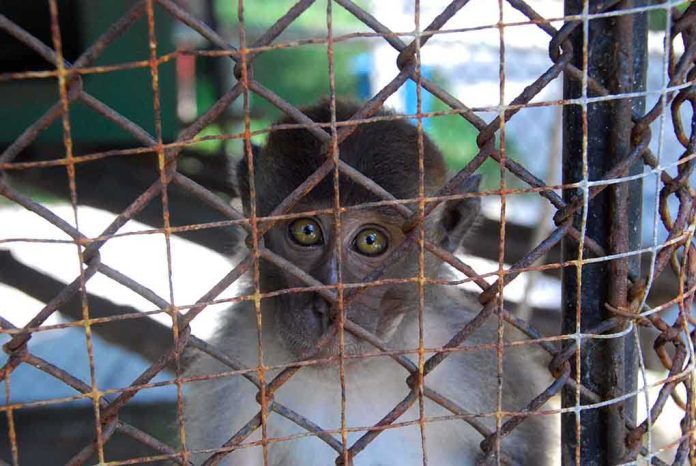
American taxpayers are funding secretive military primate laboratories across three countries where hundreds of monkeys endure surgical mutilation, sleep deprivation, and deadly infections—and the Pentagon refuses to reveal what happens behind closed doors.
Story Snapshot
- White Coat Waste filed a federal lawsuit against the Department of Defense to expose records from covert primate labs in Thailand, Peru, and the United States
- The Pentagon spends an estimated $30–35 million annually on a single Thailand facility housing 550 monkeys subjected to experiments without pain relief
- DOD ignored repeated 2025 FOIA requests for photos, videos, and documentation of experiments involving malaria, Zika, dengue, and bioweapons testing
- The lawsuit contrasts with recent Pentagon reforms ending dog and cat testing, demanding similar action for primates
- Pentagon paid disgraced breeder Envigo over half a million dollars to ship 18 monkeys to Thailand while expanding operations with marmoset purchases
Hidden Labs Operating Beyond Public Scrutiny
The Walter Reed Army Institute of Research partnered with Thailand’s Royal Thai Army in 1980 to establish what became the DOD’s largest primate colony. WRAIR-AFRIMS breeds 30 to 45 rhesus and cynomolgus macaques annually, maintaining a population of approximately 550 monkeys in a facility funded through Pentagon appropriations, DOD contracts, and National Institutes of Health awards. White Coat Waste discovered these operations cost American taxpayers between $30 and $35 million each year, yet the military refuses to disclose basic information about procedures, outcomes, or animal welfare standards applied overseas.
Fort Detrick in Maryland and the Uniformed Services University compound the problem domestically. These U.S.-based facilities test bioweapons and Ebola on hundreds of primates, with internal documents confirming experiments proceed without administering pain relief. The Peru Navy operates another military primate lab targeting at-risk monkey populations, adding international complications to oversight efforts. These facilities operate with minimal transparency despite consuming substantial public resources, shielded by national security classifications and geographic distance from American voters.
Federal Law Violated, Records Withheld
White Coat Waste submitted Freedom of Information Act requests between June and December 2025 targeting documentation from all four military primate facilities. The organization sought photographs, videos, experimental protocols, and animal welfare records to illuminate what taxpayer dollars fund in these shadowy operations. The Department of Defense violated federal transparency law by failing to respond within statutory deadlines, prompting WCW to file suit on March 26, 2026. The lawsuit specifically demands disclosure of materials showing monkeys fed to mosquitoes, force-fed experimental drugs, and deliberately infected with tropical diseases including typhus, shigella, and SHIV.
Taxpayer Dollars Funding Controversial Breeders
Documents reveal the Pentagon paid Envigo $568,510 in 2025 to transport just 18 monkeys to the Thailand facility. Envigo operates as a disgraced animal breeder with documented violations, yet continues receiving lucrative government contracts. The Army simultaneously purchased marmosets and specialized caging equipment, signaling expansion plans despite internal reports noting strain on existing colonies. These expenditures occurred while the Pentagon claimed budget constraints elsewhere, raising questions about spending priorities. The contrast between eliminating dog and cat testing programs while expanding primate operations under Defense Secretary Pete Hegseth exposes inconsistent animal welfare standards within military research.
Pattern of Secrecy in Primate Research
This lawsuit follows established patterns where government-funded primate facilities operate beyond meaningful public accountability. A 2014 Animal Legal Defense Fund suit challenged Hendry County, Florida, for secretly approving a breeding facility housing 3,200 macaques without proper public notice, citing disease transmission risks including Ebola and Herpes B virus. Oregon’s primate research center accumulated violations through 2020, including macaque deaths from neglect documented by USDA inspectors. These precedents demonstrate systemic transparency failures across primate research infrastructure, whether military or civilian-operated. White Coat Waste previously succeeded in ending DOD experiments on dogs and cats through public pressure campaigns, proving exposure drives reform.
Reform Demands Gain Momentum
White Coat Waste frames the lawsuit as extending recent Pentagon animal welfare improvements to primates excluded from prior reforms. Secretary Hegseth earned credit for discontinuing dog and cat testing programs, establishing precedent for eliminating scientifically questionable animal experiments consuming taxpayer resources. WCW argues the same logic applies to primate facilities conducting outdated infectious disease research when modern alternatives exist. The organization characterizes military monkey labs as simultaneously wasteful and cruel, demanding the Pentagon “crack down on this monkey business.” Short-term, the lawsuit may force record releases exposing experimental details that shock taxpayers. Long-term implications include potential facility closures, budget redirections, and adoption of non-animal research methods already proving effective in civilian biomedical research.
The financial burden extends beyond direct operational costs. Taxpayers fund international collaborations complicating oversight, breeder contracts enriching companies with troubled records, and expansion projects increasing animal numbers rather than reducing reliance on primate testing. Thai and Peruvian communities near these facilities face potential disease exposure risks from labs handling infectious pathogens, yet have minimal input on operations their governments host for American military interests. Animal welfare advocates view the lawsuit as essential accountability for programs operating in secrecy while spending tens of millions annually. The Pentagon’s silence on repeated FOIA requests suggests officials recognize the public relations nightmare detailed disclosures would create, making litigation the only viable path to transparency.
Sources:
Lawsuit: WCW Sues Over Secretive US Military Monkey Labs in Thailand, Peru, and U.S.
Primate Research Center in Oregon Leads Nation in Violations