
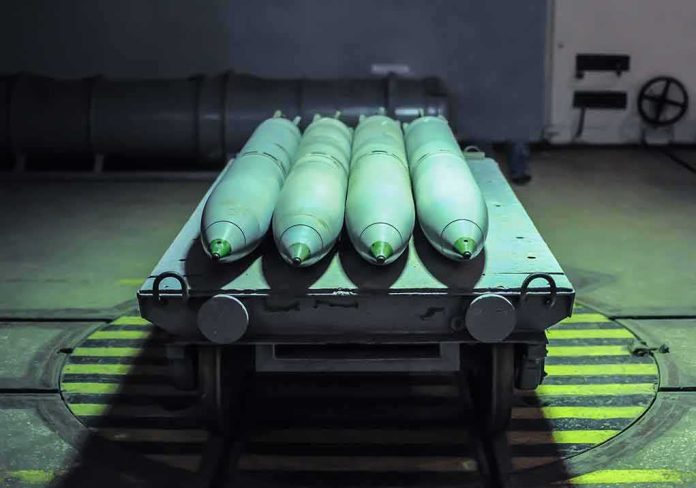
When energetic materials age into instability, the safest engineering response can look like the dirtiest one: a controlled demolition that eliminates the explosion hazard but creates visible environmental risk. The Iowa lead azide dispute sits squarely in that tradeoff, and the court-ordered pause is less a repudiation of the hazard than a demand for fuller proof that the chosen remedy is the least-dangerous way out.
At a Glance
- Army records identify roughly 9,700 pounds of degraded, crystallized lead azide—an extremely sensitive primary explosive—as the hazard to be removed.
- Justice Department filings framed a controlled, phased “blow-in-place” detonation as necessary to avert an uncontrolled explosion as temperatures fell.
- EPA issued an emergency permit with testing and cleanup requirements; an appellate court then froze that permit amid legal challenge.
- Environmental groups argue the detonation risks dispersing toxic lead dust over communities and that safer alternatives were not adequately vetted.
What the Army says is on the ground—and why that matters
The technical core is uncontested: the Iowa Army Ammunition Plant found 68 drums—about 9,700 pounds—of lead azide that has degraded and crystallized. Lead azide is a primary explosive; it initiates with friction, shock, or static, and crystallization increases sensitivity. In March 2026, during a safety review, the stockpile was flagged as unstable enough to require disposal planning. The Army’s environmental assessment documents that finding and evaluates intentional detonation among disposal alternatives. In parallel, the Department of Justice told the Eighth Circuit that the condition and quantity of material posed an immediate threat of uncontrolled initiation, particularly as seasonal temperatures dropped—a thermal-stress argument common in aging energetic materials management.
Quantity and configuration are not trivia in explosives safety; they are the hazard. Drum-scale lots of crystalline primary explosive present two problems: any handling increases initiation risk, and propagating detonation can escalate quickly if units are co-located. That is why options that look gentler to the environment—moving drums offsite or opening them for chemical neutralization—may be mechanically riskier to the humans performing the task and to the surrounding community if something goes wrong mid-operation. DOJ filings place the inventory in two magazines and describe a plan to act on a compressed timeline; whether temperature alone accelerated risk is not independently corroborated in public records, but the stated emergency posture is clear.
How the proposed operation would work—and the safeguards promised
EPA Region 7 issued an emergency permit authorizing treatment by intentional detonation, paired with post-blast obligations: air and soil testing, perimeter monitoring, and cleanup of contaminated areas if sampling triggers were met. This is a familiar emergency-waste framework under hazardous-waste law: contain the acute hazard, then remediate residues predictably rather than gamble on an unplanned event. The Army’s assessment casts the choice as minimizing handling of the most sensitive material; a phased blow-in-place would use donor charges to initiate the drums where they sit, inside magazines, with engineered standoff and sequence controls. On paper, the method shortens exposure time and removes the explosive inventory in one deliberate window, after which environmental sampling and cleanup are tractable tasks.
Two caveats complicate that narrative. First, the public record released to date does not include the quantitative risk calculations—blast modeling, transport hazard comparisons, failure probabilities—that usually anchor such a decision. Second, while the permit requires post-detonation testing, it cannot guarantee that airborne lead concentrations and deposition patterns will stay within modeled contours; it only promises to measure and clean after the fact. For nearby communities, that is precisely the concern.
Why the court stepped in—and what that does and doesn’t mean
After environmental groups petitioned for review, the Eighth Circuit issued an administrative stay of the EPA emergency permit. That stay halts reliance on the EPA authorization while the court examines the challenge; it does not establish that the hazard is illusory or that detonation is per se unlawful. The government then told the court the Army could proceed under a different emergency authority—the Resource Conservation and Recovery Act’s emergency exclusion for immediate endangerment—an assertion that, while legally colorable, introduces a procedural wrinkle: does the alternate pathway ensure equivalent health-protective safeguards and fact-finding prerequisites? The filings on that point are thin in public view, which is why the stay amplified scrutiny of process rather than nullifying the hazard itself.
From a risk-governance lens, appellate intervention is doing what courts often do in emergency environmental disputes: forcing agencies to show their work. If the technical case is as strong as asserted, producing the alternatives matrix, peer reviews, and dispersion modeling will strengthen, not weaken, the Army’s position.
The countercase: exposure pathways and the burden of proof
Environmental groups have advanced a straightforward exposure argument. Detonating lead-containing explosive will aerosolize fine particles; some fraction will travel offsite and settle on soils, gardens, play areas, and waterways. Lead does not biodegrade, so deposition creates a long-lived exposure pathway, particularly for children and grazing livestock. They also argue that newer neutralization technologies exist and that the Army and EPA did not adequately demonstrate that transportation or chemical treatment could not be made comparably safe. Finally, they fault limited notice and independent scrutiny for a high-consequence decision affecting communities in Iowa and potentially western Illinois, as suggested by plume modeling noted in coverage.
These are legitimate questions to press in public and in court. Yet their rhetorical strength should not be mistaken for dispositive proof that detonation is the wrong choice. The decisive issue is comparative risk—how the probability and consequence of catastrophic initiation during handling or transport stack up against modeled concentrations from controlled demolition, plus the certainty of post-blast cleanup. That is a quantitative, engineering judgment. The currently public documents gesture at that calculus but do not expose it in the detail needed to settle the dispute.
Per Grok:
"No, it is not taking place tomorrow (Monday, November 23).XAs of the latest official update from the U.S. Army (posted late on November 22/early November 23), the controlled detonation of the degraded lead azide at the Iowa Army Ammunition Plant in Middletown has…
— Mike Miller (@Mike___Miller_) November 23, 2026
How to evaluate the competing risks like an explosives-safety professional
Professionals resolve these cases by ranking options across four axes: (1) initiation sensitivity in current condition; (2) hazard added by required human interaction (opening drums, repackaging, loading for transport); (3) controllability of the energetic event (unplanned versus deliberately staged with standoff and barriers); and (4) environmental consequence and reversibility. With crystallized primary explosive in large quantity, the norm is to minimize movement and manipulation, then trade a planned, bounded release with immediate verification and remediation for the uncertainty of a potential mass-detonation incident. That does not trivialize lead dispersion; it foregrounds the one variable you cannot fix after the fact—a crater where your risk assessment used to be. The Army’s assessment and DOJ filings are consistent with that doctrine, though the absence of publicly released calculations weakens confidence rather than the underlying logic.
What would resolve this dispute responsibly
Transparency can convert distrust into consent for an unpleasant necessity. The Army should release the full environmental assessment and technical appendices: the alternatives matrix, dispersion model inputs and outputs, meteorological assumptions, particle-size distributions, uncertainty bounds, and monitoring and cleanup triggers. It should also publish the basis for the temperature-sensitivity alarm—inspection records, crystallization assessments, and any laboratory characterizations—along with a plain-language summary by an independent explosives-safety panel. Finally, if proceeding under an emergency exclusion rather than the stayed EPA permit, the agencies should map, side-by-side, the safeguards each pathway requires so communities can see that health protections travel with the authority, not the paperwork.
Bottom line
The court’s freeze does not erase the hazard inside those magazines; it demands proof that the chosen remedy is the least-worst option. The Army’s narrative—large quantities of crystallized primary explosive, minimized handling, planned demolition, then cleanup—tracks standard practice. The public countercase—don’t disperse lead unless you must, and show us the math—tracks common sense. The fastest path to a defensible decision is the one that brings the full technical record into daylight and lets independent expertise test it.
Sources:
zerohedge.com, abc7chicago.com, chicago.suntimes.com, nbcchicago.com, nbcdfw.com, d34w7g4gy10iej.cloudfront.net, desmoinesregister.com