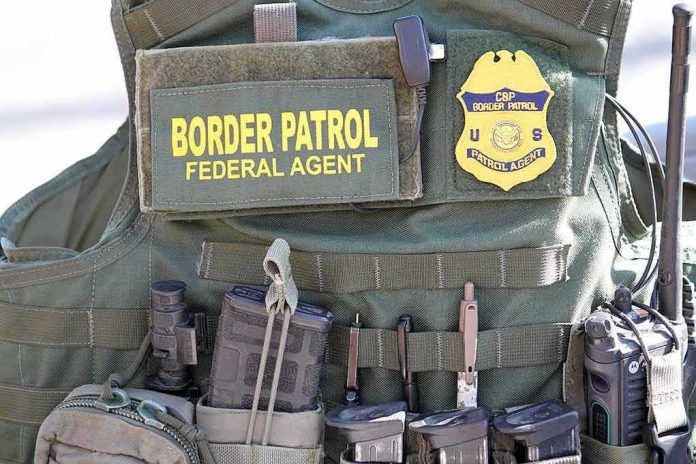
A border-security supervisor is now accused of breaking the very immigration laws he was paid to enforce—by allegedly sheltering an illegal alien and her child inside his own home.
Quick Take
- Federal prosecutors say a CBP supervisor named Wilkinson was arrested after investigators learned an illegal alien and her child were living at his residence without legal authorization.
- The allegation centers on “harboring,” a serious immigration-related offense that targets people who conceal or shield illegal aliens from detection.
- The case was announced by the U.S. Attorney’s Office for the Southern District of Texas, based on a criminal complaint that has been unsealed.
- Officials have not publicly provided key details such as the exact dates, a full timeline, or the suspect’s years of service; the “lover” characterization is not confirmed in the DOJ material provided.
What the DOJ Says Happened in South Texas
Federal prosecutors in the Southern District of Texas report that law enforcement “learned that an illegal alien was residing at Wilkinson’s residence without legal authorization,” leading to the arrest of a U.S. Customs and Border Protection supervisor. The allegation, as summarized in the DOJ announcement, is that Wilkinson harbored the illegal alien and her child at his home. The underlying criminal complaint has been unsealed, but the public release does not include a detailed timeline or trial schedule.
The government’s public description is narrow and careful: it focuses on the fact of unauthorized residence and the charge, not sensational claims. That matters because much of the viral coverage adds details—like a romantic relationship or a “25-year” career—that are not spelled out in the DOJ release provided. Conservatives should separate what is confirmed (the arrest and alleged harboring) from what remains unverified until court filings or sworn testimony establish it.
Why “Harboring” by an Insider Hits Harder Than a Typical Case
Harboring cases often involve smugglers, stash houses, or employers hiding workers. This case is different because the accused is a supervisor inside CBP—an agency tasked with enforcing border and immigration laws. When alleged misconduct comes from within the enforcement ranks, it creates two problems at once: it undermines public confidence that the rules are applied evenly, and it risks compromising operations in border regions where trust and integrity are critical to stopping illegal entry and trafficking networks.
The DOJ release does not claim Wilkinson used official systems, uniforms, or agency resources to facilitate the alleged harboring. Even so, the optics are unavoidable: an enforcement official is accused of providing shelter to someone without legal authorization. For Americans who watched the last decade of chaotic border messaging and inconsistent enforcement, the case reinforces a basic point—law matters, and enforcement credibility collapses when insiders appear to play by a different set of rules than ordinary citizens.
How This Fits the Broader Immigration Enforcement Picture in Texas
The Southern District of Texas is one of the country’s busiest zones for immigration enforcement, and the allegation arrives amid wider federal prosecution activity across the state. In a separate announcement, the U.S. Attorney’s Office for the Western District of Texas reported filing 255 new immigration cases, highlighting a steady pipeline of prosecutions tied to smuggling and repeat offenders. That broader context suggests prosecutors are trying to show sustained enforcement across multiple districts, not just isolated headline cases.
Still, the public record available here is limited. The Southern District release does not provide specifics on how investigators discovered the alleged unauthorized residency, whether there were prior warnings, or what internal CBP safeguards were triggered. Likewise, it does not describe any broader corruption network or additional suspects. At this stage, the strongest verified facts are simply the arrest, the nature of the allegation, and the location and prosecuting office handling the matter.
What Comes Next—and What We Still Don’t Know
Because the case is based on a criminal complaint, the next steps typically involve initial court proceedings where charges are presented, counsel is appointed or retained, and detention conditions are argued. The DOJ announcement does not state a plea, trial date, or final outcome, so readers should assume the process is ongoing. If further filings become public, they may clarify timelines, the defendant’s tenure, and whether any personal relationship claims are supported by evidence.
For a country trying to reestablish border integrity in 2026, the principle is straightforward: immigration law must be enforced consistently, and government personnel should be held to at least the same standard as everyone else—if not higher. At the same time, the public should demand discipline in reporting: confirmed facts from court documents and prosecutors’ statements should drive conclusions, not viral narratives that outpace what the evidence currently shows.
Sources:
Customs and Border Protection Supervisor Arrested for Harboring Illegal Alien
Western District Texas federal prosecutors file 255 new immigration cases