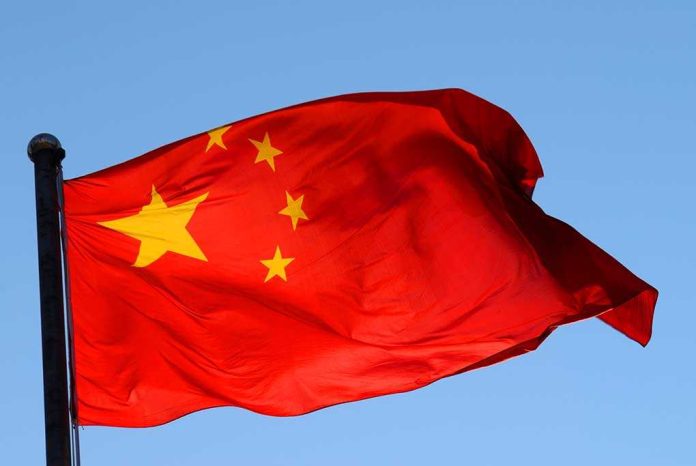
Philadelphia raised the flag of a foreign adversary—the Chinese Communist Party—above City Hall, sparking a storm of debate over national loyalty, international diplomacy, and the true cost of “friendship” with an authoritarian regime.
Story Snapshot
- Philadelphia hoisted the CCP flag to mark the 76th anniversary of the People’s Republic of China, despite protests from Congress and human rights groups.
- This is the third time the city has raised the Chinese flag, citing its 45-year sister-city relationship with Tianjin.
- Critics, including a Congressional committee chair, argue the gesture legitimizes a regime accused of human rights abuses and adversarial actions against U.S. interests.
- The event unfolded against a backdrop of heightened U.S.-China tensions, including military maneuvers near Taiwan and allegations of CCP-linked fentanyl trafficking.
- Local reactions are sharply divided, with some seeing cultural diplomacy and others a betrayal of American values.
Why Philadelphia Raised the CCP Flag
Philadelphia’s City Hall became the unlikely stage for a diplomatic controversy when officials raised the Chinese national flag—the Five-Star Red Flag, synonymous with CCP rule—to celebrate the founding of the People’s Republic of China. The city government, led by Mayor Cherelle Parker, framed the event as a gesture of international goodwill, rooted in Philadelphia’s longstanding sister-city relationship with Tianjin. The ceremony included a delegation from Tianjin and local cultural performances, emphasizing the ties between the two cities. But critics quickly pointed out that this was not just about cultural exchange—it was a symbolic embrace of a regime the U.S. government has repeatedly labeled a strategic competitor and, in some cases, an adversary.
The flag-raising was not a spontaneous decision. It followed a celebration marking 45 years of the Philadelphia-Tianjin sister-city relationship, complete with official delegations and cultural exchanges. Such relationships are common across American cities, often seen as bridges for trade, education, and mutual understanding. However, in an era of heightened geopolitical tension, these sister-city ties have come under scrutiny for their potential use as vehicles for foreign influence. Critics argue that the CCP exploits these connections to normalize its presence and messaging in American civic life, a concern amplified by recent Chinese military actions near Taiwan and allegations of CCP-linked criminal networks operating in the U.S.
Who Opposed the Flag-Raising—And Why
Opposition to the event was swift and vocal. Rep. John Moolenaar (R-Mich.), chair of the House Select Committee on the CCP, sent an open letter to Mayor Parker, urging her to cancel the ceremony. Moolenaar’s letter cited the CCP’s human rights record, its aggressive military posturing, and alleged links to fentanyl trafficking and United Front influence operations in North America. He warned that raising the flag risked legitimizing a regime that suppresses dissent, persecutes religious minorities, and challenges U.S. interests globally. Human rights advocates, including Rushan Abbas of the Campaign for Uyghurs and Victoria Coates of the Heritage Foundation, echoed these concerns, calling the event a betrayal of American values and a platform for authoritarian propaganda.
Local Chinese-American and diaspora groups were divided. Some saw the ceremony as a harmless cultural celebration, while others expressed discomfort at the overt political symbolism of the CCP flag flying over a U.S. city hall. The event’s timing—during a period of strained U.S.-China relations—only intensified the controversy. Critics questioned why Philadelphia would choose to honor a foreign government at a moment when federal officials are raising alarms about CCP influence operations and the risks of economic and technological decoupling.
The Bigger Picture: Sister Cities and Soft Power
Sister-city programs have long been touted as tools for grassroots diplomacy, fostering people-to-people connections that transcend government tensions. Philadelphia’s relationship with Tianjin, established in 1980, has included exchanges in education, business, and culture. But in recent years, these programs have faced growing skepticism. Analysts point to the CCP’s United Front Work Department, which actively cultivates overseas Chinese communities and local government ties to advance Beijing’s interests. Critics argue that sister-city relationships can be co-opted for propaganda, espionage, or economic leverage, especially when one partner is an authoritarian state with global ambitions.
The Philadelphia flag-raising is not an isolated incident. Other U.S. cities, including Washington, D.C., have hosted Chinese delegations and raised foreign flags as part of cultural exchanges. But the current geopolitical climate has shifted public and political attitudes. Where such gestures were once seen as benign, they are now viewed through the lens of national security and ideological competition. The event has prompted calls for greater transparency and oversight of local government engagements with foreign entities, particularly those linked to adversarial regimes.
What Happens Next?
Philadelphia officials have not indicated any plans to reverse course or apologize for the flag-raising. The ceremony proceeded as scheduled, despite the outcry. This defiance has only deepened the debate over the appropriate boundaries of local diplomacy and the responsibilities of city governments in an era of great-power rivalry. Human rights groups are using the moment to amplify awareness of CCP abuses, while some in the Chinese-American community are grappling with the political implications of the event.
The controversy may lead other U.S. cities to reevaluate their sister-city relationships and foreign flag ceremonies, especially with countries under scrutiny for human rights violations or adversarial actions. At the federal level, lawmakers are likely to increase pressure on local governments to align their international engagements with national security priorities. For Philadelphia residents, the episode has laid bare divisions over identity, loyalty, and the meaning of civic space in a globalized—and increasingly polarized—world.
Expert Perspectives and Common Sense
Victoria Coates of the Heritage Foundation argues that events like Philadelphia’s flag-raising undermine American values and embolden CCP propaganda. She urges citizens to reject efforts to normalize symbols of authoritarianism in public life. Rushan Abbas of the Campaign for Uyghurs condemns the use of U.S. civic spaces to amplify the messaging of a regime accused of genocide and mass surveillance. These views reflect a growing consensus among national security experts and conservative commentators that local governments must exercise greater caution in their international partnerships.
At the same time, some local officials and community members maintain that cultural exchange and international friendship are worth preserving, even in fraught times. They argue that sister-city programs can build bridges of understanding and create economic opportunities. But the burden of proof has shifted. In the current climate, the onus is on city leaders to demonstrate that such engagements are transparent, reciprocal, and free from coercion or propaganda. The Philadelphia controversy is a case study in the tension between local autonomy and national interest—a tension that is likely to intensify as U.S.-China relations remain strained.
Sources:
The Daily Signal: Philadelphia Flies Flag of ‘Foreign Adversary’
The Bureau News: Congressional Chairman Demands Philadelphia Cancel CCP Flag-Raising
AsAmNews: Philadelphia CCP Flag Immigrant Affairs Event Controversy