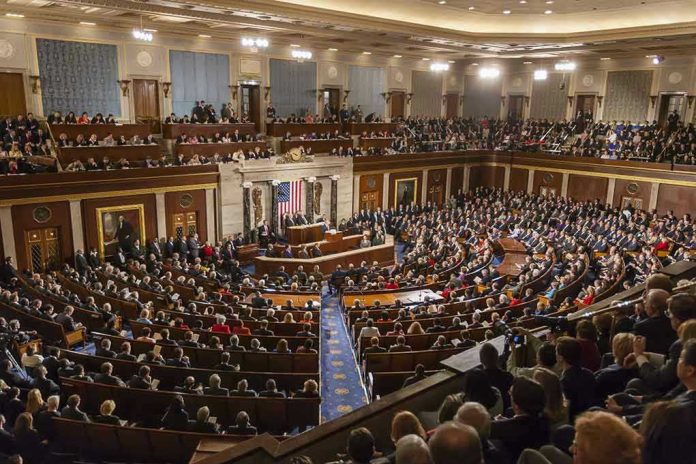
Chaos in Congress erupted as lawmakers clashed over a moment of silence for Charlie Kirk—a stark example of rising political hostility threatening both public safety and free speech.
Story Snapshot
- Speaker Mike Johnson’s call for a moment of silence after Charlie Kirk’s assassination ignited a shouting match in the House.
- National debate intensifies over political violence, security for conservative figures, and the state of civil discourse.
- Law enforcement continues a manhunt for the shooter as security policies for public and campus events come under review.
- Bipartisan condemnation of the attack contrasts with deepening partisan divisions and concerns over erosion of American values.
Political Violence Targets Conservative Voices in Public Spaces
Well-known conservative activist Charlie Kirk was shot and killed during a public debate at Utah Valley University. Kirk, founder of Turning Point USA, was a prominent advocate for conservative values and campus free speech, making his assassination a chilling blow not just to his organization but to the broader movement defending traditional American principles. The attack occurred during a “Prove Me Wrong” debate—an event format intended to encourage dialogue, but often attracting controversy and heated protest, particularly from those who oppose conservative viewpoints. Kirk’s death has shaken families, students, and activists nationwide, reigniting serious concerns about the safety of public figures and the future of open discourse.
Within hours of the tragedy, President Trump issued a statement mourning Kirk, highlighting his legacy as a champion for youth and American ideals. Speaker of the House Mike Johnson led Congress in a moment of silence, but the gesture quickly devolved into chaos as lawmakers began shouting in protest. The breakdown of decorum on the House floor exposed deep partisan rifts and underscored the rising hostility toward conservative voices. While both Republican and Democratic leaders condemned the violence, the fracas served as a jarring reminder that the country’s political polarization now extends even into symbolic acts of mourning. As the House chamber descended into shouting, Americans witnessed firsthand the erosion of civil debate and mutual respect—cornerstones of a free society.
Security, Free Speech, and the Chilling Effect on Conservative Advocacy
Law enforcement agencies responded swiftly, launching a manhunt for the shooter and locking down the university campus. Two individuals initially detained were released after being cleared of involvement, while the investigation pressed forward. The attack has prompted urgent discussions in Congress and on campuses about how to protect conservative speakers and ensure the safety of public events. Heightened security measures are now under review, but many fear these responses may inadvertently restrict the very freedoms—such as assembly and expression—that activists like Kirk fought to defend. The chilling effect is real: universities and event organizers are reassessing their willingness to host controversial speakers, while conservative students and advocates face renewed threats to their participation in open debate. For a movement already wary of leftist overreach and perceived bias in higher education, these developments raise alarm over the future of free speech in America.
Experts in political science and campus safety stress the importance of bipartisan condemnation of violence and caution against policies that might inadvertently stifle legitimate speech or dissent. Security analysts highlight the growing risk to public figures and call for sensible, targeted protections that do not undermine constitutional rights. Still, many conservatives see the attack as the predictable outcome of years of escalating rhetoric, biased campus policies, and a culture increasingly hostile to traditional values. The tragic loss of Kirk is galvanizing calls for renewed vigilance in defending not just physical safety, but also the fundamental freedoms enshrined in the Constitution.
Broader Impact: American Values, Policy Responses, and a Divided Nation
The aftermath of the Kirk assassination is reverberating across political, social, and educational spheres. Lawmakers are debating new security protocols for public officials and campus events, while activists warn against measures that could further erode rights or invite government overreach. The incident has sparked a national outpouring of grief, with flags at half-staff and tributes from across the political spectrum. Yet, the bitter disputes in Congress—and the online firestorm—underscore just how sharp the divisions remain. For conservative Americans, the episode serves as both a warning and a rallying cry: political violence and breakdowns in civil discourse threaten not only individual safety but the very fabric of the nation. As investigations continue and the country mourns, the challenge ahead lies in protecting both security and liberty, ensuring that no American—regardless of political persuasion—faces violence for exercising their rights.
Some House members shout in protest during prayers for Charlie Kirk as moment of silence sparks chaos https://t.co/tJY7cdtlkD
— American Patriot (@BuyMoreAmmo1776) September 11, 2025
Limited data is available regarding the ongoing manhunt and the shooter’s motives, but the central facts remain clear and corroborated by major news outlets and official statements. The nation watches as law enforcement pursues justice, and as leaders—especially those committed to conservative values—call for unity, vigilance, and the defense of constitutionally protected freedoms.
Sources:
Trump, Vance, lawmakers react to shooting of Charlie Kirk at Utah campus
Charlie Kirk shot and killed at Utah Valley University, House holds moment of silence