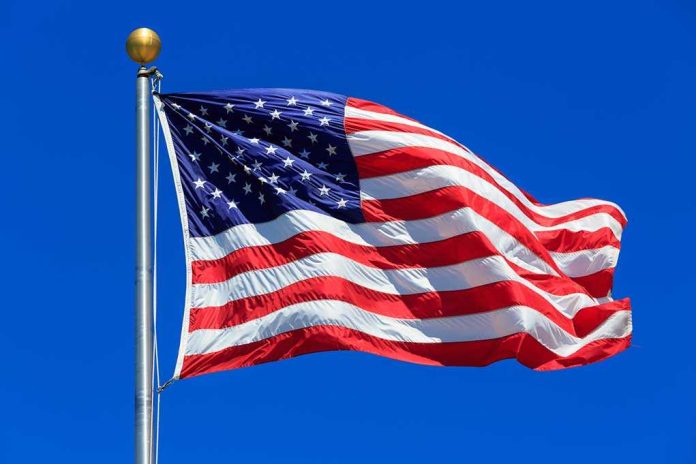
President Trump’s executive order to prosecute flag burning sends a powerful message that attacks on our national symbols will no longer go unanswered.
Story Snapshot
- President Trump signed an executive order on August 25, 2025, prioritizing prosecution for American flag desecration, including burning.
- The order directs federal agencies to pursue legal action and immigration consequences for non-citizens involved in flag burning.
- This move challenges long-standing Supreme Court rulings that protect flag burning as free speech under the First Amendment.
- The policy aims to restore respect for the flag amid rising protest activity and perceived threats to national values.
Trump’s Executive Order Targets Flag Desecration
On August 25, 2025, President Donald J. Trump signed an executive order instructing federal agencies to prioritize prosecution of individuals who desecrate the American flag, including burning. The order came after months of escalating protest activity, with incidents of flag burning frequently tied to anti-Israel demonstrations and broader political unrest. The administration frames this measure as a necessary step to defend national unity and integrity, arguing that unchecked acts of flag desecration embolden those who wish to undermine American values and public order.
Federal agencies, under the direction of Attorney General Pam Bondi, have been ordered to review current laws and aggressively pursue legal action where jurisdiction allows. The executive order also calls for cooperation with state and local authorities to ensure cases do not fall through the cracks due to overlapping legal boundaries. For non-citizens caught engaging in flag desecration, the Department of Homeland Security has been tasked with initiating immigration consequences, which could include deportation or visa revocation. The White House states that this approach is designed to deter both citizens and non-citizens from acts that are seen as hostile or provocative toward the nation.
Constitutional Clash: Free Speech Versus National Symbols
The Trump administration’s action directly challenges decades of Supreme Court precedent, most notably the 1989 Texas v. Johnson decision, which declared flag burning protected symbolic speech under the First Amendment. Despite repeated legislative attempts to criminalize flag desecration, the courts have consistently struck down such efforts as unconstitutional restrictions on free expression. Supporters of the executive order argue that the flag represents the sacrifices of generations and must be shielded from acts of contempt, while critics claim this move infringes on core civil liberties.
Legal scholars widely acknowledge that the Supreme Court remains the ultimate arbiter of these constitutional questions. While the executive order seeks to operate within existing law, it signals a willingness to push the boundaries of permissible action and potentially provoke a new round of judicial review. The administration emphasizes that prosecution will be pursued where flag desecration is tied to violence or criminal conduct, hoping to build a case that can withstand legal scrutiny even in a landscape shaped by strong free speech protections.
Political and Social Impacts: Restoring Respect or Stoking Division?
President Trump’s directive has already polarized public opinion, with many conservatives applauding the administration’s willingness to defend national symbols and enforce accountability. They see the executive order as a long-overdue response to years of unchecked anti-American displays and a vital stand for patriotism in an era marked by globalism, government overreach, and cultural radicalism. For this audience, the move represents a restoration of traditional American values and an affirmation of the nation’s foundational principles.
Civil liberties advocates, meanwhile, are preparing for legal challenges, viewing the order as a dangerous step toward government censorship and the erosion of constitutional rights. The immediate effect has been heightened scrutiny of protest actions and an intensified debate over the limits of free speech. In the longer term, the order could trigger a significant Supreme Court battle, testing whether the government’s interest in protecting national symbols can justify criminalizing symbolic acts of dissent.
“President Trump signed an Executive Order on Aug 25, 2025, titled ‘Prosecuting Burning of the American Flag.’ It prioritizes enforcement of laws against flag desecration that incites violence or violates civil rights, consistent with the First Amendment. Full text:…
— KJ (@Ivyleague788) August 26, 2025
As agencies implement the new directive, the nation is likely to witness both increased prosecution of flag desecration incidents and renewed activism from groups opposed to the policy. The outcome may shape not only the fate of the executive order but also the broader conversation about patriotism, constitutional rights, and the role of government in protecting national identity. The administration’s move has set the stage for a defining confrontation over what it means to honor the flag—and the freedoms it represents.
Sources:
Fact Sheet: President Donald J. Trump Protects the American Flag from Desecration
Trump signs executive order on flag burning
Trump’s Executive Order on Burning the American Flag Faces Supreme Court Test
Trump cracks down on flag burning with executive order
Presidential Actions: Prosecuting Burning of the American Flag