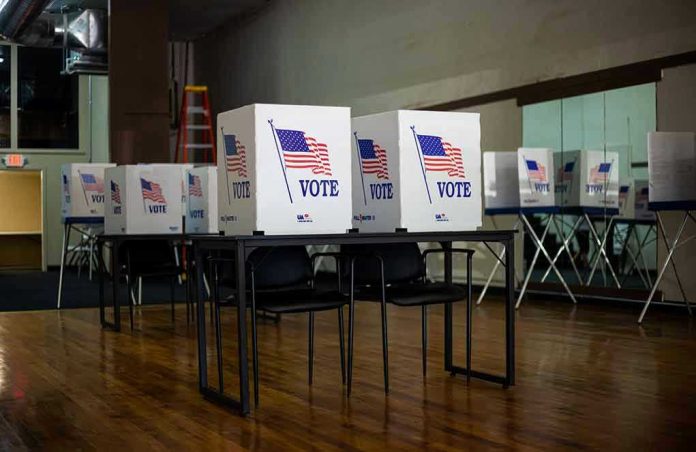
On Election Day 2025, anonymous bomb threats shut down voting across seven New Jersey counties—just as the governor’s race hung in the balance, raising urgent questions about who would try to disrupt democracy in America’s backyard and why.
Story Highlights
- Bomb threats emailed to polling places in seven key New Jersey counties forced temporary closures and redirected voters on Election Day during a neck-and-neck gubernatorial race.
- Law enforcement responded swiftly, securing sites and confirming threats as non-credible, but the psychological and logistical impact on voters and poll workers was immediate.
- State officials and candidates condemned the threats as a potential voter suppression tactic, emphasizing the resilience of New Jersey’s election infrastructure and the importance of public confidence.
- No arrests or attributions have been made, but the incident mirrors a troubling national pattern of election day disruptions, with echoes of similar threats in 2024.
- The episode underscores the ongoing vulnerability of U.S. election systems to intimidation and the critical need for coordinated, transparent responses to maintain trust in democracy.
The Morning That Shook New Jersey
Election Day in New Jersey began with chaos as emails containing bomb threats hit polling places in Bergen, Essex, Mercer, Middlesex, Monmouth, Ocean, and Passaic counties. Local and state law enforcement moved quickly, locking down sites, sweeping for explosives, and redirecting voters to alternate locations where necessary. The timing was not accidental—this was a high-stakes gubernatorial election, with polls showing a statistical dead heat between the major candidates. The scale of the disruption was unprecedented for the state, affecting a significant portion of its electorate and drawing national attention.
Officials, including New Jersey Attorney General Matthew Platkin and Lt. Gov. Tahesha Way, took to the airwaves to reassure the public, emphasizing that the threats were not credible and that voting would continue. Newark Public Safety Director Emanuel Miranda labeled the threats “fake claims,” but the damage to voter confidence was already underway. The episode forced election administrators to walk a tightrope—maintaining security without further disenfranchising voters already skeptical of the system.
Context: A Nation on Edge
New Jersey’s ordeal did not occur in a vacuum. The 2024 election saw similar bomb threats in swing states, some later attributed by the FBI to foreign actors. The Garden State, with its diverse electorate and status as a political bellwether, was a logical target for those seeking to sow chaos. The incident also unfolded against a backdrop of national anxiety about election integrity, with both major parties accusing the other of undermining democracy. In this environment, even non-credible threats can have a chilling effect, raising the stakes for officials tasked with maintaining order and public trust.
Despite the expansion of early voting and vote-by-mail options in recent years, Election Day remains a symbolic and practical linchpin of American democracy. The threats in New Jersey were a direct challenge to that tradition, testing the resilience of both institutions and individuals. Poll workers, already under strain from heightened scrutiny and partisan tensions, faced additional stress as they adapted to last-minute changes and anxious voters.
Stakeholders Under Pressure
The cast of characters responding to the crisis read like a who’s who of New Jersey politics and law enforcement. Attorney General Platkin and Lt. Gov. Way provided a unified front, coordinating with local police, county sheriffs, and likely federal partners like the FBI and Department of Homeland Security. Democratic gubernatorial candidate Mikie Sherrill was quick to frame the threats as an attempt to suppress turnout, a charge that resonated with her base but also highlighted the partisan lens through which such incidents are often viewed.
Power dynamics were clear: state officials set the tone and direction, while local law enforcement handled the boots-on-the-ground response. Federal agencies lurked in the background, offering support and intelligence but leaving the public messaging to the state. The real test, however, was for the voters themselves—would they be deterred by the disruption, or would they press on, determined to have their say?
NJ Election Day bomb threats shut down polling sites in 7 key counties — with gov’s race in dead heat https://t.co/wdzXaBaNDG
— Justice is Served (@pleasesaveour) November 4, 2025
The Day After: Impact and Implications
In the short term, the bomb threats caused confusion and inconvenience, especially for voters redirected to unfamiliar polling places. Poll workers bore the brunt of the stress, adapting to rapidly changing circumstances while maintaining professionalism. Public confidence, already fragile, faced another test—though officials worked overtime to project calm and competence.
The long-term implications are more concerning. The episode is likely to prompt reviews of threat response protocols and new investments in both physical and cybersecurity for elections. There is a real risk that such incidents, if repeated, could have a chilling effect on turnout, though initial reports suggest New Jersey voters showed resilience. The broader political impact is already evident, with the incident fueling debates over election integrity, voter access, and the potential for foreign or domestic interference.
Economically, the direct costs were minimal, but the episode may lead to increased security expenditures in future elections. Socially, it underscored divisions and anxieties around election security. Politically, it provided fresh ammunition for those advocating reforms—and for those warning of systemic vulnerability.
Expert Perspectives: Lessons and Warnings
Election security experts have long warned about the increasing sophistication and frequency of threats to election infrastructure. The rapid, coordinated response in New Jersey is seen as a model, but experts caution that sustained investment and vigilance are necessary to stay ahead of adversaries. Scholars of democracy emphasize the importance of public confidence in the electoral process, noting that even non-credible threats can have a disproportionate impact on voter perception and participation.
Officials framed the response as a success story of preparedness and resilience. Political candidates used the incident to highlight broader concerns about election integrity and the need for reform. Civil society groups advocated for greater transparency, accountability, and public education to combat disinformation and intimidation. The consensus: this was a wake-up call, not just for New Jersey, but for the nation.
Unanswered Questions and the Road Ahead
As of the latest reports, all affected polling places have been secured, and most have reopened. Law enforcement continues to investigate the source of the threats, but no credible danger has been identified and no arrests have been made. The lack of attribution leaves room for speculation—domestic agitators, foreign actors, or something else entirely? Until answers emerge, the episode will remain a cautionary tale about the fragility of American democracy in the digital age.
The 2025 New Jersey bomb threats were a stark reminder that election security is not just about counting votes accurately, but also about protecting the process from those who would undermine it. For voters over 40, who remember a time when such disruptions were unthinkable, the episode is a sobering sign of how much has changed—and how much is at stake.
Sources:
ABC News: Non-Credible Bomb Threats Temporarily Halt Voting in Northern New Jersey
WHYY: Election 2025: Chester County voter issues, New Jersey bomb threats
CBS News: Election Day bomb threats in New Jersey force some polling sites to move
New Jersey Division of Elections