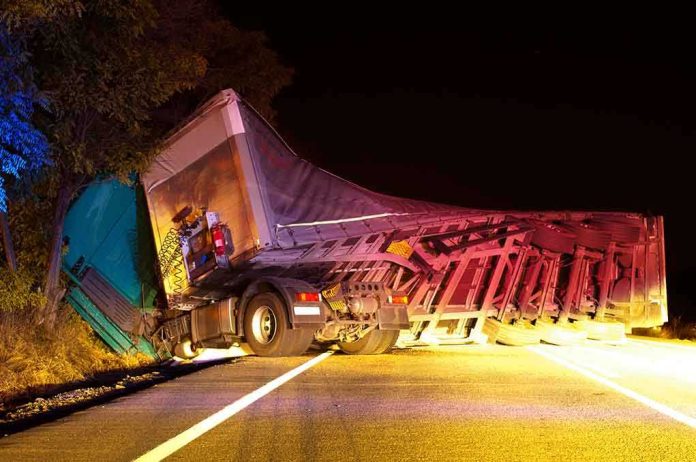
A deadly freeway pileup didn’t start with screeching brakes—it started years earlier at the border, then wound its way through our licensing and trucking systems.
Story Snapshot
- Federal sources say the driver first crossed in 2022, was released pending an immigration hearing, and remained without lawful status [1].
- Police reportedly arrested him on suspicion of gross vehicular manslaughter while intoxicated after a multicar crash killed at least three [1].
- A broadcast transcript mirrors that timeline and places the crash on Interstate 10 in Ontario, California [2].
- Public documents tying the 2022 release to licensing or employer vetting have not been produced in the record supplied [1][2].
The reported timeline: encounter, release, and a fatal crash
Fox News, citing federal law enforcement sources, reports the driver—identified as Jashanpreet Singh—was first encountered by United States Border Patrol agents in California’s El Centro Sector in March 2022 and released into the country pending an immigration hearing [1]. The outlet further states Department of Homeland Security sources confirmed he lacked lawful immigration status and that Immigration and Customs Enforcement lodged a detainer after the arrest [1]. A televised segment reiterates the same arc: 2022 border encounter, release, and later arrest following the Ontario crash on Interstate 10 [2].
Fox’s account adds the collision left at least three people dead and several injured, and that officers attributed the wreck to impairment supported by toxicology tests, with no braking before impact, leading to suspicion of gross vehicular manslaughter while intoxicated [1]. The broadcast transcript places the event in Ontario, California, identifies the driver as a 21-year-old Indian national, and asserts his presence in the country traces to a 2022 border crossing [2]. These claims rely on named outlets citing unnamed federal sources and police statements rather than released charging documents.
What the evidence shows—and what remains unproven
The available reporting establishes a plausible sequence: a 2022 border encounter and release, continuing unlawful presence, and a deadly crash that triggered state criminal charges [1][2]. The research package does not include the primary immigration file, notice to appear, or parole paperwork that would confirm the precise legal authority for release [1]. It also lacks the police collision report, toxicology results, and charging instruments necessary to verify the impairment evidence and exact counts beyond media descriptions [1]. Those gaps do not negate the reports; they limit how far to extend them.
The record likewise does not provide California Department of Motor Vehicles licensing data or federal motor-carrier qualification files showing whether the driver held a commercial license, when it was issued, and on what documents that issuance relied [1][2]. That missing link matters. Policy debates often jump straight from “released in 2022” to “driving an eighty-thousand-pound rig,” but the chain in between runs through state licensing, work authorization vetting, and employer due diligence. Without those records, causation claims risk outrunning facts.
Accountability questions that cut across agencies and industry
Border processing decisions deserve scrutiny, especially when public safety is at stake. Conservative common sense says government must enforce the law consistently, prioritize removal of those without lawful status, and minimize downstream risk. If the driver was released under a discretionary authority, Congress and the Department of Homeland Security should explain why, under what terms, and with what follow-up. If Immigration and Customs Enforcement later lodged a detainer only after the crash, that timing invites questions about earlier enforcement opportunities [1].
State and private actors cannot be left off the hook. If California issued a commercial credential to a person without clear, lawful work authorization, that is a policy failure begging for repair. If an employer onboarded a driver without robust verification and a complete driver qualification file, that is a compliance failure. The research set does not yet document either pathway [1][2]. The prudent remedy is not rhetorical blame alone; it is record retrieval, rule tightening, and enforcement consequences where files show negligence.
How to close the loop from border to big rig
Three document trails would turn speculation into certainty. First, the immigration file: the United States Border Patrol encounter log, release or parole order, immigration court docket, and any supervision terms. Second, the crash file: the full police collision report, toxicology results, dashcam or event data recorder downloads, and the charging affidavit. Third, the trucking file: California Department of Motor Vehicles records, federal motor-carrier driver qualification documents, employment eligibility verification, and medical certification. Each trail answers a different “how” that together determines “why.”
Sources:
[1] Web – Illegal immigrant trucker accused in fatal California crash released …
[2] YouTube – Illegal immigrant trucker arrested after crash leaves three dead