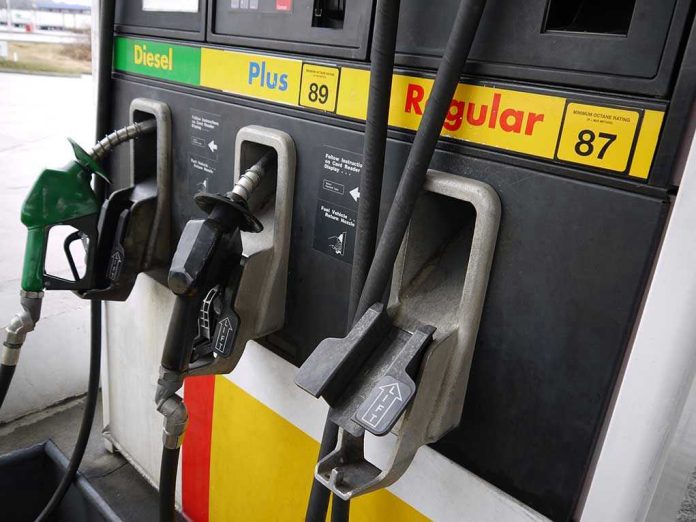
The Iran war is hitting American families where it hurts most—at the gas pump—as oil prices rocket above $90 per barrel and fuel costs surge to levels not seen since the final days of the Biden administration’s inflationary nightmare.
Story Snapshot
- Oil prices have skyrocketed over 20% in one week as military conflict with Iran escalates, reaching $90+ per barrel by March 6, 2026
- Gas prices jumped 32 cents per gallon in just seven days, hitting the highest level since August 2024
- Economists warn of stagflation—a toxic mix of economic stagnation and soaring inflation that the Federal Reserve cannot easily fix
- Trump administration temporarily lifts Russia sanctions in emergency bid to stabilize oil markets and protect American consumers
Energy Crisis Slams American Wallets
The escalating military engagement involving the United States, Israel, and Iran has triggered a severe energy shock. Brent crude oil prices surged from the high $60s to above $90 per barrel within approximately one week of coordinated strikes beginning in late February 2026. Goldman Sachs estimates that roughly $13 per barrel represents pure “war risk premium”—the price Americans pay for geopolitical uncertainty. Gas stations across the nation reflect this pain, with prices jumping 32 cents per gallon in seven days, marking the highest costs since the waning months of Biden-era inflation in August 2024.
Strategic Chokepoints Threaten Supply
Iran’s position as a major OPEC producer supplying approximately 4.5% of global oil creates significant vulnerability for world energy markets. Even more concerning is the Strait of Hormuz, through which 20% of global oil supplies transit—a critical chokepoint that could send prices above $100 per barrel if the conflict escalates to threaten shipping lanes. Goldman Sachs’ oil research team, led by Daan Struyven, notes that markets are currently pricing the conflict as a four-week engagement. If military operations extend beyond this baseline or escalate further, American consumers could face even steeper price increases at the pump.
Stagflation Nightmare Returns
The toxic combination of surging energy costs and weak employment data has economists sounding alarms about stagflation—the same economic poison that devastated American families in the 1970s. As of March 6, 2026, U.S. employers cut more jobs than they created, while oil prices simultaneously spiked. Brian Jacobsen, chief economic strategist at Annex Wealth Management, stated bluntly: “You can’t sugarcoat this report. A negative payrolls number combined with a big jump in oil prices will have traders worrying about stagflation risks.” This creates a worst-case scenario where the Federal Reserve lacks effective tools to address both problems simultaneously—higher interest rates combat inflation but worsen unemployment, while rate cuts might boost jobs but accelerate price increases.
Markets React to Dual Threats
Wall Street experienced its worst week since October as the dual threats of energy inflation and economic weakness hammered investor portfolios. The S&P 500 dropped 1.3% on March 6 alone, while the Dow fell 453 points and the Nasdaq sank 1.6%. The Dow Jones breached negative territory for 2026, erasing earlier gains. Morgan Stanley warns that prolonged conflict could create a stagflationary environment challenging both equity and fixed-income investments—a scenario where traditional portfolio diversification strategies fail to protect wealth. This mirrors historical precedents from the 1973 oil crisis and 1990 Gulf War, when sustained supply disruptions triggered recessions alongside inflation.
Trump Administration Takes Emergency Action
Recognizing the severity of the supply crisis, the U.S. Treasury Department on March 6 announced a temporary 30-day waiver lifting penalties on Russia to allow India to purchase Russian oil. Treasury Secretary Scott Besson characterized this as “a very brief change in policy just to keep oil prices down a little bit better than we could otherwise.” This pragmatic move demonstrates the administration’s focus on protecting American consumers from runaway energy costs, even if it requires temporary policy flexibility. The military operations themselves carry substantial costs, with a bipartisan think tank estimating the first 100 hours of U.S. attacks cost $3.7 billion—approximately $900 million per day—while more than 20,000 Americans have returned from the Middle East since operations began.
Protecting Your Family’s Finances
While policymakers work to address supply disruptions, American families must take practical steps to weather this storm. Business analyst Jill Schlesinger recommends focusing on controllable factors: “beefing up your emergency reserve fund, paying down that outstanding credit card balance if you can,” and increasing retirement plan contributions if those priorities are covered. The combination of higher gas prices and potential broader inflation means household budgets face increasing pressure in coming months. If oil prices remain elevated above $90-100 per barrel, core inflation could reaccelerate from recent moderation, potentially forcing the Federal Reserve to maintain higher interest rates longer than markets anticipated, which would increase borrowing costs for mortgages, auto loans, and credit cards.
Sources:
Oil Prices Surge as Iran War Impacts Stock Market 2026 – Intellectia.ai