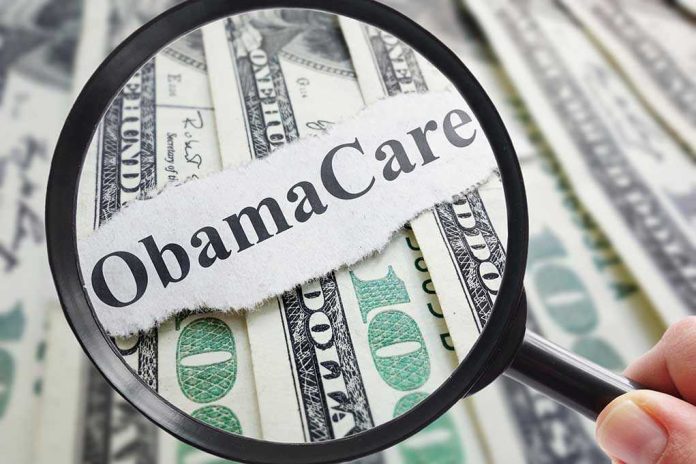
A proposed $40 billion bailout for Obamacare threatens fiscal stability, sparking fierce opposition from conservatives.
Story Highlights
- Democrats propose a $40 billion bailout for Obamacare.
- Republicans staunchly oppose the bailout, citing fiscal irresponsibility.
- The bailout could lead to increased national debt and inflation.
- Conservatives argue this move undermines free-market principles.
Democrats Push for $40 Billion Obamacare Bailout
The Democratic Party is advocating for a substantial $40 billion bailout aimed at rescuing Obamacare. As the economy grapples with challenges from past fiscal decisions, the proposal has intensified partisan debates. Democrats argue that this funding is essential to maintain healthcare coverage for millions of Americans. They stress that without this financial injection, the healthcare system risks collapsing, leaving vulnerable populations without necessary medical access. However, the opposition sees this as another instance of fiscal irresponsibility.
Republican leaders vehemently oppose the bailout, emphasizing the long-term consequences of increased national debt. They argue that the proposed $40 billion will further strain an already burdened economy, potentially leading to inflation and higher taxes. This stance aligns with conservative values, prioritizing limited government intervention and fiscal conservatism. Republicans are calling for more sustainable, market-driven solutions that don’t rely on substantial federal spending, reflecting a belief in a self-regulating free market.
Potential Economic Implications
If the bailout is approved, it could have significant implications for the American economy. Critics warn that adding such a substantial amount to the national debt could exacerbate inflation—a concern that resonates deeply with conservatives who prioritize economic stability. The move is seen by many as a continuation of policies that have led to the current fiscal challenges. Advocates argue that it is a necessary step to ensure healthcare access, but the debate highlights broader concerns about government overreach in the economy.
Beyond the immediate fiscal impacts, the proposed bailout raises questions about the future of healthcare policy in the United States. Conservatives argue that continually propping up Obamacare with federal funds only delays necessary reforms. They advocate for a system that encourages competition and innovation within the healthcare market. This ongoing debate underscores a fundamental ideological divide over the role of government in managing healthcare and its implications for economic freedom.
Conservative Values and Free-Market Principles
For many conservatives, the prospect of a $40 billion bailout is not just a question of fiscal prudence but a challenge to foundational principles. The preference is for solutions that reduce dependency on government aid and instead empower individuals and businesses through free-market mechanisms. This approach is viewed as essential for preserving the American spirit of entrepreneurship and self-reliance. The debate over the Obamacare bailout serves as a microcosm of broader ideological battles over the size and scope of government intervention in the economy.
As the debate continues, conservatives are rallying to advocate for alternative healthcare reforms that emphasize market solutions. They argue that only through reducing government involvement can true innovation and efficiency in healthcare be achieved. This issue remains a touchstone for broader discussions about how best to balance public welfare with economic freedom, a critical concern for those committed to conservative values and a thriving, independent nation.
Sources:
SurgeGraph: YouTube ownership, timeline, and impact
Wikipedia: YouTube history, founding, and growth
VdoCipher Blog: Early development and platform features
Britannica: User statistics and platform facts
“`