
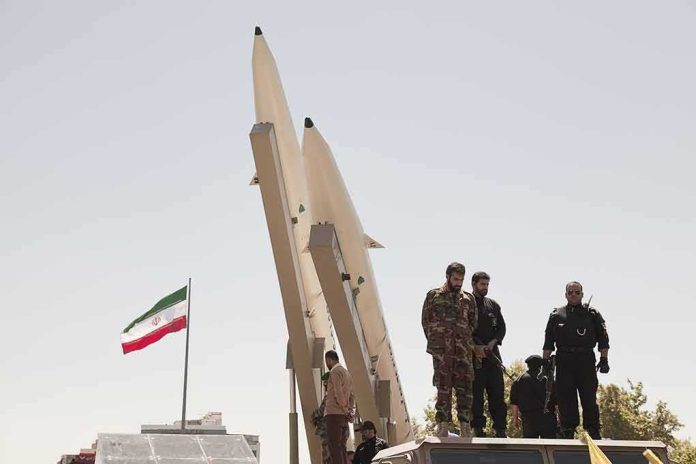
Deterrence in the Gulf is not a speech; it is a system. When Iran’s leadership publicly directs its armed forces to bring “all U.S. and Israeli assets, tangible and intangible” within reach and prepare for an “immediate” and “geographically unrestricted” response, it is codifying a standing strategy: raise the price of coercion high enough that adversaries think twice, while preserving the latitude to retaliate asymmetrically if struck first.
At a Glance
- Iran’s leadership issued a directive to expand its target list to include U.S. and Israeli assets worldwide, framing the move as deterrence and conditional retaliation.
- The order paired targeting guidance with practical readiness measures: more munitions production, stronger intelligence, and indigenous defense development.
- U.S. planning simultaneously contemplates rapid, large-scale strikes on Iranian energy, military, and nuclear sites—escalation risk runs both ways.
- The trigger for Iran’s promised response—renewed U.S. or Israeli “military or terrorist” attacks—remains undefined, keeping ambiguity as a tool.
What the directive says, and why its wording matters
Reports attributed to Iran’s leadership on October 31, 2026 describe orders to the armed forces that broaden the set of U.S. and Israeli targets under consideration—extending to “tangible and intangible” assets—and call for “intelligent combat readiness” to maximize deterrence. The statement emphasizes conditionality: if the United States or Israel “once again” mount military or terrorist attacks, Iran will determine the timing and scope of its response, without geographic limits. That pairing—expansive target scope and conditional retaliatory framing—is classic Iranian deterrent signaling, designed to complicate an adversary’s planning calculus while avoiding an explicit promise of preemption. The same reporting outlines directives to increase ammunition and weapons output, bolster military intelligence, and accelerate indigenous defense capabilities—signals that the order is not merely rhetorical but tied to resource posture and force readiness.
The language is sweeping, and intentionally so. “Tangible and intangible” invites translation ambiguity—whether physical facilities, digital infrastructure, financial nodes, or reputational and political instruments—but the strategic effect is clear: Tehran claims the right to strike where it can impose cost, not only where maps show bases and refineries.
How this fits Iran’s deterrence doctrine
Iran’s modern deterrence practice is built on three pillars: credible retaliation options across domains (missiles, drones, cyber, covert action), ambiguity about thresholds, and a laddered escalation model that mirrors adversary moves. Over four decades, Tehran and its network have responded to strikes and sabotage with actions calibrated to impose pain without inviting annihilation—hitting shipping, energy infrastructure, regional bases, or diplomatic footprints—then signaling openness to de-escalate once costs are registered. Congressional and think-tank analyses of the 2025–2026 cycles of confrontation describe this reciprocity pattern in detail: each side casts its move as defensive; each uses the other’s action to justify the next rung up the ladder. In that light, an order to expand target lists and accelerate readiness is not a bolt from the blue; it is an instrument in a familiar deterrence toolkit.
Crucially, deterrence here is not static. Iranian planners aim to raise the expected cost of renewed attacks by advertising reach—“geographically unrestricted”—and by signaling that the definition of a legitimate target is elastic. That elasticity, particularly where “intangible” assets could include cyber or financial infrastructure, is meant to deter pressure campaigns that stop short of open war yet bite deeply.
Limits of what we actually know
There is an important evidentiary boundary. The reporting establishes a public directive and describes its themes in consistent language across multiple outlets, but it does not authenticate a formal Iranian document, provide the full Persian text, or tie the guidance to a numbered operations order, a named unit tasking, or a timestamped targeting database. Nor does it prove capability against “all” U.S. and Israeli assets, which is a political statement more than an operational claim. The trigger condition—renewed “military or terrorist” attacks—remains undefined: does it include cyber operations, covert action, proxy strikes, or only attributable kinetic attacks? Ambiguity is a feature, not a bug, but it leaves outside observers inferring thresholds rather than reading them.
Equally, nothing in the available material speaks to imminence. Readiness instructions and broader target sets are posture, not launch authorization. No specific execution window, mobilization order, or named operation appears in public view.
The other half of the ledger: U.S. and Israeli planning
Deterrence is relational. U.S. and Israeli military planning, as reported by outlets citing officials with direct knowledge, envisions a rapid strike package against Iranian energy infrastructure, military installations, and nuclear facilities, executable within days of presidential authorization. Those plans, by design, would threaten assets central to Iran’s economy and regime security. Intelligence assessments also map expected Iranian retaliation against U.S. personnel and facilities across the region—and potentially beyond—should such strikes occur.
This reciprocal posture matters for interpreting Tehran’s directive. When an adversary is signaling the ability to hit oil, power grids, or undersea cables, widening your own legal and operational target sets—and saying so—becomes a form of compellence and preemption insurance. Analysts differ on whether expanding lists changes behavior; some argue it clarifies risks without altering fundamentals. But the consequence is unmistakable: both sides are now on record that any renewed round could escalate swiftly across domains and geographies.
Mechanisms of Iranian reach: from missiles to “intangible” targets
How might an “unrestricted” response manifest? Iran’s toolset spans precision and deniable instruments. Ballistic and cruise missiles, increasingly paired with one-way attack drones, threaten fixed infrastructure regionally. Proxy formations in Lebanon, Iraq, Syria, and Yemen provide depth and deniability for strikes on bases and logistics nodes. Cyber units can contest “intangible” assets—banking networks, industrial control systems, or data centers—below the threshold of overt war. Maritime harassment and mining pressure energy shipping and insurance premiums, with global ripple effects. The point is not omnipotence; it is option value. Iran does not need to strike everything; it needs enough credible options to alter adversary cost-benefit math.
Iran’s parallel emphasis on indigenous production—munitions, air defenses, sensors—serves that aim. Sanctions resilience requires shorter supply lines and domestic sustainment; deterrence requires magazines that do not empty after one salvo. The directive’s call to boost production and intelligence capacity is, in that sense, the spine of the policy rather than its flourish.
Where reasonable disagreement lies
There is genuine debate over whether Tehran’s framing—deterrence conditional on being attacked—constrains behavior in practice. U.S. intelligence assessments suggest Iran is unlikely to launch preemptive escalatory attacks against U.S. personnel or Israel absent a triggering strike, but would retaliate rapidly and broadly if targeted, potentially including assassination plots and attacks on diplomatic footprints. Critics of Iran’s signaling argue that expansive phrases—“geographically unrestricted,” “all assets”—blur into coercive threat-making and invite miscalculation. Supporters of a strict deterrence reading counter that the conditional clause, and the historical pattern of retaliatory rather than initiatory behavior in major flare-ups, should guide interpretation.
Both positions can be true in part. Ambiguity stabilizes by keeping options open, yet destabilizes when each side misreads the other’s threshold. That is why authentication of the full directive, clearer definitions of triggering actions, and observable indicators of mobilization would materially improve outside assessment—none of which are publicly available today.
NEW: Senior officials from the Mecca Pact’s three signatories met with senior Iranian officials in Tehran on October 26 to discuss a new US-Iran deal in concert with ongoing Pakistani and Qatari efforts.
Read more ⬇️ https://t.co/7Ax5kkxQE1
— Institute for the Study of War (@TheStudyofWar) October 27, 2026
Implications: how to read the next moves
For policymakers and markets, the takeaway is straightforward. The directive formalizes a broader Iranian target universe and ties it to readiness measures, but it does not by itself herald immediate action. Escalation risk turns on the interaction of two active plans: U.S.-Israeli strike options against high-value Iranian assets and Iran’s promised rapid retaliation across domains if those plans move from paper to execution. In that environment, indicators matter more than headlines: upticks in Iranian missile-unit dispersal, air-defense activation cycles, munitions production surges, proxy force alerting, or cyber reconnaissance would signal movement from declaratory policy to operational posture. Absent those, the directive remains what it was designed to be—a deterrent stake in the ground, reminding adversaries that the costs of renewed attacks will not be confined to the immediate battle space.
Sources:
facebook.com, dailysabah.com, store.jpost.com, timesofindia.indiatimes.com, theedgemalaysia.com, shafaq.com, humenglish.com