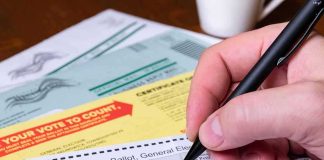

The fight over who may touch ballots before an election is certified is not a personality drama; it is a constitutional and operational question at the heart of American elections: states run them, and their custody rules are designed to keep ballots secure, auditable, and countable — even when federal investigators come knocking.
The Short Version
- California law and regulations require unbroken chain of custody for ballots and bar removing election materials from elections officials before certification, with narrow exceptions.
- Federal courts rejected the Justice Department’s emergency bid to segregate ballots tied to about 20,000 “likely noncitizens,” citing state control of elections, timing, and feasibility risks.
- The DOJ’s filings described “likely” noncitizens based on data matching, not a verified list of ineligible voters or proof that all returned ballots.
- Newsom’s warning letter urged federal judges to scrutinize any pre-certification search-warrant attempts; whether that letter exists on a docket is less important than the custody law it invokes.
What election custody actually requires — and why it exists
Every serious system of ballot handling is built around a simple engineering truth: once ballots leave controlled custody, you jeopardize both security and the public’s ability to accept the result. California codifies that principle in two places. First, the Secretary of State’s ballot-counting rule requires continuous, documented chain of custody, with dual control and secure storage, for ballots involved in audits such as the one-percent manual tally. “Ballots shall be kept securely, and the chain of custody maintained at all times.” That is not window dressing; it is how auditors later reconstruct and verify what happened to the paper trail. Second, California Elections Code §15551(d) prohibits taking “any … election-related material or equipment necessary for the conduct of an election” from the elections official’s custody before certification, save for narrow statutory exceptions. The statute is a prophylactic against exactly the sort of disruptive mid-process seizure that can upend counts and audits.
Those controls do not foreclose lawful investigation. They do insist that any investigative access be tailored to preserve custody — for example, supervised inspection, logging, imaging of non-ballot data, or post-certification processes under court supervision. The point is to protect the integrity of the election record while enabling evidence gathering, not to immunize wrongdoing.
How the federal–state collision took shape
The recent clash arose when the Department of Justice announced it had identified more than 20,000 California registrants it deemed “likely” noncitizens, asserting that these individuals had been sent vote-by-mail ballots and asking a federal court to halt tabulation of any ballots associated with them pending case-by-case verification. A federal district judge declined to order segregation, emphasizing that states control their election machinery and that the requested relief would intrude on that allocation of authority. The Ninth Circuit, on emergency appeal, also refused to compel California to set aside the disputed ballots. The panel majority focused on practical risk, writing in substance that there is no feasible way to identify and wall off specific individuals’ ballots without potentially catastrophic effects on the system; it also noted the government’s “emergency” was at least partly self-created by timing its request so close to counting.
Two things follow from those rulings. First, the federal courts were not persuaded that an eleventh-hour, mass-segregation remedy could be executed without undermining the very integrity the government said it sought to protect. Second, the courts did not decide — and did not need to decide — whether a future, narrowly tailored warrant or supervised inspection consistent with state custody law could be valid. The decisions turned on feasibility, timing, and constitutional structure, not on a categorical bar against all investigative access.
Data matching is not verification — and why that matters to remedies
The DOJ’s complaint repeatedly used the qualifier “likely” to describe the 20,000-plus names. In practice, large-scale voter file matching to immigration or other datasets almost always generates false positives because voter rolls were not designed with a unique citizenship identifier; names, dates of birth, and addresses are noisy inputs, and even small error rates can produce large lists in a state of California’s size. The legal consequence is straightforward: a court should be reluctant to impose a sweeping remedy — such as segregating thousands of ballots during counting — on the strength of a probabilistic list, especially when custody-disruptive steps risk disenfranchising eligible voters or compromising audits.
That does not mean potential noncitizen voting is impossible or unimportant; it means the remedy must match the quality of evidence and the operational realities of election administration. Courts weighed exactly that balance in declining to order segregation midstream, and California’s custody rules embody the same logic.
Gavin Newsom’s warning and what it really argues
Against this backdrop, Governor Gavin Newsom sent a letter to California’s four federal district courts cautioning against pre-certification seizures via search warrant. The quoted thrust was not novel: federal judges should apply heightened scrutiny to any warrant that would remove ballots, equipment, or other materials from elections officials before certification, because doing so risks violating California’s chain-of-custody requirements and undermining election administration. The letter reportedly was precautionary; it identified no specific pending warrant. While the record available here does not include a docketed copy with date and case number, the argument he advanced rests squarely on the state’s custody statute and regulations, which are public and explicit.
Critics may cast that as political theater; the stronger reading is legal hygiene. Custody statutes mean little if, at the first whiff of controversy, their core protection — that ballots stay in elections officials’ hands under documented control — evaporates. A governor reminding federal judges of those constraints before emergency motions arrive is not audacious; it is anticipatory advocacy aimed at preventing avoidable chaos.
Where the real dispute lives: access protocol, not abstract authority
Strip away the rhetoric and the durable question is practical: what investigative access can be afforded during the canvass without breaching custody? California’s position in the public record emphasizes what may not occur (pre-certification seizure, mass segregation on thin showings) but is less explicit about what can occur — for example, supervised, logged inspection of non-ballot records; forensic imaging of election management systems under dual control with cryptographic hashes; or stipulated post-certification review with preserved seals and audit trails. Conversely, the DOJ’s filings pressed an urgent remedy — set aside thousands of ballots — without first furnishing validated, person-level evidence that would make such an intrusive order proportionate to the risk, and without a protocol that would avoid collateral damage to reconciliation and audits.
Bridging that gap is not mysterious. Courts routinely appoint special masters, require protective orders, and compel joint protocols to reconcile law-enforcement needs with statutory safeguards. A feasible approach here would define scope-limited access, retain election officials’ physical custody at all times, generate independent chain-of-custody logs, and defer any disruptive examination of voted ballots until certification — unless a judge, on a record stronger than “likely,” finds probable cause that specific, identifiable materials constitute evidence of a crime and that no less intrusive alternative exists.
California Governor Gavin Newsom has warned of possible federal interference in election processes, raising concerns about potential ballot seizures under Donald Trump. The warning comes amid growing tensions over election integrity and voting rights ahead of US midterms.… pic.twitter.com/TeGw4A3Mrg
— NewsX World (@NewsX) November 1, 2026
The bottom line for future clashes
Three lessons endure. First, chain-of-custody law is not bureaucratic fetishism; it is the backbone of election legitimacy. Breach it casually, and you break the evidence you are trying to protect. Second, data-matching allegations, even from federal agencies, are hypotheses — not findings. Remedies should scale to the proof, especially when they risk touching live ballots. Third, the federal courts’ response was not nullification of federal enforcement; it was a reminder that timing, feasibility, and federalism matter when the ask is to reach into a state’s ongoing count. The way forward is narrower, more disciplined, and entirely familiar to courts: targeted access under protocols that keep ballots where they belong until the canvass is complete.
Sources:
redstate.com, sos.ca.gov, nbcnews.com, cnn.com, justice.gov, democracydocket.com