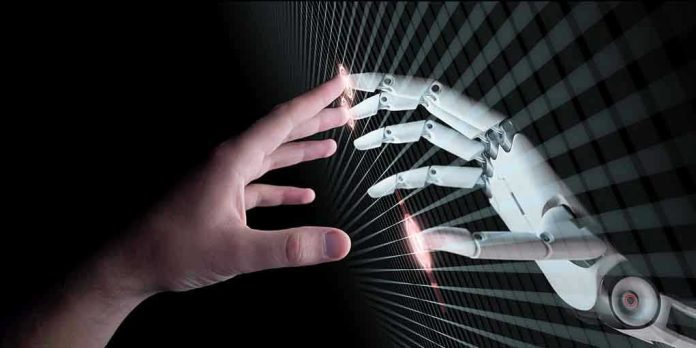
Imagine a robotic hand that not only detaches from its arm but also skitters on its fingertips, redefining the boundaries of what’s possible in robotics.
Story Snapshot
- Robotic hand developed at EPFL can detach and move independently.
- Uses genetic algorithms for non-anthropomorphic design optimization.
- Capable of grasping and carrying objects while detached.
- Potential applications in confined spaces and hazardous environments.
Revolutionary Design and Capabilities
The robotic hand developed by researchers at the Swiss Federal Institute of Technology in Lausanne (EPFL) is a marvel of modern engineering. This hand is not bound by the limitations of human anatomy. It can detach from its arm and move independently on its fingertips, bending its fingers in ways human hands never could. This capability allows it to navigate and operate in confined spaces, making it an invaluable tool for tasks where traditional robots or humans cannot reach.
Using a combination of four to five fingers for walking and the remaining fingers for manipulation, this robotic hand can perform complex tasks such as picking up objects and carrying them. The design was optimized through genetic algorithms, which simulate various trait combinations to find the most effective configurations for crawling, grasping, and carrying tasks. This approach marks a significant departure from traditional robotic hand designs and opens up new possibilities for robotics.
Potential Applications and Benefits
The detached hand robot has far-reaching implications. In industrial settings, it could inspect and repair pipes, perform maintenance in tight spaces, and assist in disaster response scenarios where human access is limited. The ability to detach and maneuver independently allows it to perform tasks that would be challenging or impossible for other robots. Its unique design could also lead to advancements in prosthetics, offering greater dexterity and functionality for amputees, although further research is needed to integrate neural controls.
Experts like Xiao Gao from Wuhan University have highlighted the potential of this technology in various applications. The robotic hand’s design offers a level of versatility that could revolutionize how we approach tasks in hazardous and confined environments. By breaking free from the constraints of human anatomy, this innovation paves the way for new robotic solutions that are both practical and efficient.
Innovative Approach to Robotic Design
The use of genetic algorithms in the design of this robotic hand represents a shift towards more innovative approaches in robotics. Unlike traditional manual designs, these algorithms allow researchers to explore a wider range of possibilities, resulting in more efficient and effective robotic systems. The ability to bend fingers bidirectionally and detach for independent movement sets this robotic hand apart from its predecessors.
The project led by Aude Billard at EPFL exemplifies the potential of combining artificial intelligence with robotics to create solutions that go beyond human capabilities. By optimizing designs through genetic algorithms, researchers can develop robotic systems that are not only more adaptable but also capable of performing tasks in environments that were previously inaccessible.
Future Prospects and Challenges
While the current prototypes have demonstrated impressive capabilities, there are still challenges to overcome. The integration of neural control systems for prosthetic applications remains a significant hurdle. However, the potential benefits of this technology are immense, offering new possibilities for robotics and prosthetics alike.
As research continues, the impact of this detached hand robot is likely to grow. Its ability to navigate and operate in confined spaces, coupled with its innovative design, makes it a promising tool for various industries. With further development, this technology could lead to significant advancements in robotics, providing solutions that enhance human capabilities in ways previously thought impossible.