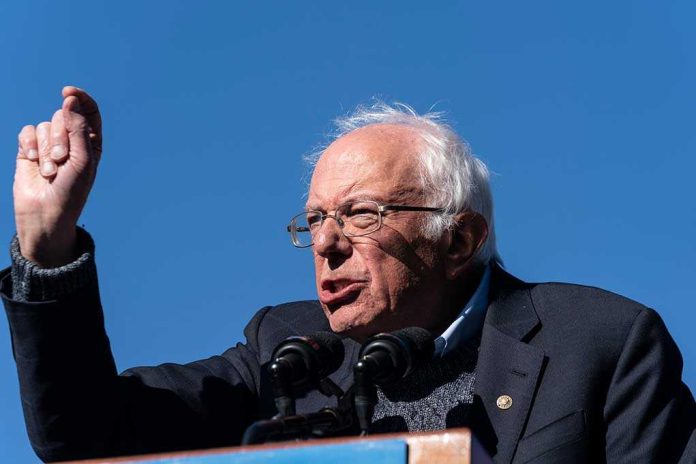
Bernie Sanders hijacked the Democratic spotlight, turning a victory lap into a political standoff that exposed the party’s deepest fault lines—now, the fate of government and healthcare hangs in the balance.
Story Snapshot
- Sanders crashed Schumer’s press conference, demanding Democrats keep the government shutdown until Republicans concede on healthcare.
- Democratic electoral wins fueled Sanders’ argument for a hardline stance, deepening divisions within the party.
- The shutdown, now the longest in U.S. history, centers on expiring ACA tax credits for low-income Americans.
- Internal conflict over negotiation strategy and support for progressive candidates threatens party unity and leverage.
Sanders Shatters Democratic Unity in Public Clash
On November 5, 2025, Bernie Sanders strode to the microphone at a press conference meant for Senate Minority Leader Chuck Schumer and upended the Democratic narrative. Instead of a routine celebration of the previous night’s electoral victories, Sanders used the moment to demand Democrats maintain the ongoing government shutdown, arguing that anything less would be a betrayal of the voters who had just endorsed their healthcare agenda. This spectacle was not a backroom disagreement—it was a live demonstration of rifts splitting the party’s negotiating strategy down the middle.
Sanders’ intervention occurred at a pivotal moment, immediately after Democrats secured notable wins at the ballot box. He insisted these victories were proof that the public supports Democratic efforts to protect healthcare, particularly the extension of Affordable Care Act tax credits set to expire. His message was uncompromising: cave on healthcare, and Democrats risk squandering their hard-won momentum and betraying their base. Sanders’ posture diverged sharply from Schumer’s, who preferred to leverage the party’s gains without risking further political fallout from a prolonged shutdown.
Healthcare Showdown: The Real Stakes of the Shutdown
The government shutdown that Sanders wants to prolong is more than a political chess match—it’s a fight over real-world consequences. At the heart of the standoff is whether ACA tax credits for low-income Americans will be extended. Republican leadership, backed by President Trump, refuses to negotiate on healthcare until the government is reopened. Democrats, led by Sanders and emboldened by recent victories, counter that reopening must be contingent on concrete healthcare commitments. Federal employees, healthcare providers, and millions of families face mounting uncertainty as the deadlock drags on.
Bernie Sanders crashes Schumer news conference, criticizes Democratic Party leadership https://t.co/XzNgcR5BEQ #FoxNews
— Enrico Antonucci (@Antonucci2020) November 6, 2025
Schumer and other Democratic leaders argue that the electoral setbacks suffered by Republicans should force them to the table. Sanders, however, isn’t waiting for the opposition to blink—he’s challenging his own party to uphold the promises that won them votes. The ideological tension is heightened by Sanders’ criticism of Democratic leadership for failing to support progressive candidates like NYC mayor-elect Zohran Mamdani, exposing a broader struggle over the party’s direction and priorities.
Party Fault Lines: Progressives vs. Establishment
Sanders’ press conference takeover laid bare the growing friction between progressive and establishment wings of the Democratic Party. Sanders is driven by conviction rather than partisanship, pressing for tangible policy gains and greater support for progressive candidates. Schumer, in contrast, is attempting to steer the party through a period of political opportunity without courting chaos. The public nature of Sanders’ challenge raises the stakes, signaling to Republicans that Democrats may be less unified than they appear.
This dynamic has implications beyond the shutdown itself. If Sanders’ approach gains traction, it could redefine how progressives interact with party leadership during high-stakes negotiations. The confrontation also serves as a test for Democratic unity: will the party rally behind a single strategy, or will internal divisions weaken their negotiating position and embolden Republican resistance? The answer could shape not only the current policy fight but also future battles over the soul of the Democratic Party.
Economic and Social Fallout: Who Pays the Price?
The protracted shutdown is already rippling through American society. Federal employees face missed paychecks, while uncertainty over ACA tax credits threatens healthcare access for vulnerable populations. The healthcare sector braces for policy whiplash, unsure whether subsidies will be extended or allowed to lapse. Democrats risk alienating their base if they compromise, but a prolonged shutdown could also erode public support and trigger broader economic pain. For Sanders, this is a moment to double down; for Schumer, it’s a delicate balancing act between principle and pragmatism.
The broader impact extends to every sector reliant on federal services. The shutdown tests the limits of political brinkmanship and the ability of elected officials to deliver on promises made during campaigns. As Sanders leverages electoral momentum to push for aggressive negotiation tactics, the party’s next moves will determine whether this standoff is remembered as a turning point in Democratic strategy or a cautionary tale about the costs of internal discord.
Sources:
OAN – Bernie Sanders crashes Schumer’s press conference, calls on Dems to continue govt shutdown
Politico – Democrats shutdown fight elections
AOL News – Bernie Sanders crashes Schumer news conference