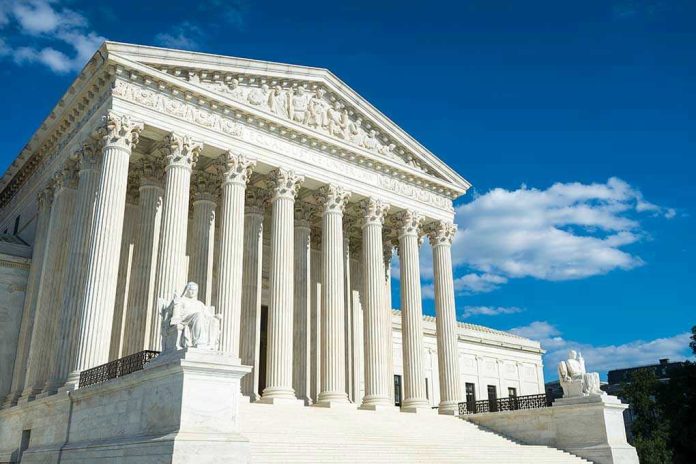
The future of America’s political landscape could hinge on a Supreme Court decision that challenges the balance of race and representation in Louisiana’s congressional map.
Story Overview
- The Supreme Court is reviewing Louisiana’s congressional map’s legality.
- The case tests the Voting Rights Act against the Equal Protection Clause.
- Affects 2026 midterms and minority representation nationwide.
- Supreme Court’s decision could redefine national redistricting laws.
Critical Legal Battle Over Louisiana’s Congressional Map
The U.S. Supreme Court is delving into *Louisiana v. Callais*, a case that carries significant implications for redistricting across the nation. The case questions whether Louisiana’s congressional map, which includes two majority-Black districts, aligns with the Voting Rights Act (VRA) or breaches the Equal Protection Clause. The decision could influence not just Louisiana, but set a precedent for how states can consider race in their redistricting efforts.
Louisiana’s journey to this legal crossroad began in 2022 when its legislature passed a congressional map that included just one majority-Black district. Federal courts quickly identified this as a likely violation of the VRA, prompting a redraw in 2024 to include two majority-Black districts. This was an attempt to comply with Section 2 of the VRA, yet it sparked a legal battle over whether this approach itself constituted unconstitutional racial gerrymandering.
The Role of the Supreme Court in Shaping Redistricting Laws
The Supreme Court’s involvement showcases the case’s gravity. Initially, the Court allowed the 2024 elections to proceed under the new map after granting an emergency stay. However, the decision to order reargument in 2025 underscores the case’s complexity and potential to reshape national redistricting laws. The central issue remains whether intentionally creating majority-minority districts, even as a remedy under the VRA, infringes upon constitutional principles.
The Supreme Court is hearing oral arguments in a HUGE voting rights case today.
Louisiana v. Callais will determine whether the heart of the Voting Rights Act lasts beyond the midterms.
Uphold the VRA.
— Senate Judiciary Democrats 🇺🇸 (@JudiciaryDems) October 15, 2025
The reargument scheduled for October 2025 indicates the Court’s intent to dissect these constitutional questions further. The outcome could redefine the permissible use of race in crafting electoral districts, with profound implications for future legislative maps and minority representation across the United States.
Implications for the 2026 Midterm Elections and Beyond
The 2026 midterm elections loom large over this case. Should the contested map be used, it will directly impact Louisiana’s congressional delegation, influencing not only local politics but also the national political scene. The ruling could shift the partisan balance and dictate how other states approach redistricting in areas with significant minority populations.
Beyond immediate electoral concerns, the decision carries long-term ramifications for the enforcement of the VRA. A ruling against the map could curtail the scope of race-conscious districting, potentially limiting remedies for racial vote dilution and altering the landscape of minority voting rights enforcement. This could affect public trust in the electoral process and perceptions of racial equity.
Stakeholders and the Broader Impact
The case has attracted attention from various stakeholders, including civil rights groups and political parties. The NAACP Legal Defense Fund argues that upholding the remedial map is crucial for fair representation and compliance with the VRA. Conversely, some state officials claim the map constitutes unconstitutional racial gerrymandering, highlighting the contentious nature of this legal battle.
For Black voters in Louisiana, the stakes are high as they seek adequate representation in Congress. The broader political implications cannot be understated, as the outcome could influence control of the U.S. House of Representatives and set a precedent for future redistricting litigation. The case stands as a pivotal moment in the ongoing debate over race, representation, and the principles that underpin American democracy.
Sources:
NAACP Legal Defense Fund, “Louisiana v. Callais – Legal Defense Fund”