A new Trump-brokered peace framework between Israel and Lebanon promises to end decades of war, but leaves Hezbollah and Iran on the outside looking in.
Story Snapshot
- United States, Israel, and Lebanon signed a Trilateral Framework to end formal conflict and restore Lebanese sovereignty.
- The deal sets “pilot zones” for Israeli redeployment as the Lebanese army clears and disarms Hezbollah and other armed groups.
- Hezbollah and key Lebanese political leaders reject the agreement, warning it is one-sided and fragile.
- The United States under President Trump backs the deal with aid, a new military coordination group, and a tougher stance on Iran.
Trump’s Trilateral Framework: What Was Signed in Washington
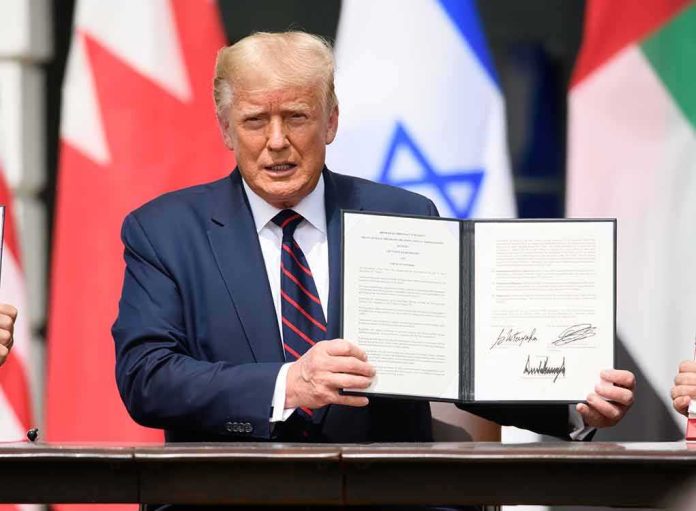
On June 26, 2026, Lebanon, Israel, and the United States signed a Trilateral Framework agreement in Washington, D.C., after five rounds of direct talks. The text says Israel and Lebanon “declare their intent to conclusively end the conflict” and formally end any state of war between them. This is a major step, backed “with the full support of the United States under President Donald J. Trump,” toward finally replacing constant cross‑border fire with a structured peace process. The agreement’s core goal is simple: end open war, restore borders, and give Lebanon real control over its own land.
The Framework lays out a path where Lebanon’s government and its national army, the Lebanese Armed Forces, are supposed to regain full authority over all Lebanese territory, especially the south. That process depends on “verified disarmament of non‑state armed groups,” with Hezbollah named as the main target. Once that disarmament is confirmed, the Israeli Defense Forces would “progressively redeploy out of the Lebanese territory,” meaning a phased pullback tied to security benchmarks. The United States also helped attach a Security Annex that spells out steps for clearing weapons, checking compliance, and rebuilding liberated areas.
How the Deal Works: Pilot Zones, Military Group, and U.S. Support
The Framework starts with two “pilot zones” inside areas now occupied by Israeli forces in southern Lebanon. In these zones, a four‑step plan applies: first, clearance of tunnels, weapons, and command centers; second, verification that clearance is complete; third, full operational control by the Lebanese Armed Forces; and fourth, state‑led reconstruction so civilians can safely return. The idea is to test the model, prove it works, and then expand it so Lebanese troops, not militias, guard the border. This staged approach matches conservative concerns about tying any Israeli redeployment to hard proof that terrorist infrastructure is truly gone.
To run this process, the agreement creates a Military Coordination Group for Lebanon, called the Military Coordination Group for Lebanon, with participation from Israel, Lebanon, and the United States. This group manages deconfliction so armies do not clash, oversees verification of disarmament, and coordinates the timing of each redeployment. The United States also pledged serious resources: an immediate $100 million in humanitarian assistance in coordination with the United Nations, plus $30 million to reimburse the Lebanese Armed Forces and improve their capability to secure cleared areas. For many American readers worried about endless foreign aid, this money is tied directly to security reforms that weaken Iran’s main proxy on Israel’s northern border.
The Big Gaps: Hezbollah, Lebanese Politics, and Ongoing Strikes
Despite the strong language in the Framework, the biggest armed actor on the ground, Hezbollah, did not sign the deal and has openly rejected it. Hezbollah leaders demanded a full, unconditional Israeli withdrawal and warned the agreement could push Lebanon toward more conflict, not less. Lebanon’s powerful Parliament Speaker Nabih Berri, who has ties to Hezbollah, also labeled the pact “one‑sided” and said it does not do enough to protect national sovereignty. This domestic backlash makes it harder for the Lebanese Armed Forces to act freely against Hezbollah, even as the state promises “complete and verified disarmament of all non‑state armed groups.”
‼️ Lebanese Presidency statement on Trump/Aoun meeting :
President of the Republic, General Joseph Aoun, held bilateral talks today at the White House with President of the United States Donald J. Trump, following an official invitation from the U.S. President for a working…
— Hiba Nasr (@HibaNasr) July 21, 2026
Israeli actions after the signing show why critics call the deal fragile. Reports describe Israeli strikes against Hezbollah tunnels and positions in Nabatieh, Tyre, and Majdal Zoun nearly two weeks after the ceremony, including the destruction of a 200‑meter tunnel. The Framework itself avoids the word “withdrawal” and instead talks about “phased, conditions‑based, progressive reduction and eventual redeployment” of Israeli forces. That means Israeli troops will stay in a security zone until Hezbollah is disarmed across all of Lebanon, not just the pilot areas, keeping pressure on the group but also leaving the peace process exposed if disarmament stalls.
What It Means for U.S. Conservatives: Peace, Sovereignty, and Iran
For American conservatives, this agreement reflects several familiar Trump themes: backing Israel’s right to defend itself, demanding that aid serve clear security goals, and pushing Middle Eastern states to take responsibility instead of relying on United Nations peacekeepers. The Framework states that nothing in the text prevents Israel or Lebanon from using their “inherent right to defend themselves,” and that no third party can exercise that right on their behalf. In practice, this language sidelines Iran and its proxies by insisting that only national governments, not foreign‑backed militias, control legitimate force.
At the same time, history warns that deals which shut out key militant groups often struggle. Past Middle East agreements that did not include armed movements like Hamas or Hezbollah have frequently delivered only short ceasefires instead of lasting peace. Experts already frame this Trilateral Framework as an “initial step” that must be backed by real change on the ground. If the Lebanese state truly follows through, disarms non‑state gunmen, and uses U.S. support to rebuild its border regions, the deal could mark a win for national sovereignty and a setback for Iran’s regional plans. If not, Americans may see yet another paper peace that fails to stop rockets, tunnels, and terror along Israel’s northern frontier.
Sources:
youtube.com, state.gov, aljazeera.com, reuters.com, jpost.com, al-monitor.com