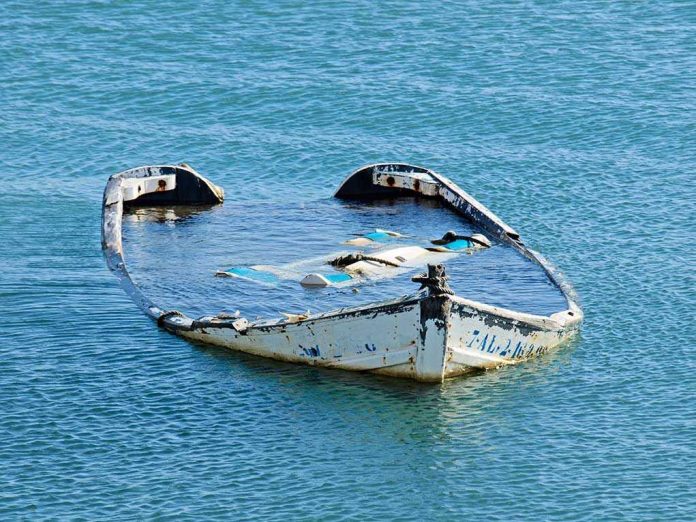
A Hellfire missile has become America’s newest border checkpoint—floating miles off the U.S. coast in the Caribbean Sea.
Quick Take
- U.S. Southern Command struck a vessel in the Caribbean on February 13, 2026, killing three alleged “narco-terrorists.”
- The strike was described as the 39th lethal boat attack since the campaign began in September 2025.
- The Trump administration frames the operation as an “armed conflict” to choke off drug flows and deter cartel networks tied to designated terrorist groups.
- Critics argue the mission blurs counterdrug law enforcement with wartime rules, raising questions about proof of cargo, targeting standards, and long-term effectiveness.
The 39th Strike and the Message It Sends
U.S. Southern Command said a Hellfire strike hit a vessel running known smuggling routes in the Caribbean on February 13, 2026, killing three people identified as narco-terrorists. The date matters less than the number: thirty-nine. That count signals repetition, routine, and a deliberate attempt to reshape traffickers’ cost-benefit math. Missiles turn speedboats into liabilities, and every public announcement dares the next crew to test whether Washington will blink.
The operation’s logic relies on deterrence more than seizures. Traditional counterdrug work celebrates bales recovered and arrests made; this campaign measures success by quiet sea lanes and traffickers who never launch. Defense Secretary Pete Hegseth and the White House have leaned into that framing, describing cartels as adversaries in an armed conflict and claiming some top operators paused or stopped runs after repeated strikes.
Operation Southern Spear: How a Drug Route Became a Battlefield
Smugglers have used the Caribbean for decades because geography rewards them: scattered islands, long coastlines, and enforcement spread thin across enormous water. U.S. estimates have long treated the corridor as a major artery for U.S.-bound cocaine. Operation Southern Spear, launched in early September 2025, changed the playbook by authorizing lethal force against drug boats—an escalation that moved the mission from interdiction to something closer to maritime manhunting.
The timeline shows a campaign that learned to sprint. Strikes began around September 2, 2025, initially at roughly one per week near Venezuelan-adjacent waters, then expanded and intensified by late October, reaching into the Eastern Pacific. The U.S. also built a larger surveillance-and-response posture, including major naval deployments and persistent monitoring off Venezuela. The point wasn’t just to hit boats; it was to make the ocean feel watched.
Why Venezuela Keeps Appearing in the Background
Venezuela sits at the intersection of politics, trafficking, and U.S. strategic impatience. The administration’s November 2025 move to treat Venezuelan-linked cartels as foreign terrorist organizations widened the legal and rhetorical doorway for military action. Then came a bigger jolt: U.S. special forces captured Nicolás Maduro on January 3, 2026, according to the research summary, with U.S. narco-terrorism charges pending in New York.
That capture changed the psychological map of the region. If Washington can grab a sitting strongman, it can certainly destroy a boat. Analysts have warned the campaign could slide from counterdrug strikes into pressure on regime-linked infrastructure, especially if policymakers start treating trafficking as inseparable from state power. The carrier presence and the “armed conflict” framing feed that suspicion, even if the day-to-day targets remain small and mobile.
The Conservative Common-Sense Case for Force—And Its Hard Limits
American conservative values usually start with a government’s first job: protect citizens. If cartel networks move poison into U.S. communities and partner with groups labeled as terrorists, treating them like armed enemies fits a plain reading of national defense. The deterrence theory also matches common sense: repeated, painful consequences can push criminal enterprises to change routes, pause operations, or raise costs until the business model cracks.
Hard limits show up where facts get thin. Critics, including policy watchdog groups, question whether public evidence consistently proves boats carried drugs, posed imminent threats, or met standards Americans expect before lethal force. That skepticism deserves attention because legitimacy matters. A campaign can be tough and still be disciplined; it can be aggressive and still insist on verifiable intelligence, clearer rules, and meaningful oversight—especially when the mission operates far from the U.S. shoreline.
The Next Problem: Displacement, Escalation, and the Counting Trap
Thirty-nine strikes can mean deterrence, but it can also mean adaptation. Traffickers reroute when pressure rises, shifting to different sea lanes, smaller loads, better decoys, or land corridors that punish neighboring countries instead. The research also hints at a possible reduction in recent activity, but the cause remains uncertain: fear, tactical pause, or simple evolution. Counting strikes is easy; measuring reduced drug availability on U.S. streets is harder.
The bigger strategic risk comes from mission creep. Massive naval power chasing small boats can look mismatched, and the rhetoric of armed conflict invites escalation if a strike hits the wrong people or a regional actor retaliates. The Maduro capture and the anti-regime undertone create additional volatility. Conservatives should demand clarity: a defined end state, measurable outcomes, and proof that lethal force serves the national interest rather than becoming a self-perpetuating scoreboard.
Hellfires in the Caribbean feel decisive because they are decisive in the moment—one flash, one wreck, three deaths, and a headline. The open question is what comes after the headlines: fewer overdoses, fewer cartel profits, and a safer homeland, or simply a more militarized whack-a-mole. Operation Southern Spear now owns its number—thirty-nine—and the country will judge it by results that can’t be counted in strikes alone.
Sources:
Trump’s Caribbean Campaign: The Data Behind a Developing Conflict
Operation Southern Spear: U.S. Military Campaign Targeting Venezuela
The Boat Strikes Are Still Happening: Five Things You Need to Know