Asking airport security screeners to work without paychecks during the busiest travel season of the year turns out to be a recipe for catastrophic delays—who could have predicted that basic economics would apply to government workers too?
Story Snapshot
- Security lines stretched to 3.5 hours at Houston Hobby Airport and 3 hours at New Orleans on March 8, 2026, as unpaid TSA workers called out sick during a DHS funding lapse
- Approximately 50,000 TSA screeners have worked without pay since February 13 after Congress deadlocked on immigration reform, with their first full missed paycheck hitting March 13
- The crisis coincides with record spring break travel of 171 million passengers, a 4% increase over the previous year
- The 2025 shutdown already cost TSA 1,110 officers in just two months, a 25% spike in attrition that gutted checkpoint staffing before this new funding gap began
When Political Poker Meets Travel Season Reality
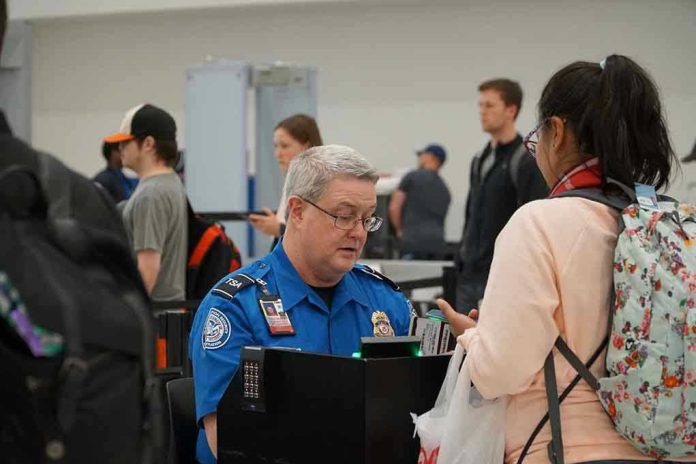
Congress managed to turn spring break into a stress test for American patience by letting DHS funding expire on February 13, 2026. The culprit was a familiar Washington standoff: Democrats demanded immigration enforcement reforms, Republicans refused to budge, and roughly 50,000 TSA screeners became unpaid hostages to the stalemate. These workers still showed up to scan bags and check IDs because aviation security cannot simply shut down, but working without a paycheck has predictable consequences. By March 8, travelers at Houston Hobby faced waits exceeding three and a half hours just to reach their gates.
The timing could not have been worse. Airlines for America projected 171 million passengers would travel during spring break season, up 4% from the previous year. Major hubs like Houston Intercontinental, New Orleans Louis Armstrong, Charlotte Douglas, and Atlanta Hartsfield-Jackson all reported severe delays. Airport officials in New Orleans told passengers to arrive three hours early just for domestic flights. DHS confirmed that delays approached three hours at multiple locations, causing missed connections and scrambled vacation plans for families who booked trips months in advance.
History Repeating With Worse Consequences
This is not the first rodeo for TSA workers caught in shutdown crossfire. The 2018-2019 government closure produced similar checkpoint nightmares and significant attrition as screeners sought jobs that actually paid them. More recently, a 43-day shutdown in late 2025 hemorrhaged 1,110 TSA officers between October and November alone, representing a 25% jump compared to 2024 departure rates. Those losses had not been replaced when the current funding lapse began, meaning checkpoints entered this crisis already understaffed. Ha Nguyen McNeill, who leads TSA, testified to Congress about the 2025 attrition surge, warning that repeated shutdowns make retention impossible.
The fundamental problem is that TSA screeners are classified as essential personnel who must work during shutdowns even though their pay stops. FY2024 DHS appropriations funded TSA operations through normal budget mechanisms, but when funding lapses, those mechanisms freeze while security requirements do not. Screeners face bills, rent, and grocery costs that do not pause for congressional dysfunction. When the first full missed paycheck landed on March 13, absences predictably spiked as workers either called in sick or simply stopped showing up to unpaid shifts.
Blame Game While Passengers Wait
The Trump administration and DHS pointed fingers squarely at Democrats, arguing that immigration reform demands held up clean funding bills. From a conservative perspective rooted in limited government and fiscal responsibility, tying essential security funding to unrelated policy debates demonstrates exactly the kind of Washington dysfunction voters despise. Immigration policy deserves serious debate, but using TSA paychecks as leverage punishes travelers and frontline workers who have no role in legislative negotiations. Airlines for America CEO Chris Sununu captured the cynicism perfectly: “They’re not going to act until something desperate happens, until we get long lines.” He predicted conditions would worsen after the March 13 paycheck miss.
The economic damage extends beyond missed flights and ruined vacations. Airlines lose revenue when passengers cannot board, airports burn resources managing crowd control, and the travel industry’s reputation takes another hit. TSA families meanwhile face genuine hardship, choosing between showing up to work without pay or finding side gigs to cover immediate expenses. Long-term implications look grim: if attrition follows 2025 patterns, checkpoint staffing will deteriorate further just as summer travel peaks. Rebuilding TSA ranks takes months of recruitment and training, meaning today’s political standoff creates operational problems lasting well into 2027.
Sources:
Division C Homeland Security Appropriations FY2024
Security lines at some US airports hit three hours as TSA absences rise