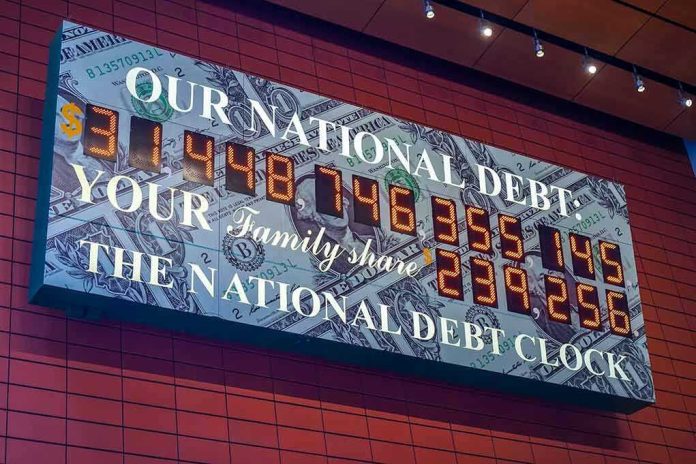
America just borrowed its way past $38 trillion in national debt, climbing at a rate that would make a Las Vegas high roller blush—nearly $70,000 every single second while politicians argue over who’s more fiscally responsible during a government shutdown.
Story Snapshot
- U.S. national debt surged past $38 trillion in October 2025, jumping $4 trillion in less than two years
- The debt accumulates at $69,714 per second, the fastest pace outside COVID-19 emergency spending
- Interest payments alone are projected to consume $14 trillion over the next decade, crowding out other federal priorities
- This milestone arrived during the second-longest government shutdown in U.S. history, as lawmakers remain gridlocked over fiscal policy
- The Trump administration claims deficit reduction success, but experts warn of inflation risks and reduced economic growth
The Staggering Pace of Debt Accumulation
The numbers tell a story that should alarm every American taxpayer. When 2024 began, the national debt stood at $34 trillion. By November of that year, it hit $36 trillion. Come August 2025, we crossed $37 trillion. Now, just two months later, we’ve blown past $38 trillion. That’s a $4 trillion increase in under 22 months—a rate of acceleration unmatched except during the pandemic’s emergency spending frenzy. To put this in perspective, the debt grew more in this short period than the entire federal budget for most years in American history. Every tick of the clock adds another $69,714 to what our children and grandchildren will owe.
The Government Accountability Office isn’t mincing words about what this means for ordinary Americans. Higher debt translates directly into increased borrowing costs across the economy. Businesses face steeper interest rates on loans, reducing their ability to invest in equipment, facilities, and workforce expansion. That reduced investment means fewer job opportunities and lower wages for workers. The ripple effects touch everyone from the small business owner trying to expand to the factory worker hoping for a raise.
Political Theater While Rome Burns
The timing couldn’t be more ironic or troubling. This historic debt milestone arrived during a federal government shutdown—the second-longest in U.S. history. While essential services grind to a halt and federal employees face uncertain paychecks, the debt clock keeps spinning. Lawmakers on both sides of the aisle remain locked in partisan gridlock, unable to agree on spending priorities, tax policy, or meaningful entitlement reform. The spectacle reveals a fundamental dysfunction in American governance: politicians posture about fiscal responsibility while the nation’s credit card bills pile up unopened.
Treasury Secretary Scott Bessent has tried to paint a rosier picture, highlighting that the cumulative deficit from April to September 2025 totaled $468 billion—the lowest since 2019. The administration trumpets this as evidence of spending discipline, claiming a $350 billion reduction compared to the previous year through spending cuts and revenue growth. These claims aren’t entirely without merit. Reducing the annual deficit does represent progress in slowing the rate at which we’re digging the hole deeper. But focusing on the deficit while ignoring the mountain of existing debt is like celebrating that you’re only adding ten feet of water per hour to a flooding basement instead of fifteen.
The Interest Payment Death Spiral
Here’s where the math becomes truly frightening for anyone who understands compound interest. Over the past decade, the United States spent $4 trillion just paying interest on the debt—money that bought exactly nothing in terms of services, infrastructure, defense, or social programs. It simply serviced our past borrowing. Projections show this figure exploding to $14 trillion over the next ten years if current trends continue. That’s $14 trillion that can’t go toward fixing crumbling roads, strengthening national defense, funding medical research, or reducing taxes. It’s dead money, pure and simple.
The Federal Reserve’s efforts to combat inflation through higher interest rates have created a vicious cycle. Those rate increases were necessary to cool an overheated economy, but they’ve dramatically increased the cost of servicing our existing debt. Every percentage point rise in interest rates adds hundreds of billions to what taxpayers must fork over to bondholders. We’re approaching what economists call a “debt doom loop”—where interest costs drive further borrowing, which increases future interest costs, which requires more borrowing, and so on. Breaking this cycle requires politically painful choices that neither party seems willing to make.
Economic Consequences Beyond the Headlines
Expert warnings about this debt trajectory aren’t abstract economic theory—they’re practical predictions about declining American prosperity. When the government borrows this heavily, it competes with private businesses for available capital. This “crowding out” effect drives up interest rates economy-wide, making it more expensive for companies to borrow for expansion, for families to buy homes, and for students to finance education. Reduced business investment means slower productivity growth, which translates directly into stagnant wages and fewer opportunities for working Americans.
The inflation risks are equally concerning. While the administration has made progress on reducing the annual deficit, the sheer scale of existing debt creates ongoing inflationary pressure. Government borrowing effectively prints money, increasing the supply of dollars chasing the same amount of goods and services. For Americans already squeezed by years of elevated inflation, the prospect of debt-driven price increases adding to their burden represents a real threat to family budgets and retirement savings. The purchasing power of hard-earned dollars continues eroding while politicians debate whose fault it is.
A Crisis Decades in the Making
This didn’t happen overnight, and no single party or president bears sole responsibility. The debt crossed $1 trillion in the 1980s, hit $10 trillion during the 2008 financial crisis, and surpassed $20 trillion in 2017. The COVID-19 pandemic added over $5 trillion in two years through necessary emergency spending. But the emergency ended, and the spending didn’t. Structural deficits in entitlement programs like Social Security and Medicare, combined with reluctance to either cut spending or raise taxes sufficiently to cover commitments, have created a fiscal trajectory that everyone acknowledges is unsustainable yet nobody seems able to change.
The path forward requires honest conversations about what Americans want from their government and what they’re willing to pay for it. That means examining sacred cows across the political spectrum—defense spending, entitlement programs, tax policy, and discretionary spending. It means politicians leveling with voters instead of promising everything while delivering debt. Most importantly, it means recognizing that fiscal responsibility isn’t about scoring political points—it’s about preserving prosperity and opportunity for future generations who will inherit the consequences of today’s choices.
Sources:
Joint Economic Committee Republicans – Debt Dashboard