When a franchise finally breaks a 53-year title drought in a city that treats sports as a civic religion, you do not just get a win—you get a collective eruption that spills from the arena into the streets and, soon after, onto the Canyon of Heroes.
Key Points
- The New York Knicks have secured their first NBA championship since 1973, ending a 53-year drought that has defined generations of fandom.[2][3]
- The win triggered immediate, mass street celebrations across Manhattan, with fans flooding the areas around Madison Square Garden and beyond.[5]
- New York City’s mayor, Zohran Mamdani, has formally announced a Knicks ticker-tape parade and civic ceremony, converting anticipation into official policy.[6][7]
- This will be the first full-fledged championship parade in Knicks history, turning decades of deferred hope into a rare shared civic ritual.[8]
A drought broken, a city unleashed
The core fact is uncontested: the New York Knicks are NBA champions again. In Game 5 of the Finals, they closed out the San Antonio Spurs 94–90, winning the series 4–1 and capturing their third title in franchise history.[2][3] It is the first since 1973, a 53-year gap that has loomed over both the organization and its fan base. That time scale matters. It means most living Knicks fans had never seen a title; the drought became part of New York’s self-understanding, shorthand for frustration and loyalty tested but not broken.
The trophy presentation on the floor made that history explicit. Commissioner Adam Silver handed the Larry O’Brien Trophy to Knicks leadership as the arena roared.[2] Owner Jim Dolan, long a lightning rod, struck a rare communal tone, saying he “saw a team” that “beat a team the whole time,” a nod to the collective identity the franchise has tried to rebuild.[1] President Leon Rose echoed the theme, praising the “family atmosphere” and willingness to sacrifice that underpinned a 16–3 playoff run.[1] Head coach Mike Brown called the moment “surreal,” and star big man Karl-Anthony Towns framed it in almost fatalistic terms: “It is written. This was written for New York and we went and got it done today.”[1]
Those are not just victory-lap clichés; they are an attempt to articulate why this particular title feels like the end of a long, shared ordeal. For New York, the championship is not a sudden surprise. It is the payoff to decades spent watching other cities host parades while Knicks fans sat with their what-ifs.
From arena to asphalt: how New York celebrated
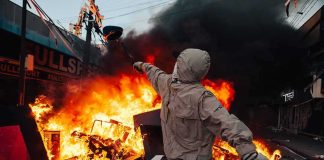
The instant the final buzzer sounded, the story moved from the court to the city itself. Local outlets documented the transition in real time. ABC7NY and other broadcasters showed fans pouring out of bars, watch parties, and living rooms onto the streets around Madison Square Garden and deep into midtown.[5][6] Seventh Avenue became a spontaneous block party, with blue-and-orange jerseys jammed shoulder to shoulder, horns blaring, and chants of “Let’s go Knicks” ricocheting off buildings.
Fox 5 New York captured the emotional range of the reaction: older fans, some in tears, hugging strangers and talking about loved ones who had not lived to see this day; younger New Yorkers seeing their first Knicks championship and treating it as the natural order finally restored.[5] Social clips—from Times Square to the West Village—showed a city behaving less like it had won a game and more like it had reclaimed a piece of its identity.[3] In a town accustomed to Yankees canyons and Giants rallies, Knicks joy has always been mostly hypothetical. Suddenly, it was physical: dancing on sidewalks, climbing light poles, turning intersections into mosh pits.
There were rough edges. CBS reporting referenced scattered arrests after pockets of rowdy behavior tipped into minor mayhem.[5] That too is part of the pattern for large, emotionally charged gatherings in dense urban space. But the dominant motif was catharsis, not chaos. For a few hours, New York functioned as one big postgame bar, all exits leading to the street.
From “there will be a parade” to “here is the parade”
In the immediate aftermath of a championship, media and social platforms often speak in the future tense long before city hall signs anything. That familiar gap between “expected” and “announced” is where confusion often creeps in. Initially, coverage around the Knicks win fell into that pattern: broadcasters and fans confidently predicting a ticker-tape parade, Instagram posts asking “who is making the trip for the parade?” and Facebook groups sharing speculative route and attire guidance.[1][2][4]
The key difference in this case is that the informal conversation quickly converged with formal authority. New York City mayor Zohran Mamdani publicly confirmed that the Knicks will receive a ticker-tape parade through Manhattan on a Thursday date—June 18—followed by a City Hall ceremony.[6] Fox 5 summarized the announcement, noting that the celebration would include Keys to the City and skyline illuminations in Knicks colors.[6] Bleacher Report independently reported that Mamdani used a post on X to announce “a championship parade will take place on Thursday in Manhattan,” providing the same core details.[7] Basketball outlet BasketNews likewise described a “2026 championship parade through Manhattan on Thursday,” framing it as the formal celebration of the first title since 1973.[8]
That cluster of outlets—local television, national sports media, and international basketball press—are not primary legal documents. They are, however, consistent secondary witnesses tying the decision directly to the mayor by name and specifying date and basic location.[6][7][8] Social channels tracking city politics amplified the same message, quoting Mamdani’s confirmation that the parade would take place in New York City on June 18.[9] At that point, the parade ceased to be journalistic assumption and became municipal policy, even if the underlying permit paperwork and NYPD operations memos are not sitting in the public’s lap.
The Canyon of Heroes and a long-delayed first Knicks parade
New York’s ticker-tape parades are not generic marches; they are a specific civic ritual tied to the stretch of Broadway known as the Canyon of Heroes. The tradition dates back more than a century, with honorees ranging from Charles Lindbergh to the 1969 Mets, from astronauts to World Cup teams. For decades, however, the Knicks have been conspicuously absent from that roll call. Archival reminders circulate regularly: in 1970, the team celebrated at Gracie Mansion; in 1973, there was a City Hall ceremony, but no full ticker-tape parade down Broadway.
That context is why this moment carries extra symbolic weight. Social posts by Knicks historians and fan accounts underscore the point bluntly: “The New York Knicks have never had a championship parade.” The emphasis is not on pedantic record-keeping; it is on the sense that an iconic New York institution had never been invited into the city’s highest civic ritual. The newly announced parade closes that loop. It places the Knicks alongside other champions who have been showered with confetti paper from office windows as they move past the financial district’s stone canyons.
Community planning chatter has already begun to map the familiar route, with fan-organized groups circulating expected paths along Battery Place and Broadway toward the civic center.[1] While these grassroots guides are not authoritative, they track closely with the standard Canyon of Heroes template and with the broad “through Manhattan” formulation in media reports.[7][8] For most attendees, the precise turn from Worth to Lafayette will matter less than the simple fact of seeing a Knicks float in that corridor at all.
YESSSS! First title in 53 years! Knicks are champions! 🏆 The parade is gonna be insane. New York forever!
— -❁RSL❁(╹◡╹)♡- (@rodshaleang1994) June 14, 2026
Emotion, media, and the risks of narrative outrunning process
This episode also illustrates how modern sports celebration narratives are shaped. In the hours after a title, clips and captions outrun bureaucracy. Instagram reels show “New York wild rn” as fans play keep-up with a basketball in midtown; TikTok highlights from the NBA itself celebrate the “first title in 53 years” with emphatic overlays.[2][4] X users joke that the ticker-tape parade will be “the closest thing New York City ever experiences to world peace,” while others trade plans about calling out of work to attend. The story most people absorb is not “a parade is under consideration” but “the parade is happening,” long before the ink dries on a special-events permit.
That media environment creates genuine risks for accuracy. As researchers of civic events note, commercial incentives favor the dramatic and the shareable over the procedural.[1] Broadcasters get more audience from lingering on weeping fans than from interviewing a deputy commissioner about traffic diversions. Social posters gain more traction predicting “total riot” or “New York is officially over” than quoting the precise wording of a City Hall press release.[2] In that environment, the distinction between a parade being anticipated and officially announced can evaporate unless journalists and city officials communicate clearly and early.
In the Knicks case, the counter-evidence review finds no meaningful opposition to the basic facts: the team won the championship, the city is embracing it, and the parade has been specifically confirmed by the mayor.[6][7][8] The initial documentation gap—no permit PDFs, no NYPD route map—reflects the normal lag between decision and fully published logistics, not a dispute over whether the event will occur. For historically minded fans, the more interesting question is not whether the parade is happening but what it reveals about how New York now wants to relate to its basketball team.
What this means for New York and for Knicks fandom
For the franchise, this championship and its aftermath mark a turning point. The language from ownership, front office, and players—team, family, sacrifice—aligns with what skeptical fans have long demanded: competent, coherent stewardship that respects both the game and the city.[1] A 16–3 playoff run that included winning all four series on the road is not just narratively satisfying; it is the sort of dominant performance that helps heal past scars.[1]
For the city, the parade will serve as both celebration and civic reset. It is a chance to see midtown not as a commuter gauntlet but as a shared living room, to watch older fans who suffered through decades of false starts stand alongside teenagers who know the Knicks only as winners. In a moment when many large cities face narratives of fragmentation and decline, staging a safe, exuberant, well-managed mass gathering has symbolic value beyond sports.
And for the fans who packed Seventh Avenue the night the trophy was lifted, the jammed streets were a preview. The difference is that, soon, police barricades, sanitation trucks, and timing grids will frame what was once spontaneous. The confetti will be officially sanctioned; the chants will echo against office towers instead of just arena walls. After 53 years of waiting, Knicks supporters are finally getting what other fan bases take for granted: the right to bring their basketball joy into the heart of the city and watch it fall from the sky like ticker tape.
Sources:
[1] Web – Knicks fans go insane after first NBA Finals win in 53 years — with …
[2] Web – hoisting the trophy & announced for first time as CHAMPS! – #NBA
[3] Web – What a way for Knicks fans to celebrate this historic win – Instagram
[4] Web – The New York Knicks have never had a championship parade …
[5] Web – New York Knicks Championship Parade Details and Attire Guidelines
[6] YouTube – Knicks fans take to NYC streets to celebrate Knicks win
[7] Web – Knicks to have NYC ticker-tape parade on Thursday: Details
[8] Web – Knicks Parade 2026 Route, Date, Schedule, TV Info and More
[9] Web – Knicks championship parade announced: Date and location confirmed