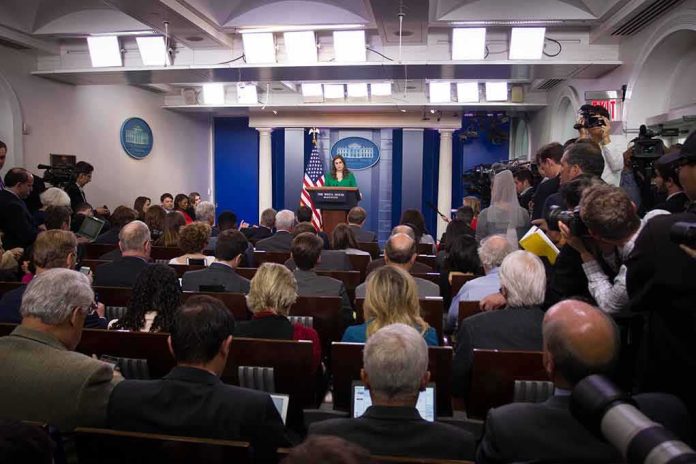
Karoline Leavitt’s departure from the White House press secretary role is best understood not as a rupture, but as a highly visible personnel transition wrapped in the language of family, loyalty, and political continuity. The reporting supports a temporary step back from the podium, with Leavitt still remaining inside Trump’s wider orbit rather than disappearing from it.
Intro Header
- The core fact is simple: Trump says Leavitt is leaving at the end of the month to spend more time with her family.
- The official narrative does not describe a firing; it places Leavitt in an advisory role after she steps away from the daily briefing schedule.
- Leavitt herself has already tied her recent absences to maternity leave and the demands of caring for young children.
- The rumor of a deeper break rests mostly on interpretive chatter and old briefing-room tensions, not on documentary evidence of forced removal.
A Family-Centered Exit, Not a Political Ejection
The central record in this story is remarkably consistent. Trump said Leavitt would leave her role at the end of the month so she could spend more time with her young children and family, and he framed the decision as one he “totally understand[s] and respect[s].” That matters because in Washington, the distinction between “stepping down” and “being pushed out” is not semantic trivia; it determines whether a departure is read as a sign of collapse or simply as a recalibration of duties. Here, the public statements point firmly toward the latter.
Trump’s account also preserves Leavitt’s political value. Rather than severing ties, he cast her as an “outside advisor” and an “influential voice” within the Republican Party. That is an important signal. In administrations built around a small circle of loyal communicators, a press secretary often functions as both messenger and political surrogate. Moving someone off the podium while keeping them in the advisory network is a familiar Washington pattern: the title changes, but the relationship remains intact.
Why the Family Explanation Fits the Public Record
Leavitt’s own recent remarks reinforce that interpretation. Before this latest departure, she had already gone on maternity leave, and multiple reports noted that she returned to the White House podium after giving birth to her second child in May. In the available footage, she described her earlier goodbye to reporters in plain terms associated with leave, not dismissal, and one clip quoted her saying, “This will likely be my last gaggle for some time.” That kind of language is what routine family leave sounds like when it comes from a public official whose job requires relentless visibility.
The chronology matters as much as the phrasing. Leavitt temporarily stepped away in late April, returned to the briefing room in mid-July, and then faced a fresh announcement in August that she would depart at month’s end. That sequence is unusual only in the sense that it is compressed. It is not unusual in the sense of indicating a scandal. Public-facing roles, especially among very young parents, are often shaped by the practical friction between institutional demands and family life; the White House press secretary is simply one of the most scrutinized examples of that tension.
Where the Rupture Theory Comes From
The counter-narrative is not invented out of thin air. There is a visible pattern of tense, abrupt briefing-room exits in the material supplied, including clips that describe Leavitt “storming out” after heated exchanges with reporters and “abruptly” ending a press briefing without taking questions. Those videos provide emotional fuel for a rupture story because the press secretary’s job is public combat by design; every sharp exchange can be reinterpreted as evidence of strain. But the videos do not show a personnel decision, and they do not contradict the family-leave explanation in any concrete way.
That distinction is crucial. Behavior in a briefing room can tell you something about atmosphere; it does not, by itself, tell you whether a departure is voluntary, temporary, or disciplinary. The strongest skeptical argument in the supplied record is not “she was fired,” but rather “the White House has not laid out the paperwork in public.” That is a legitimate transparency critique, but it is not evidence of a firing. Inference is not documentation, and in politics the two are often mistaken for each other because both travel well on social media.
The Administrative Mechanics Behind a Very Public Role
Press secretary departures are inherently overread because the role is symbolic. The press secretary stands at the intersection of message discipline, presidential access, and staff loyalty; any change at that desk is instantly treated as a proxy for the president’s confidence in the inner circle. That is why a move that is likely administrative can be inflated into a narrative of factional warfare. The public record here, though, points to a lighter explanation: no named replacement was immediately introduced, and the available reporting describes a continued advisory role rather than a clean break.
That matters for how the White House functions. A modern communications operation does not live or die by a single podium occupant; it is distributed across aides, surrogates, and senior officials. The supplied material even notes temporary fill-ins during Leavitt’s earlier leave, underscoring that the operation had already adapted to her absence once before. In other words, the office is designed to absorb interruptions. A departure from the briefing room can be important without being destabilizing.
What This Means for the White House Communication Machine
The larger lesson is that personnel moves in a Trump White House are often read through two competing lenses at once: loyalty politics and life logistics. Supporters hear reassurance when Trump praises the departing aide and promises she will stay close. Critics hear euphemism and suspect a soft landing that masks something sharper. The evidence supplied here supports the first reading more strongly than the second. There is no primary-source document, named rebuttal, or official record in the package showing a firing, demotion, or forced removal.
That does not make the story trivial. Leavitt has become a recognizable emblem of the administration’s communications style, and her move away from the press secretary role will change the daily texture of the White House briefing operation. But the meaning of that change is not a scandal unless stronger evidence emerges. For now, the cleanest reading is also the most ordinary one: a young, high-profile press secretary is stepping back from a punishing public job, Trump is keeping her nearby, and the political world is doing what it always does with visible departures — turning a personnel adjustment into a drama before the facts warrant it.
🚨 White House press secretary to leave her role at the end of the month — Trump
💬 “Our wonderful White House Press Secretary, and one of my most trusted aides, Karoline Leavitt, will be departing her role at the end of the month,” US President Donald Trump wrote on Truth… pic.twitter.com/Z6DMN2uLNv
— brane mijatovic (@brane_mija64426) August 12, 2026
Sources:
facebook.com, azfamily.com, usatoday.com, btimesonline.com, youtube.com, c-span.org, reddit.com, independent.co.uk