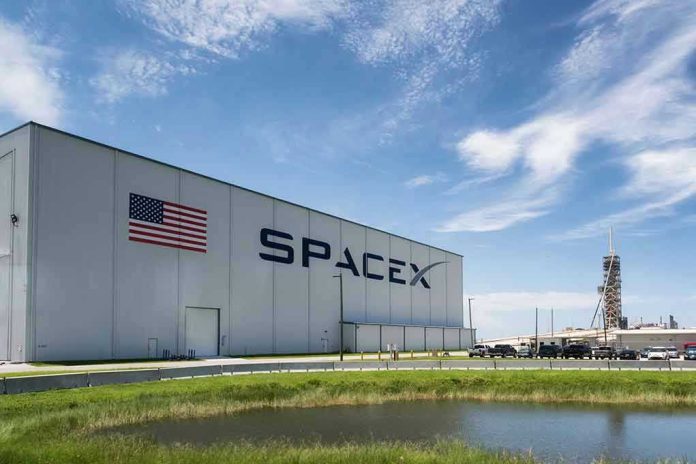
Wall Street’s next mega-IPO could mint the world’s first “trillionaire” while everyday Americans are still paying the price for years of inflation and elite-driven priorities.
Story Snapshot
- Multiple outlets report SpaceX has confidentially filed preliminary paperwork for an IPO, with a possible launch as soon as June 2026.
- Reports cite a potential raise of roughly $50–$75 billion and a valuation range of about $1–$1.5 trillion, which would likely make it the biggest IPO ever.
- Elon Musk’s reported 42%–44% stake could push his net worth past $1 trillion, depending on final pricing and any dilution.
- Because the filing is confidential and SpaceX has not publicly confirmed details, the exact timing, valuation, and share structure remain uncertain.
SpaceX’s confidential filing sets off a high-stakes Wall Street scramble
Reports published April 2–3, 2026 say SpaceX has confidentially filed IPO paperwork, a process that lets companies and regulators work through disclosures before the public sees an S-1. The reporting points to investment banks preparing what could become a blockbuster listing, with a targeted window as soon as June. SpaceX has not publicly confirmed the filing, so key deal terms still rest on unnamed sources familiar with the process.
The scale being discussed is enormous by any standard. Several reports put the capital raise in the tens of billions, with valuations floated from $1 trillion up to $1.5 trillion. That range would eclipse the largest prior IPO benchmarks often cited in mainstream coverage, and it would instantly turn SpaceX from a long-private national-security-adjacent contractor into a household ticker symbol—opening the door for retail investors while also pulling the company deeper into Wall Street’s short-term expectations.
How Musk gets to “trillionaire” depends on valuation math and dilution
The trillionaire headlines hinge on two moving parts: SpaceX’s eventual market cap and Musk’s stake after new shares are issued. Reporting puts Musk’s ownership roughly in the low-to-mid 40% range, with some references citing 42% and others 44% based on prior disclosures. If pricing lands near the top end of the reported valuation range, even a modest reduction in ownership from dilution could still lift Musk’s paper wealth over the trillion-dollar mark.
Wealth estimates also vary across coverage, underscoring how much of this story is still a projection rather than a completed transaction. Some reporting cites Forbes placing Musk around $823 billion, which frames SpaceX’s potential listing as the tipping point. Other figures floating in the media appear lower and likely reflect older snapshots or different methodologies. Until the IPO is public, and until the share count, lockups, and pricing are known, “world’s first trillionaire” remains a plausible outcome—not a verified fact.
Why SpaceX’s value has surged: Starlink scale and U.S. launch dominance
SpaceX’s rise from a 2002 startup to a company discussed in trillion-dollar terms is tied to reusable rocketry and the growth of Starlink, now widely described as the largest satellite internet provider. Reports also cite the company’s continued NASA relationship and the steady demand for launches, which together support the view that SpaceX is not just a speculative tech play. A late-2025 valuation around $750 billion, cited in coverage referencing secondary sales, set the baseline for today’s IPO chatter.
That said, a rapid jump from roughly $750 billion in late 2025 to as much as $1.5 trillion in mid-2026 is exactly why investors should watch the details rather than the hype. Secondary-market valuations can behave differently than a public market once quarterly scrutiny, liquidity, and macro conditions kick in. If the deal is priced aggressively, early trading could be volatile, and the “headline valuation” may not hold if broader market sentiment turns.
What it could mean for the public: access, risk, and a bigger politics-of-power debate
For everyday investors, a SpaceX IPO would create something many Americans have wanted for years: a chance to buy into a company that has been effectively off-limits while it scaled. Employees and long-time private investors could also finally see liquidity after decades in a private structure. But the same dynamic raises a caution flag: when elite finance sets the terms, the average buyer often arrives after the biggest gains have already been captured privately.
Conservatives watching the bigger picture may also see a familiar tension: America’s private-sector excellence on display, alongside a system where the largest players can operate with limited transparency until the moment they decide to cash in. Confidential filings are legal, but they limit what the public can evaluate in real time. If SpaceX becomes a public company, constitutional concerns are not the issue—market integrity and honest disclosure are. The deal will stand or fall on what the filings ultimately reveal.
For now, the most responsible takeaway is straightforward. The reporting indicates a confidential filing and a possible June 2026 timeline, but no official confirmation and no final numbers. Investors should separate “trillionaire” hype from the mechanics—valuation, dilution, lockups, and revenue disclosures—because those details determine who wins and who overpays. If the IPO proceeds, it will be a defining test of whether today’s market rewards real capability or just the biggest story.
Sources:
Elon Musk Just Filed for Space X IPO
Elon Musk, world’s first trillionaire: one implication of the massive SpaceX IPO
Elon Musk to Be Trillionaire in SpaceX IPO