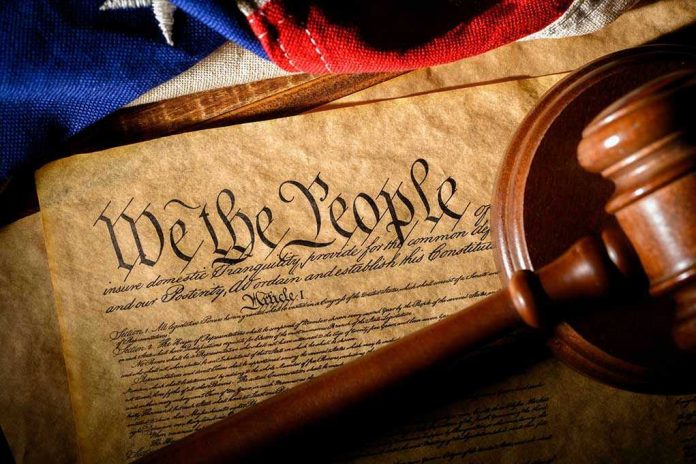
The Supreme Court sits on a matchstick: a 14-word clause that could reset who belongs to America—and whether courage still lives in black robes.
Story Snapshot
- The Constitution’s Citizenship Clause contains a limiting phrase—“subject to the jurisdiction”—that animates today’s fight over birthright citizenship [16].
- United States v. Wong Kim Ark is widely read to protect citizenship for most born on U.S. soil, but dispute remains over children of those here unlawfully [3].
- Advocates urge the Court to narrow birthright citizenship; opponents warn of chaos and two-tier nationality if it does [15].
- Policy pressure escalated after a presidential order sought to cabin birthright citizenship, pushing a direct test to the Court [20].
The Clause That Built a Nation Now Faces Its Smallest, Hardest Words
Fourteenth Amendment Section 1 speaks plainly—citizenship for all born or naturalized “and subject to the jurisdiction thereof”—until that final phrase forces a choice: territorial birthright for nearly everyone, or a limited grant tied to allegiance and lawful ties. Constitutional annotation used by Congress describes the Clause and its doctrine, underscoring long-running debates over the breadth of “jurisdiction” [16]. That single hinge decides whether children of undocumented entrants and short-term visitors inherit membership, or whether the nation may require something more.
United States v. Wong Kim Ark anchors modern understanding. State Department guidance cataloging Supreme Court decisions treats Wong Kim Ark as confirming that a person born in the United States to noncitizen parents was a citizen under the Fourteenth Amendment, a view institutional actors have applied for generations [3]. Critics argue the ruling concerned lawful resident aliens and left unanswered whether children of those present unlawfully, or transiently, fall inside the Clause’s protection, keeping the interpretive door ajar.
Original Meaning Versus Settled Practice: The Conservative Fork in the Road
Proponents of a narrower reading focus on consent and allegiance. They read “subject to the jurisdiction” as requiring full political obedience, akin to what the Reconstruction Congress denied to the children of diplomats and occupying forces. The Council on Foreign Relations explains how birthright citizenship differs from naturalization, reinforcing the binary Congress and the Constitution created [4]. A narrower rule would reaffirm that citizenship is not an automatic byproduct of violating immigration laws, aligning membership with responsibility, rule of law, and a coherent social contract.
Institutional defenders counter that reversal would fracture families and manufacture statelessness risks. The American Immigration Council frames birthright citizenship as a stabilizing principle that avoids inherited caste and bureaucratic overreach [15]. They warn that creating a paperwork test at the hospital would invite discrimination and litigation. From this view, the Clause’s jurisdiction language already excludes children of diplomats and hostile forces, and the rest of the line has held for practical, moral, and constitutional reasons. The conservative reply is simple: durability is not destiny when the text points elsewhere.
The Executive Gauntlet and the Court’s Test
The modern fight sharpened when a presidential action sought to limit birthright citizenship for defined categories of children, arguing the Fourteenth Amendment has always had exclusions broader than the diplomatic carveout [20]. That move forced a reckoning that Congress avoided for decades. The Brennan Center’s overview underscores how mainstream institutions have long read the Clause to include the children of immigrants, which sets a high bar for change and frames the executive’s gambit as a direct challenge to precedent and entrenched administrative practice [1].
'It would be a disgrace if SCOTUS allows that to happen': Trump pressures Supreme Court over birthright citizenship debate
READ: https://t.co/ule50HJnnAhttps://t.co/ule50HJnnA
— WION (@WIONews) May 21, 2026
The Court now faces two clean paths and one messy compromise. It can reaffirm a broad territorial rule and tell political branches to fix immigration at the border and in the workplace. It can recognize a lawful-presence principle and hold that those who defy sovereign consent cannot transmit membership as a reward for the violation. Or it can craft a middle rule that tracks durable residence and clear ties. Conservative common sense favors clarity: citizenship, once given, is nearly impossible to unwind. The safer course is to anchor it to law and allegiance at the front end.
What Courage Looks Like When Words Are This Small
Courage here is not rhetorical; it is methodological. The Court must read the text that exists, not the policy it prefers. If “subject to the jurisdiction” means more than mere presence—as diplomatic and enemy-force exceptions suggest—then the Court should say so and define the limiting principle precisely. If Wong Kim Ark extends to all but the narrowest historical exceptions, the Court should forthrightly reaffirm that rule and instruct the political branches to address illegal entry with enforcement, not citizenship tinkering. Either way, precision beats drift, and the nation needs a rule everyone can read without a lawyer.
Sources:
[1] Web – Birthright Citizenship Under the U.S. Constitution
[3] Web – 8 FAM 102.3 SUPREME COURT DECISIONS – Foreign Affairs Manual
[4] Web – What Is Birthright Citizenship and Could the Supreme Court End It?
[15] Web – Birthright Citizenship – American Immigration Council
[16] Web – Amdt14.S1.1.2 Citizenship Clause Doctrine – Constitution Annotated
[20] Web – Protecting The Meaning And Value Of American Citizenship