As India publicly blasts Washington over a deadly tanker strike, Trump’s America faces a hard test: enforce a vital Iran blockade without letting hostile media turn it into a story of “reckless” U.S. power.
Story Snapshot
- Three Indian sailors died after a U.S. strike disabled the Palau-flagged tanker MT Settebello off Oman, deepening global tensions.[1][2]
- U.S. Central Command says the ship was breaking a lawful Iran oil blockade and ignored repeated orders to stop before a precision hit on its engine room.[1][2]
- India has summoned the top U.S. diplomat in New Delhi, demanding an end to ship attacks and stressing freedom of navigation for commercial vessels.[1][3][4][5]
- The clash unfolds in a war zone where Iran is already attacking commercial shipping, and where any U.S. hesitation could embolden the regime and drive up energy costs.
What Happened Off Oman — And Why It Matters To Americans
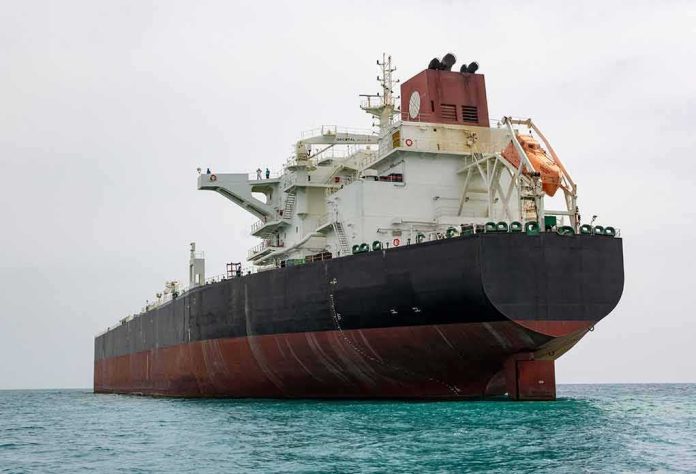
News from the Gulf of Oman is simple but serious: a U.S. aircraft hit the engine room of the Palau-flagged oil tanker MT Settebello after its crew “repeatedly failed to comply with directions from American forces.”[1][2] The strike disabled the ship near the Strait of Hormuz, a narrow sea lane that carries a huge share of the world’s oil. Indian officials say three Indian sailors on board were killed and later identified by name, turning a military enforcement action into a human tragedy.[1][2][3]
India says the Settebello carried twenty-eight crew members, including twenty-four Indians, and calls the incident a direct result of the wider West Asia conflict.[3][4] U.S. Central Command states the tanker was “violating the ongoing blockade by attempting to transport oil from Iran,” tying this strike to a broader campaign to choke off Iran’s energy revenue.[1][2] The ship’s manager has pushed back, denying any link to Iranian oil and demanding a transparent international probe into what happened and why.[1]
India’s Sharp Protest: Civilian Safety Versus U.S. Blockade Policy
New Delhi has not stayed quiet. India summoned Jason Meeks, the United States chargé d’affaires in New Delhi, to lodge a formal demarche and express “deepest concerns over the ongoing attacks.”[1][3][4] Officials stress that three Indian sailors have died on the Settebello and that two other tankers with Indian crews, including the Marivex and Jalveer, were also hit or disabled in recent days.[1][2][3] India frames its protest around freedom of navigation, commercial safety, and the rights of its citizens who work at sea.[3][4][5]
India’s foreign ministry says all three targeted ships were foreign-flagged and notes that at least two were already sanctioned or listed as non-compliant vessels under U.S. rules.[3] That detail cuts both ways. It shows Washington was not picking targets at random. But it also fuels India’s argument that its people are paying the price for a conflict between Iran and the West. Indian media and some opposition voices are already leaning into an emotional narrative of innocent seafarers caught in the crossfire.[4]
Trump’s Dilemma: Be Tough On Iran Without Feeding The “American Bully” Storyline
For Trump’s administration, this crisis sits at the crossroads of two core promises: crush the Iranian regime’s terror funding and protect American prosperity at home. The U.S. blockade aims to stop Iran from using shadow tankers to move oil, raise cash, and keep its war machine alive. U.S. Central Command says it has redirected or disabled dozens of tankers trying to enter or leave Iranian ports since the start of the blockade, often using precision strikes on stacks or engine rooms instead of full ship seizures.[2]
At the same time, Iran is already attacking commercial shipping across the Gulf of Oman and Persian Gulf, using drones, missiles, and unmanned boats to send a message that no vessel is truly safe. A U.S. maritime advisory warns that the risk to commercial ships in this region is “high” and urges American-flagged vessels to keep their distance from U.S. warships and answer all radio calls. In other words, this is not peacetime law enforcement. It is an active combat zone where hesitation can invite attacks, but any civilian death is instantly weaponized by critics.
What We Still Do Not Know — And Why Transparency Matters
Both sides are now locked into public talking points, but key facts remain hidden from view. Reporters quote U.S. Central Command saying the Settebello was warned many times and refused orders to stop, yet the underlying radio logs, strike video, and full battle-damage report have not been released.[1][2] India, for its part, has not provided ship logs or cargo records that would disprove the U.S. claim that the tanker was carrying or seeking Iranian oil.[1][3]
Deeply devastated by the tragic news from the Gulf of Oman. Three innocent Indian civilian seafarers — Patnala Suresh, Shivanand Chaurasiya, and Aditya Sharma — have lost their lives following a targeted US precision military strike on the commercial oil tanker, M/T Settebello.…
— Shashi Tharoor (@ShashiTharoor) June 11, 2026
For Americans who care about a strong but lawful military, this gap matters. Trump’s team has a clear interest in showing that U.S. forces did everything by the book: issued clear warnings, used precise weapons, and focused on disabling suspected sanctions-busting ships while minimizing harm.[2] Releasing more evidence would undercut hostile media and foreign governments who want to paint our country as a lawless aggressor. It would also honor the families of the dead sailors by giving a fuller account of the decisions that led to that strike.
Sources:
[1] Web – India Demands End to U.S. Ship Attacks After 3 Sailors Killed
[2] Web – May 26, 2026: CENTCOM: U.S. Defensive Strikes Against IRGC …
[3] Web – Lethal Kinetic Strike, June 3, 2026 – southcom
[4] Web – CENTCOM launches new strikes against ISIS targets in Syria
[5] Web – 2026 United States military buildup in the Middle East – Wikipedia