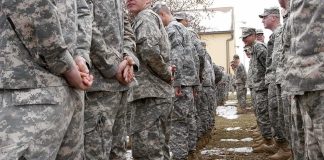
When Congress fights over military pay, the sharpest fault line is no longer whether to raise salaries at all, but whether the youngest, lowest‑paid troops should finally break away from the “everyone gets the same percentage” tradition that has left many of them struggling at the edge of poverty.
Key Points
- Junior enlisted personnel (E‑1 to E‑4) have become the focal point of military pay debates, with House lawmakers pushing targeted double‑digit raises on top of across‑the‑board increases.[4][6]
- The Senate has repeatedly favored flatter, more uniform raises, endorsing smaller junior‑enlisted premiums or initially rejecting larger House proposals before agreeing to a scaled‑back compromise.[1][2]
- The FY25 NDAA deal—4.5% for everyone plus another 10% for E‑1 through E‑4, totaling 14.5%—is both a historic win for young troops and a retreat from the House’s original 19.5% ambition.[4][1]
- Despite rhetoric about hardship and food insecurity, neither side has anchored its position in publicly available, granular data on rank‑by‑rank cost burdens, leaving the argument to be fought mainly on policy preference and budget politics.[4][5]
How junior enlisted pay became the pressure point
Modern military pay is built on a simple mechanical rule: each January, basic pay rises roughly with private‑sector wages, using the Employment Cost Index as the benchmark.[10] That structure keeps compensation broadly in line with the civilian labor market, but it is indifferent to the lived reality of a 19‑year‑old private paying off a used car while renting near an expensive coastal base. When inflation spikes or housing markets run hot, the statutory formula does not discriminate; a colonel and a brand‑new seaman get the same percentage bump, even though a jump in rent or groceries consumes a much larger share of the junior member’s income.
Over the last several years, those structural stresses have become impossible for lawmakers to ignore. Stars and Stripes reported that some junior enlisted members were earning “as little as $24,000 in basic pay,” even as housing allowances and local rents rose in tandem.[1] That is not a trivial hardship; for a young service member with a spouse and child, it is the difference between being marginally above the poverty line on paper and relying on food pantries in practice. A bipartisan quality‑of‑life panel spent months examining pay, housing, and food insecurity and concluded that junior pay had failed to keep pace with both inflation and the private sector.[5] That set the stage for a more fundamental challenge to the one‑size‑fits‑all raise.
The House’s bid for a structural correction, not a symbolic bonus
House Armed Services Committee leaders did not tiptoe into this debate; they aimed to rewrite the basic pay table for the bottom of the ranks. Their FY25 blueprint layered a 15% targeted raise for E‑1 through E‑4 on top of the standard 4.5% across‑the‑board bump, for a combined increase of 19.5% for the most junior troops.[4][9] In committee and floor materials, House members framed this not as a morale boost but as a correction of a chronic underpayment problem, explicitly citing “steep inflation and the rising cost of living.”[1][5] The committee’s own release spelled out what that meant in concrete terms: with the compromise’s 14.5% raise, not even the full 19.5% they wanted, junior troops would gain about $3,000 to $6,000 per year depending on rank, raising an E‑1’s annual basic pay from $24,206 to $27,828 and an experienced E‑4’s from $38,368 to $44,107.[5]
Crucially, the House effort did not operate in isolation. It was bundled with expansions of the Basic Needs Allowance, a stipend designed to help low‑income military households avoid food insecurity; the bill raised the eligibility cap from 150% to 200% of federal poverty guidelines.[5] It also aligned with moves to restore full Basic Allowance for Housing coverage of average rent, reversing an earlier policy that had left service members responsible for 5% of calculated housing costs.[4] Taken together, these choices send a clear signal: lawmakers accepted the premise that junior enlisted families are uniquely exposed to economic pressure and that their compensation problem could not be fixed by a flat percentage applied to the entire force.
Why the Senate pushed back—and what it did and did not reject
The Senate never denied that young troops were under strain. What it resisted was the scale and structure of the House’s solution. Early reporting on the Senate Armed Services Committee’s draft showed a markedly different posture: a 4.5% raise for all service members, consistent with White House guidance, and only a 5.5% total increase for junior enlisted—just 1% above the baseline.[2] Stars and Stripes later summarized the chamber’s counteroffer as a 5.5% raise for E‑1 to E‑4, in contrast to the House’s 19.5% proposal.[1] In other words, the Senate’s instinct was to preserve the standard formula and tinker at the margins, not to overhaul the bottom of the pay table.
The administration’s position ran in the same direction. The White House expressed “strong opposition” to making such a large, permanent change to basic pay before a formal compensation review, warning of “pay compression” if junior salaries moved too close to mid‑grade enlisted pay without comparable adjustments above.[5] The argument was not that junior enlisted members were comfortable, but that a sudden, steep adjustment at the bottom could distort the entire pay structure and should wait for a broader analysis.
Budget politics amplified that caution. House staff estimated that the extra 15% for junior troops would cost more than $24 billion over five years.[6] For senators already navigating hard caps on overall defense spending, absorbing that bill for a single component of pay—however sympathetic—was a heavy lift. A flat raise is both more predictable in cost and easier to defend to the rest of the force: everyone gets the same percentage, no one is singled out for a smaller increase.
The eventual compromise: a win, but smaller than the need‑based case implied
After months of negotiation, Congress landed on a hybrid design. The FY25 NDAA grants a 4.5% across‑the‑board basic pay raise effective at the start of the year and adds an extra 10% for E‑1 through E‑4 beginning in April, for a total of 14.5% for the most junior troops.[5] Stars and Stripes accurately called it a “historic 14.5% pay raise” for junior enlisted, emphasizing that all others would receive the 4.5% bump only.[1] Sen. Jon Ossoff’s office celebrated the same structure as a “historic pay increase for junior‑enlisted servicemembers,” underscoring that Congress had, in fact, broken with the pure flat‑raise model.[2]
Measured against the House’s initial ambition, however, this is less a full victory than a partial vindication of the underlying premise. Lawmakers did acknowledge that junior troops needed something beyond the formulaic raise; they just settled on a smaller adjustment than advocates argued was required. Put bluntly, the Senate rejected the 19.5% solution but ultimately conceded that a 4.5% flat raise was not adequate either. The final text writes this logic into law: targeted pay at the bottom is now part of the pay architecture, not merely an idea floated in a committee report.[4]
What the evidence shows—and what it conspicuously does not
The public record around this fight is rich in statements of principle and thin in hard data. House materials reference inflation, rising living costs, and “years” of junior troops struggling to afford basic necessities like food.[5] Expansion of the Basic Needs Allowance, along with repeated references to food insecurity, makes clear that lawmakers had heard consistent anecdotal evidence of hardship. Yet the documents at hand do not contain the sort of rank‑by‑installation budget analysis that would show how often, and by how much, E‑1 to E‑4 households fall short of local cost‑of‑living thresholds compared with more senior personnel.
On the other side, the Senate’s preference for a flatter raise is visible as a policy judgment—backed by concerns about pay compression and fiscal impact—but not as a data‑driven rebuttal. No publicly cited testimony or memorandum in this record shows a formal Pentagon or budget office conclusion that a 19.5% or 14.5% junior raise would be excessive relative to documented need, or that a uniform 4.5% would resolve the hardship.[3][5] The Senate Armed Services Committee’s later posture on a separate year’s NDAA, proposing a 3.6% flat raise and rejecting a White House request for a tiered 5–7% increase weighted to lower ranks, reinforces that institutional preference for simplicity and parity, not that junior hardship has been disproved.[3]
In short, the evidentiary burden here is asymmetric. The House, and outside advocates, have made the case that junior enlisted pay is inadequate, supported by specific pay‑table examples and the existence of food‑assistance programs targeted at low‑rank families.[1][4][5] The Senate and the administration have not offered rival measurements; they have argued, instead, that any correction should proceed more slowly and within a broader review. That does not invalidate their prudence, but it means the claim that junior troops “need it most” rests more on reasonable inference and a pattern of hardship indicators than on a comprehensive, public dataset.
Beyond this round: a template for future pay debates
This episode is not an anomaly; it fits a pattern that is likely to repeat. Whenever inflation runs ahead of the Employment Cost Index, or when housing costs surge around major installations, pressure builds to abandon strictly uniform raises and direct more money to the lowest ranks.[4][8] The 14.5% junior raise for 2025 has already become a reference point for subsequent years: in 2026, lawmakers considered a 3.8% raise plus another 10% for junior enlisted, again splitting the difference between a flat formula and a targeted correction.[8] For 2027, both the White House and House proposals featured tiered raises—7% for E‑5 and below, 6% for mid‑grades, 5% for senior officers—cementing the idea that pay equity in the force is not accomplished by a single number.[6][7]
For service members and their families, the stakes are straightforward. When Congress leans toward the flat‑raise instinct, junior troops see their real‑world purchasing power eroded fastest. When lawmakers embrace targeted raises without recalibrating the entire pay table, mid‑grade NCOs can feel leapfrogged and undervalued, especially if responsibilities and retention expectations grow faster than pay. The politically sustainable path is almost certainly what FY25 delivered in miniature: a predictable baseline raise for everyone, periodically supplemented by larger, clearly justified adjustments at the bottom.
The missing piece, and the one that would elevate these debates beyond dueling press releases, is transparent, rank‑specific hardship data. Congress and the Pentagon have the analytical tools to show, by installation and family composition, how many E‑1 through E‑4 households are operating below local living‑wage thresholds, how that compares to E‑5 and above, and how different raise designs might change the picture. Until those numbers are visible, the case for special help for junior troops will continue to rely on common sense and compelling anecdotes—and will continue to run into institutional habits that default to “everyone gets the same percentage,” even when the evidence we do have points in another direction.
Sources:
[1] Web – Senate Rejects Pay Boost in NDAA for Junior Troops Who Need It Most
[2] Web – Senate approves historic 14.5% pay raise for junior enlisted troops
[3] Web – Following Sen. Ossoff’s Push, U.S. Senate Passes Historic Pay …
[4] Web – Senate committee proposes 3.6% military pay raise, rejecting White …
[5] Web – FY25 NDAA Would Give Junior Troops 14.5% Pay Raise in 2025
[6] Web – Senate approves historic 14.5% pay raise for junior enlisted troops
[7] YouTube – MOAA Summer Advocacy in Action: Pay Raises for Junior Enlisted …
[8] Web – The Senate Armed Services Committee has proposed a flat 3.6 …
[9] Web – The Senate is proposing a lower raise for troops than what was …
[10] Web – Senate rejects pay raise proposal – Politico