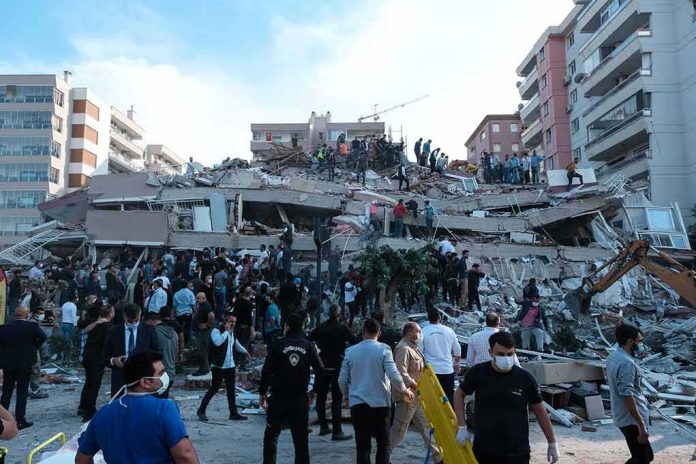
When two major earthquakes struck Venezuela, they did not collide with a well-functioning state but with a hollowed-out system, exposing in a few violent minutes what years of institutional decay and contested authority had already made inevitable.
Key Points
- Opposition leaders María Corina Machado and Edmundo González frame the earthquakes’ toll as the predictable result of a state that had abandoned its basic responsibilities.
- The Maduro-aligned government highlights rapid emergency decrees, funding pledges, and international coordination to present an image of active crisis management.
- Behind the immediate dispute lies a longer story of Venezuela as a petrostate with deeply degraded infrastructure and restricted information flows.
- The contest over “natural disaster” versus “man‑made catastrophe” will shape not only accountability for this tragedy, but the terms of any serious reconstruction effort.
A disaster that hit a weakened state
The twin earthquakes that devastated Venezuela in 2026 were powerful enough, on their own terms, to produce collapsed buildings, mass displacement, and a national trauma. Yet the most consequential debate is not about the Richter scale readings; it is about what the quakes revealed. For opposition leaders such as Nobel Peace Prize laureate María Corina Machado and Edmundo González, the central fact is that when the shaking stopped, the country’s emergency systems, communications, and basic infrastructure were already “destroyed” in the sense that they arrived at the crisis with almost no capacity left.[1][7]
González captured this in a stark formulation: rescue teams, the health system, and communications infrastructure “arrive at this tragedy destroyed,” insisting that Venezuela “will need international support… because its own State has abandoned it.”[1] Machado’s language is similarly uncompromising; she described the situation as a “critical” emergency marked by “infinite” suffering and argued that “every hour counts,” while calling for urgent humanitarian aid from abroad.[1][2] Her status as a Nobel Peace Prize recipient for defending democratic rights adds weight to the claim that the catastrophe is inseparable from long‑term authoritarian mismanagement.[7]
Opposition accounts: abandonment and infrastructural failure
In opposition narratives, the earthquakes serve as a stress test that Venezuela’s political and physical systems failed almost instantly. Machado reported the closure of Simón Bolívar International Airport due to severe damage, a single detail with outsized implications: when a country’s main international gateway is knocked offline in the opening hours of a disaster, logistics for rescue teams, medical supplies, and evacuations are immediately compromised.[2] This is not simply bad luck; it is a sign of infrastructure that was not built or maintained with resilience in mind.
Machado also named specific states—Caracas, Vargas, Aragua, Carabobo, Yaracuy, Lara—where “thousands of Venezuelans” were forced into the streets after structural collapse or serious damage to their homes.[1] Even in the absence of precise engineering tallies, that granularity underscores a pattern of widespread vulnerability across multiple regions rather than isolated failure. González, for his part, emphasized the information vacuum: Venezuelans abroad could not confirm whether their families were alive, and those inside the country struggled to gauge the true scale of the disaster, in part because of systematic blocking of independent information.[1]
This description dovetails with broader analyses of Venezuelan infrastructure and information controls. Over the last decade, experts have documented how lack of investment and maintenance repeatedly disrupted the electricity grid, water systems, and digital networks, while telecom regulators ordered ISPs to censor independent news and social platforms.[15][16][17] The earthquakes did not create those weaknesses; they exposed them all at once.
Government response: emergency decrees and visible action
The government’s account emphasizes rapid reaction and visible mobilization. Acting President Delcy Rodríguez declared a state of emergency soon after the quakes and announced a high‑level task force to oversee search and rescue.[10][11] She pledged an initial rebuilding fund of $200 million and described coordination with private businesses to deploy heavy machinery to dig survivors out from under collapsed structures.[10][12] Classes in public schools were suspended, and medical personnel were urged to report to work immediately, signaling an attempt to reorient public institutions toward the emergency.[10][14]
Rodríguez also underscored the inflow of international assistance. Offers of help reportedly came from the United States, Mexico, Colombia, France, Spain, Italy, and Qatar, with teams and equipment being integrated into the response effort.[10][14] From this vantage point, the state is not absent but hyper‑present: issuing decrees, mobilizing funds, coordinating foreign help, and appearing on national broadcasts to reassure the population.
Casualty figures further illustrate the government’s framing. Official tallies cited at least 164 deaths and 971 injuries, alongside extensive building damage, especially in Caracas and coastal areas.[6][13] These numbers differ from earlier, smaller figures circulated by opposition sources, and they position the disaster as massive but fundamentally the result of extreme seismic forces—a tragedy that even well‑run societies struggle to absorb without significant loss.[6][10][13]
Where the evidence is strong—and where it is thin
On both sides of the dispute, certain claims rest on solid ground, while others are more political than empirical. The existence of the earthquakes, their high magnitude, and the scale of physical destruction are uncontested; so too are the government’s formal acts of declaring an emergency, creating a task force, suspending classes, and announcing a reconstruction fund.[10][11][12] These are documented in official statements and international coverage.
By contrast, neither camp has yet produced forensic engineering audits of the collapsed buildings, hospitals, or transport hubs. González’s assertion that rescue teams and infrastructure arrived “destroyed” is a powerful encapsulation of perceived state failure, but it remains qualitative—rooted in observation and long‑standing criticism rather than structural surveys.[1] Similarly, opposition references to decades of neglected maintenance are historically plausible in light of wider analyses of Venezuela’s crumbling electricity, transport, and digital systems, yet they do not currently rest on detailed pre‑quake repair logs for the specific structures that failed.[16][17][19]
The government’s case has its own gaps. It has not provided detailed quantitative breakdowns of exactly how many buildings collapsed or suffered severe damage, nor has it engaged directly with opposition allegations of “State abandonment” by releasing internal readiness or deployment records. Claims that emergency funds and heavy machinery were mobilized rapidly are credible in broad outline but lack transparent timelines and resource allocations that would allow outsiders to measure performance against reasonable standards.[10][12]
Information control, surveillance, and the politics of visibility
One reason this dispute is so sharp is that Venezuela’s information environment is structurally constrained. Independent journalists and citizens rely on mobile phones and private data plans to document events on the ground, while state agencies and aligned media control most broadcast channels.[1] Technical analyses have shown that Venezuelan regulators have repeatedly ordered ISPs to block independent news sites and major social platforms, producing intermittent blackouts of politically sensitive information as well as chronic connectivity problems rooted in underinvestment.[15][3]
For opposition figures like Machado, who has been subject to precautionary measures from the Inter‑American human rights system due to the risk of irreparable harm and faces surveillance and mobility restrictions, these constraints are not abstract.[4] When she uses X or appears on foreign networks to describe the situation as “catastrophic,” she is operating partly outside domestic channels, precisely because they are not trusted to carry unfiltered information.[5][9] That same dynamic means independent verification of both opposition and government claims is harder than it would be in a more open context.
Social media adds another layer. Algorithmic moderation decisions on platforms like X, Facebook, and YouTube can affect the reach of footage and testimony from the disaster zone, especially when content touches on politically sensitive criticism of a still‑powerful regime. The result is a fragmented public record in which some voices travel widely while others remain confined to niche audiences, even when they document the same rubble.
The deeper pattern: petrostate decline and disaster risk
To understand why the earthquakes produced such intense argument about causation, one has to step back from the immediate images of collapsed facades. For years, Venezuela has been cited as a textbook case of a petrostate: a government heavily dependent on oil revenue, with concentrated power and widespread corruption, suffering severe economic contraction and hyperinflation.[16] Output shrank by roughly 80 percent over the last decade, the largest peacetime economic collapse in modern records, and key infrastructure—from electricity grids to transport networks—deteriorated correspondingly.[17]
Analyses by international institutions and policy centers describe basic infrastructure as “severely deteriorated,” with energy systems dating back to the 1950s and lacking spare parts.[17][19] Digital systems underlying identity, payments, and public records have also frayed, undermining the state’s capacity to coordinate and account for large‑scale operations.[18] In that environment, a major earthquake does not hit a neutral baseline; it strikes a landscape already marked by underinvestment, politicized control, and overlapping crises.
This pattern is not unique to Venezuela, but it is particularly pronounced there. Previous episodes—from nationwide blackouts to health‑care breakdowns and shortages of basic goods—have been accompanied by similar blame contests. Opposition leaders and independent experts point to mismanagement and repression; sitting authorities emphasize external sanctions, bad luck, and heroic efforts by loyal institutions.[3][16] The earthquake debate fits squarely into that template.
What accountability will require
Moving beyond assertion to accountability will depend on evidence that does not yet exist in public. Several types of documentation would be decisive: internal emergency response logs showing when and where assets were deployed; independent engineering audits of collapsed structures in Caracas, Vargas, and other affected states; testimonies from first responders on the condition of hospitals, communications networks, and rescue equipment upon arrival; and satellite analysis comparing pre‑ and post‑quake infrastructure.[1][10][12]
If such records confirm that many buildings failed because they were never built or retrofitted to withstand foreseeable seismic risk, or that emergency systems had been allowed to rot through corruption and neglect, the opposition’s framing of a “man‑made catastrophe” layered atop a natural one will be strongly reinforced. Conversely, if audits show that most failures were within the range expected even for reasonably maintained systems under extreme shaking, and that emergency deployments were timely and effective relative to global norms, the government’s claim to have responded as a functional state will gain ground.
Either way, reconstruction cannot sensibly proceed as a narrow technical project. The same analyses that document Venezuela’s infrastructural decay emphasize that rebuilding will require tens of billions of dollars, anchored in transparent institutions, modern digital systems, and credible rule of law.[17][18][19] Earthquake‑resilient design, maintenance regimes, and emergency planning are engineering tasks; but they depend on political choices about openness, oversight, and responsibility.
Why this dispute matters beyond the rubble
For Venezuelans living through the aftermath, the most immediate stakes are tangible: whether their families receive help, whether their homes can be repaired, whether basic services stabilize. For the country’s political future, however, the fight over how to narrate the earthquakes has longer reach. If the disaster is successfully framed, domestically and internationally, as an unavoidable act of nature met by an energetic state, the pressure for deeper reforms may ebb once the rubble is cleared. If, instead, it is broadly understood as the culmination of a prolonged period of infrastructural abandonment and authoritarian distortion, the case for systemic change is strengthened.
Machado and González are arguing for the latter interpretation, backed by years of documented decline and their own experience of repression.[1][4][7] Rodríguez and the government are pressing the former, emphasizing emergency funds, visible actions, and international coordination.[10][12] In a country where both concrete and institutions have been eroding for a long time, the truth is unlikely to sit entirely with either camp. Yet only by forcing the state’s performance—and its long‑term stewardship of infrastructure—into the open, with independent evidence, can Venezuelans ensure that the next earthquake measures progress rather than decay.
Sources:
[1] YouTube – ‘Catastrophic situation’: María Corina Machado on aftermath of two …
[2] Web – Machado and González ask for world help after the earthquakes
[3] Web – Venezuela reeling after powerful twin earthquakes kill at least 32 …
[4] Web – South Florida lawmakers, María Corina Machado express solidarity …
[5] Web – María Corina Machado: Extracted From Venezuela – Grey Bull Rescue
[6] YouTube – Venezuelan opposition leader Maria Corina Machado praises US …
[7] Web – Venezuela earthquake kills at least 164 and downs buildings … – BBC
[9] Web – Trump says US is ‘ready, willing, and able to help’ Venezuela after …
[10] Web – Nobel Peace Prize winner, Maria Corina Machado, says … – Instagram
[11] Web – What we know about Venezuela’s biggest earthquake in more than …
[12] YouTube – Government Declares State of Emergency After 7.5 and …
[13] Web – Thousands feared dead in Venezuela after two major earthquakes
[14] Web – 2026 Venezuela earthquakes – Wikipedia
[15] Web – Up First briefing: Venezuela earthquakes; Trump; Chris Donahue
[16] Web – NEWS UPDATE: Venezuelan president declares state of emergency …
[17] Web – Natural Disaster Alert: U. S. Embassy (Caracas, Venezuela) (June …
[18] Web – U.S. Embassy Caracas is closely monitoring the aftermath of a …
[19] Web – Venezuela: Earthquakes – Jun 2026 | ReliefWeb