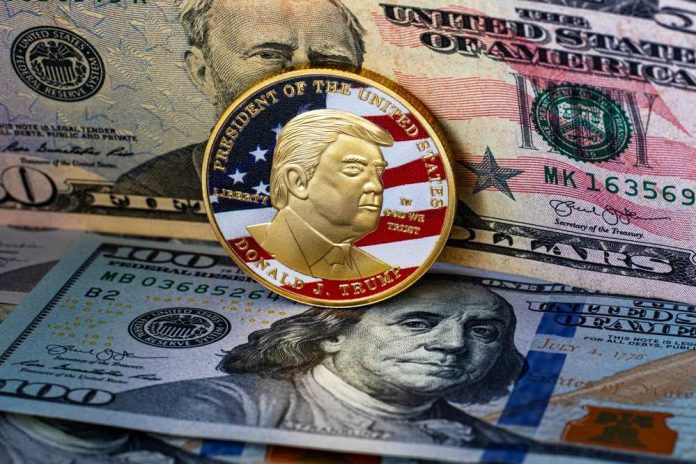
A new $1 coin putting President Donald Trump’s face into Americans’ wallets turns a technical coin law fight into a loud warning about how far today’s government is willing to bend long‑standing rules for the powerful.
Story Snapshot
- Trump-backed officials are pushing a semiquincentennial $1 coin that would show a living president, something federal law has long tried to prevent.
- Treasury lawyers say a 2020 commemorative coin law makes the Trump coin “perfectly legal,” but older statutes appear to say only dead people belong on U.S. currency.
- A hand‑picked arts commission has already endorsed a gold Trump coin design, deepening fears that federal panels now serve politicians, not the public.
- Both conservatives and liberals see the fight as one more sign that elites can rewrite rules to honor themselves while everyday Americans struggle with real problems.
How the Trump $1 Coin Plan Took Shape
Treasury Secretary Scott Bessent has publicly promoted draft designs for a new $1 coin that would feature President Trump as part of the 250th anniversary of American independence. The idea comes from a 2020 law, the Circulating Collectible Coin Redesign Act, which lets the Treasury issue special $1 coins in 2026 with designs “emblematic” of the nation’s semiquincentennial. U.S. Treasurer Brandon Beach has argued that Trump’s profile is the most emblematic image for the front of that coin, tying the country’s birthday directly to the current president. At a January meeting, a Mint official told the Commission of Fine Arts that Treasury lawyers had already done the research and concluded the design would be “perfectly legal” under the 2020 act.
Alongside the circulating $1 coin, a separate 24‑karat gold commemorative coin featuring Trump has already cleared a major hurdle. The U.S. Commission of Fine Arts, a federal advisory panel, unanimously endorsed the gold coin’s design showing Trump seated at a desk, as part of the same 250th‑anniversary program. News reports say Bessent is expected to authorize production once the Mint finalizes technical details, making this only the second time in about 75 years that a living person appears on a U.S. coin. Supporters frame both coins as patriotic tributes; critics see them as personal branding for a sitting president.
The Legal Tug‑of‑War Over Living People on Money
The Trump coin plan runs straight into a wall of older law and tradition that tried to keep living politicians off American money. After a 19th‑century Treasury official slipped his own face onto notes, Congress passed the Thayer Amendment in 1866, saying only portraits of deceased people may appear on U.S. currency and securities. Later rules and practice reinforced this norm, and modern guides still say no living person can appear on U.S. coinage. On top of that, a 2005 presidential dollar coin law states that no coin in that series may bear the image of a living former or current president, and that honoring a president on those dollars must wait at least two years after death.
Treasury officials answer these concerns by leaning hard on the newer 2020 coin redesign act. That law clearly allows special 250th‑anniversary coins, and it includes one very specific ban: no head‑and‑shoulders portrait of any person, living or dead, and no likeness of a living person may appear on the reverse side of these coins. The law does not mention the front side. Administration lawyers argue this silence means they can put Trump’s portrait on the “heads” side while keeping the “tails” side free of living people. A Mint spokeswoman has said the semiquincentennial law does not explicitly bar placing people on the obverse, and Treasury claims that makes the Trump design lawful despite the older bans.
Advisory Panels, Tradition, and Fears of Government for the Few
The committee that blessed the gold Trump coin, the Commission of Fine Arts, is made up entirely of members appointed by Trump. The panel gave its approval without any dissent, even though federal rules have long discouraged putting living presidents on currency. For many Americans, that looks less like independent review and more like insiders rubber‑stamping a boss’s wish. This fits a wider worry shared by people on the left and the right: official boards and agencies often serve politicians and donors first, and the public interest comes second.
The US Mint is starting production now (as of July 15, 2026) on a commemorative 2026 $1 coin featuring President Trump's likeness on the obverse (front).It commemorates America's 250th anniversary (Semiquincentennial). It is not yet for sale and is expected to become available in…
— Louisiana Charm (@CajunCharm24) July 15, 2026
Democratic lawmakers and coin collectors have protested, saying the Trump coins break tradition and may violate the Thayer Amendment’s rule that only dead people belong on currency. Media outlets from Time to NBC and The Guardian have described the coins as self‑aggrandizing and “monarchical,” comparing the imagery to kings placing themselves on money. Supporters answer that Congress itself passed the 2020 law and never banned portraits on the front of semiquincentennial coins, so they are simply using legal tools that already exist. So far, there is no court ruling or independent legal brief that settles the clash between the old bans and the 2020 act, leaving regular citizens to watch two sets of rules fight it out on technical grounds.
Why This Coin Fight Hits a Nerve With Everyday Americans
For many older conservatives, the Trump coin story feels like one more example of elites playing games while real issues go unsolved. They have spent years watching Washington pour money into global projects, green energy mandates, and massive spending that helped drive inflation, while families struggle with high prices and unstable jobs. Seeing leaders focus on putting their own faces on gold and dollar coins can look like a priority list turned upside down, where symbolism matters more than fixing broken systems.
Older liberals see a similar pattern from another angle. They are angry about an America First agenda that cuts safety‑net programs, deports long‑time residents, and keeps fossil fuel use high while the gap between rich and poor grows. To them, a Trump coin backed only by Trump appointees and internal lawyers feels like the federal government serving one man’s image instead of the public’s needs. Both sides already believe a “deep state” of powerful insiders protects itself. A coin that seems to rewrite long‑standing rules about who belongs on American money only strengthens the sense that government now works best for those at the very top.
Sources:
redstate.com, usatoday.com, yahoo.com, time.com, theguardian.com, forbes.com, coinnews.net, youtube.com, axios.com, facebook.com, lawreview.uchicago.edu, atlasobscura.com, texaslawreview.org, academic.oup.com, britannica.com