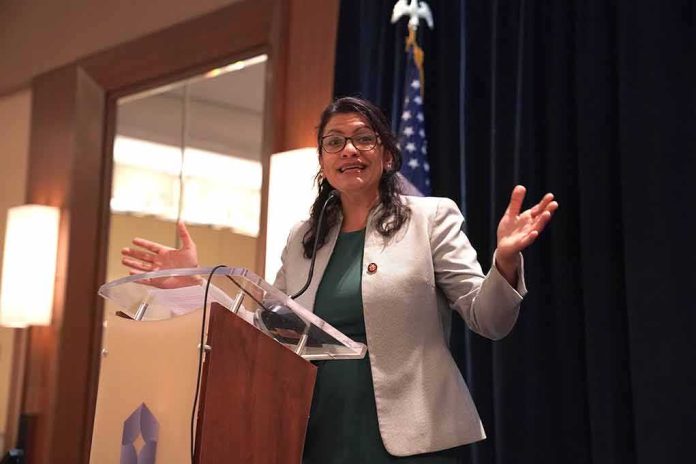
When elected officials use the word genocide, they are not just making a moral claim; they are invoking a legal category that can reshape policy, mobilize movements, and trigger institutional backlash. That is why the fight over Rashida Tlaib’s speeches—accusing U.S. structures of being built on slavery and genocide, and U.S. aid of “funding genocide” in Gaza—matters beyond one member of Congress. It exposes how the genocide label functions in American politics: as a high-stakes instrument that forces clarity on complicity, intent, and the boundaries of permissible dissent.
At a Glance
- Tlaib’s core assertions rest on explicit, on-record statements: she argued U.S. political structures were built on slavery and genocide, and that American tax dollars are funding genocide in Gaza.
- The legal threshold for genocide hinges on intent; no final court determination has labeled Gaza a genocide, but the term is often used in U.S. policy debates without such rulings.
- Critics focus on Tlaib’s rhetoric and decorum—censure, profanity, and denunciations of “genocide enablers”—rather than furnishing specific counter-evidence on the funding or legal claims.
- The pattern is familiar: genocide language in U.S. discourse frequently precedes or operates without judicial determinations, yet still carries real diplomatic and political consequences.
What Tlaib actually said—and why the wording is the battlefield
Two sets of claims need disentangling: foundational and contemporary. On the foundational side, Tlaib said U.S. political structures were built on slavery and genocide, with a catalog of abuses: slavery, genocide, rape, oppression. That is not an offhand paraphrase; transcripts and video capture the phrasing, and her subsequent statements reiterate a throughline—American power has too often been secured at the expense of subjugated peoples, at home and abroad. On the contemporary side, she charged that what is happening in Gaza is genocide and that U.S. tax dollars are helping fund it—language she used in a full recorded address, describing the campaign as “extermination,” aided and abetted by the United States. These are clear, declarative assertions; they are not inferred or secondhand.
Critics answered on tone and fitness for office. They highlighted profanity—“every genocide enabler… we ain’t going anywhere”—and argued the rhetoric shames colleagues and endangers Jewish communities, culminating in censure efforts and televised condemnations. The dispute, then, is asymmetrical: Tlaib’s side advances a set of substantive claims about structure, policy, and international crimes; her detractors answer largely on decorum and social harm. That asymmetry shapes how we should weigh the evidence.
The legal architecture of “genocide” versus the political uses of the term
Under the Genocide Convention, genocide consists of specific acts—killing, causing serious harm, deliberately inflicting conditions of life calculated to bring about a group’s physical destruction—committed with the intent to destroy, in whole or in part, a protected group. That intent element is the fulcrum: you do not have genocide legally without proving it. U.S. governments, however, have often deployed the word in policy without awaiting court rulings; the Uyghurs in Xinjiang were designated victims of genocide by the U.S. executive branch well before any binding international court judgment, reflecting the term’s role in diplomatic signaling as much as judicial determination.
Applied to Gaza, Tlaib’s claim is consciously legalistic—she refers to destruction of medical infrastructure and displacement as evidence of international crimes—yet it does not rest on a final court verdict. The available record here shows no primary-source legal document or judgment formally labeling the conflict a genocide; the argument is moral-legal advocacy, not a citation to a dispositive ruling. That does not make it trivial. In U.S. practice, genocide language can drive sanctions, arms conditions, and alliances even in the absence of adjudication; it is a lever, not a footnote.
Funding, complicity, and the mechanics of U.S. leverage
The most concrete of Tlaib’s immediate claims is about American money. She says U.S. tax dollars are funding genocide—meaning Washington’s military aid and diplomatic cover facilitate a campaign she characterizes as exterminatory. The evidentiary bar for “funding” in political speech is not a line-item appropriation labeled “genocide”; it is the nexus between material support and foreseeable, proscribed outcomes. Her speeches do not cite a bill number or appropriation figure, which her critics seize upon as a weakness. But the counter-case has not supplied data disproving the flow or effect of U.S. aid either; it defaults to denouncing her language rather than furnishing a quantitative rebuttal of the funding chain.
In U.S. law and policy, the implication is straightforward: if a partner is plausibly committing atrocity crimes, continued, unconditional assistance risks legal exposure under statutes and conventional obligations. That is why conditioning aid—the position Tlaib has long articulated, including explicit calls to tie U.S. support to human-rights compliance and to end what she labels apartheid—sits squarely in the mainstream of accountability mechanisms, even if the rhetoric around it is incendiary. Conditioning is the policy tool that reconciles alliance politics with atrocity prevention; it is where moral language meets enforceable leverage.
Foundations, slavery, and the genocide charge against American “structure”
The other half of the controversy is historical. Saying the United States was built on slavery is a matter of record; calling it built on genocide is a charge about the destruction of Native nations through conquest, forced removals, and policies that led to mass death. Tlaib’s speech offers the claim without scaffolding citations, which her opponents flag as overreach. Yet they do not answer with counter-history; they answer with accusations of anti-Americanism or disloyalty. This is the wrong terrain on which to test a factual proposition. If a rebuttal exists, it would compile demographic, legal, and archival analyses to contest that “genocide,” as a term of art, applies to U.S. expansion and Native dispossession. That work does exist in scholarship; it simply is not what her critics marshal in these exchanges.
There is a deeper point here. American politics regularly metabolizes harsh foundational critiques. “We Charge Genocide” in 1951 indicted U.S. racial terror in terms derived from the UN definition; Cold War administrations rejected the framing but could not ignore the indictment’s international costs. The pattern persists: genocide claims expose contradictions between American ideals and American alignments, and they escalate the reputational price of neglecting atrocity risks.
The critics’ case: decorum, danger, and censure
Side B’s strongest evidence is not a refutation of facts but an institutional reaction. Censure resolutions, broadcast segments highlighting profanity, and denunciations of “conduct unbecoming” are concrete. The claim is that Tlaib’s rhetoric shames colleagues, inflames communal fear, and veers toward celebrating extremist actors; in Congress, decorum is not ornamental—it is a self-regulatory guardrail for a plural chamber. On those terms, her opponents have a case rooted in institutional norms and the perceived safety of Jewish constituents, backed by formal censure action and public transcripts.
What the critics have not produced, in this research record, is the other half of an evidentiary duel: specific appropriations traced to discrete acts that are clearly non-genocidal in intent or effect; a court finding rejecting genocide as misapplied to Gaza; or a primary-source historical analysis countering the “built on genocide” charge. They critique the vehicle, not the cargo. That strategic choice may make sense politically—rhetoric is visible and sanctions-ready—but it leaves the substantive questions largely unanswered on their side of the ledger.
🚨 The video of Rashida Tlaib screaming her brains is from last summer at the People's for Conference for Palestine in Detroit.
I weaseled my way into that terrorist trade show. Let me tell you, it was not to be believed.
Thousands of attendees honored Hamas snipers like Anas… https://t.co/fHC8Y7gYHq pic.twitter.com/gDh2NgjVgJ
— NizNellie3 (@NizNellie3) July 13, 2026
How to adjudicate claims that outrun the courts
Absent a binding genocide judgment, responsible analysis asks three questions. First, are the alleged acts—mass death, starvation tactics, systematic destruction of medical systems—occurring at a scale and pattern consistent with atrocity crimes? Second, is there evidence of intent to destroy a protected group, in whole or in part, or of policies calculated to bring about its physical destruction? Third, does U.S. support materially enable those outcomes such that conditioning, suspending, or redirecting aid would change the risk calculus? Tlaib’s rhetoric answers yes to each, even as she forgoes granular sourcing in the speeches at issue; her broader record wraps the claims in policy demands—ceasefire, aid conditionality, and legal accountability—that are recognizable tools in atrocity-prevention playbooks.
Critics might win the etiquette fight; they have already mustered the votes to censure. But to win the argument, they would need to meet the substance: produce a legal pathway that shows why the genocide label is inapposite to Gaza under the Convention’s mens rea standard; demonstrate, with appropriations and end-use monitoring, that U.S. aid does not foreseeably facilitate proscribed acts; or present historical counter-evidence that narrows the “built on genocide” claim to rhetorical flourish rather than analytic description. Until then, the core asymmetry remains: one side makes consequential assertions about crimes and complicity; the other polices tone.
What this signals about American politics going forward
The genocide label has become a lever of last resort in U.S. debates: a way to force action when other moral vocabularies feel exhausted. It is risky—legally freighted, politically polarizing, vulnerable to overuse—but it is also clarifying. When a member of Congress uses it, the argument is not just about a war zone; it is about what American power chooses to enable. That is why these fights are durable. They do not end with a censure vote or a viral clip. They end when the United States can demonstrate, with facts and law, that its alliances are bounded by the same prohibitions it helped write—genocide among them—or, failing that, when it conditions its support to make that true in practice.
Sources:
workingfamilies.org, democracynow.org, peoplesworld.org, reddit.com, youtube.com, idosr.org, uscirf.gov, en.wikipedia.org, congress.gov