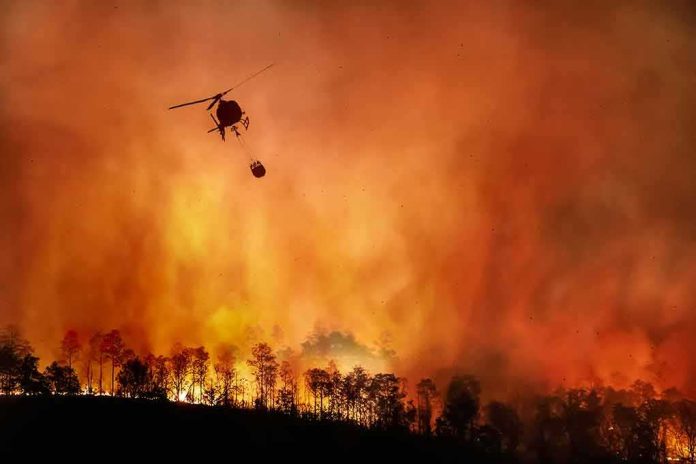
When a modern state deploys its army, activates European crisis mechanisms, and convenes round‑the‑clock emergency cabinets over a wildfire, it is signaling something clear: in parts of southwestern France, fire has crossed the line from seasonal hazard to national‑scale security crisis.
Key Points
- Massive wildfires in the Gironde/Bordeaux region triggered the evacuation of well over 100,000 people, with France and Spain together displacing roughly a quarter of a million residents.
- President Emmanuel Macron ordered the armed forces to “mobilise” in support of civil security, while Prime Minister Sébastien Lecornu chaired an interministerial crisis cell on the fires.
- Military units, specialized aircraft, and reinforcements from across France and the EU Civil Protection Mechanism were deployed to support overwhelmed firefighters.
- Officials describe the fires as among the worst France has faced in decades, with Interior Minister Laurent Nunez pledging to “do everything” to protect Bordeaux as the blaze advanced.
From seasonal threat to national emergency
Wildfire is not new to France; the country has a long history of summer blazes in pine forests and Mediterranean scrub. What is new is the combination of scale, speed, and proximity to dense urban areas that turned the Gironde fires into what local officials and evacuees frankly called an apocalyptic inferno. Multiple outlets report that, across France and Spain, more than 200,000 – in some tallies closer to 250,000 – people were evacuated as fires raged near Madrid and Bordeaux. In France alone, figures around 110,000 evacuees in the southwest recur, tied to a fire that had already burned roughly 14,000 hectares of forest in Gironde.
The geography matters. Bordeaux is not a remote village; it is a metropolitan area of around 300,000 residents, encircled by tourist resorts, vineyards, and transport infrastructure critical to the regional economy. As the fire perimeter expanded, reports describe ash-darkened skies, smoke columns drifting toward the city, and suburbs and campgrounds emptied under police direction. In that environment, the question for the French state ceased to be routine fire suppression and became protection of a major urban region and its lifelines.
The decision to mobilise the armed forces
The decisive political move came when President Macron ordered the army and other armed forces to mobilise in support of civil security operations. Agencies from Anadolu to regional European outlets describe Macron formally asking the army to help contain what they call “the worst wildfire the country has ever seen,” after France had already requested assistance from the European Union. In parallel, Macron announced that France had activated the EU Civil Protection Mechanism, a legal framework that allows member states to request specialized aircraft, equipment, and teams from partners when national capabilities are overstretched.
Operationally, the order translated into several layers of military involvement. First, soldiers were deployed on the ground alongside firefighters and gendarmes in the Gironde region, shoring up evacuation logistics, cordon enforcement, and support tasks as local services strained under mass displacement. Second, the government prepared and then launched missions using specially adapted A400M military transport aircraft configured to drop tens of tonnes of fire retardant on the blaze front threatening Bordeaux. Finally, military medical services and logistics units were tapped: one interministerial update mentioned the mobilization of the armed forces’ health service and delivery of 1.5 million FFP2 masks to Gironde, both for personnel on the line and civilians exposed to hazardous smoke.
This was not improvisation. Macron and his ministers refer to existing protocols between civil security and the army—frameworks that allow rapid integration of bulldozers, engineering units, and aerial platforms into firefighting operations when the Interior Ministry requests them. By moving from “prevention” to “intervention,” as the armed forces’ own communications put it, the military crossed from background support into direct crisis participation.
The crisis cell and government command structure
Alongside military mobilisation, the French state elevated its political response through the activation of a crisis cell—essentially an interministerial war room for domestic emergencies. Prime Minister Sébastien Lecornu convened key ministers in what several reports describe as a government crisis meeting focused on the wildfires and associated heatwave. This cell sits at the top of France’s standard crisis architecture: it coordinates Interior (security and civil protection), Defense (armed forces), Health, Transport, and Environment portfolios, aligning decisions on evacuation, resource deployment, and public messaging.
The prime minister’s role in chairing such meetings is not ceremonial. In earlier, smaller fire events in southern France, Lecornu had already used crisis meetings to scale up national resources when local prefects signaled that regional thresholds had been exceeded. In the Gironde case, the cell authorized the dispatch of 500 additional soldiers, 100 more firefighters, and the A400M aircraft mission, and approved the large-scale distribution of respiratory masks in smoke-affected areas. It also oversaw transport restrictions—warnings to avoid key roads and, in some reports, efforts to limit train use in corridors at risk from fire and smoke.
On the ground: overwhelmed services and European reinforcements
France’s firefighting capacity is substantial in normal years, but the Gironde fires pushed that baseline past its limits. About 800 firefighters, backed by hundreds of gendarmes and soldiers, were already deployed west of Bordeaux as the crisis intensified. Other accounts put the number of firefighters involved at 1,000 or more as additional units from other departments arrived. Interior Minister Laurent Nunez explicitly acknowledged that France had “never before seen such fires on this scale” and pledged to do everything possible to protect Bordeaux from encroaching flames.
The EU Civil Protection Mechanism became a force multiplier. Once activated, it allowed the European Commission to coordinate the dispatch of water-bombing aircraft—Canadair and other types—from countries such as Greece, Italy, Croatia, and Portugal to operate under French command. These aircraft, combined with France’s own Canadairs and Dash planes, provided concentrated aerial bombardment on the most volatile fire edges. In Spain, a similar pattern unfolded, with the military emergency unit leading operations and joint coordination across borders.[euronews transcript]
Numbers in motion: evacuations, burned area, and casualties
One feature of fast-moving wildfire crises is numerical instability: evacuation counts and burned-area estimates shift markedly over the first days as perimeters expand and data is consolidated. Coverage of the Gironde fires reflects this. Some outlets cite 110,000 evacuees in the French southwest; others, aggregating France and Spain, speak of 166,000 or 200,000 people displaced. The Gateway Pundit and regional broadcasters amplify higher figures still—near 197,000 evacuees in France alone and roughly 270,000 across both countries—based on later official tallies.
The same variability appears in burnt hectares. Early reports reference 14,000 hectares in Gironde, while subsequent briefings mention 22,000 hectares ravaged by the main fire threatening Bordeaux. Interior Minister Nunez, taking a broader seasonal view, spoke of nearly 98,000 hectares burned in France since the start of the year, up sharply from his own earlier estimate around 50,000—a revision that underscores how quickly conditions deteriorated.[AlArabiya transcript] Despite the scale, several officials involved in command briefings stressed that, at least at certain points in the crisis, there were no civilian fatalities directly from the Gironde blaze itself, though firefighter injuries and isolated deaths in other fire zones occurred.
Why this fire was different
France has seen destructive fires before, notably in 1976 and in more recent southern heatwaves, but Macron’s own language and the decision set around Gironde signal that this was treated as qualitatively different. He publicly framed the country as facing its worst wildfires since World War II, a phrase echoed in some of the international coverage. That is not only rhetorical escalation; it reflects several structural shifts. Repeated heatwaves had preceded the fires, drying forests and agricultural land across large swaths of the southwest. Wind patterns drove flames toward high-value, densely populated zones instead of remote massifs. And the national protection model, refined after deadly heatwave failures in 2003, now errs on the side of aggressive early mobilization—rapid crisis cells, pre-emptive evacuations, and heavy use of inter-regional reinforcement.
The political calculus is simple: the cost of mobilizing soldiers and foreign aircraft is modest compared to the economic and human consequences of losing suburbs, industrial parks, or major transport hubs. That calculus is even starker for Bordeaux, where the surrounding vineyards and tourist sites are both economic engines and cultural symbols. A government seen as underreacting to an existential threat to such assets would pay a long-term legitimacy price; overreacting, by contrast, is easier to defend in retrospect.
🚨🇪🇺 More Than 250,000 Evacuated as Wildfires Sweep France and Spain
Wildfires continue to devastate France and Spain, forcing more than 250,000 people to flee their homes as firefighters battle dozens of blazes amid strong winds and extreme heat.
🔥 France
🔹 Around 200,000… pic.twitter.com/rtqT0PV3r3
— Emmanuel – Big Tech & AI Investor (@EmmanuelInvest) July 25, 2026
Wildfire, climate, and the expanding role of the military
Stepping back from the Gironde event, the episode illustrates a broader shift in how European states conceive of wildfire. Health bodies such as WHO Europe have flagged a more than 50% increase in wildfire activity across the region, driven by hotter, drier summers, land-use changes, and accumulated fuels in forests.[euronews transcript] As fire seasons lengthen and overlap across countries, the notion that civilian services alone can cope with peak crises becomes less tenable.
France’s use of its armed forces in this context is part of a quiet doctrinal evolution. Soldiers are no longer an ad hoc last resort; they are being woven into standardized response protocols, from earthmoving and logistics to aerial retardant deployment and even health-support roles. The Gironde fires showcased this integration: military engineers working alongside local SDIS units, specialized aircraft executing precision drops under civil command, and health services distributing protective equipment to residents breathing smoke hundreds of kilometers from the front.
For citizens, the practical implication is that wildfire has moved onto the same mental shelf as floods and pandemics: a risk that can, at times, warrant full-spectrum state mobilization, including the military. For policymakers, the lesson is that planning for such events now extends beyond forestry and civil protection into defense budgets, European coordination, and crisis communication strategies. The Gironde inferno forced that realization into the open. Future summers will test how well France and its neighbors have absorbed it.
Sources:
thegatewaypundit.com, france24.com, vanguardngr.com, lemonde.fr, thehindu.com, arabnews.com, inkl.com, youm7.com, facebook.com, saudigazette.com.sa, dailybaku.az, youtube.com, 1lurer.am, slobodenpecat.mk, rfi.fr, jeanmarcmorandini.com